Hormel Foods (HRL) — Customer Relationships and Commercial Signals for Investors
Hormel Foods is a global packaged‑foods manufacturer that monetizes through branded and private‑label sales across Retail, Foodservice, and International channels; the company sells finished protein and snack products to large retailers, foodservice distributors, and operators while recognizing revenue at shipment and recording trade promotions as a reduction of revenue. This analysis distills Hormel’s customer relationships and the operating constraints that drive concentration, working capital, and margin risk. For a broader screening of commercial signals, visit https://nullexposure.com/.
What investors need to know in one paragraph
Hormel operates a high‑volume, low‑margin consumer foods business that is concentrated in a few large customers (top five accounted for ~38% of gross sales) and sells primarily on short‑term terms (shipments within one year). Revenue is exposed to trade promotion accruals, channel mix shifts between Retail and Foodservice, and global market dynamics; key customers like Walmart single‑handedly represent meaningful spend and receivable concentration that translate directly into cash flow and margin sensitivity.
Company‑level operating constraints and model signals
- Contracting posture — short term. Hormel recognizes that a majority of its revenue is short‑term in nature with shipments within one year, indicating transactional order‑to‑cash cycles typical of grocery and foodservice supply agreements.
- Customer concentration — material. The company reports Walmart alone represented roughly 15.6% of consolidated gross sales in FY2025, and the top five customers were ~38% of gross sales, creating measurable counterparty and receivable concentration that impacts credit and pricing leverage.
- Promotion and accrual criticality. Trade promotions and consumer incentives are a critical accounting estimate and are recorded as reductions to revenue; Hormel carried ~$85.9 million in trade promotion liabilities as of Oct 26, 2025.
- Geographic breadth with U.S. footprint first. Hormel sells across all 50 U.S. states while operating internationally; the business is global but US‑centric, with international sales significant but individually immaterial by country.
- Spend bands and working capital. Large account relationships exceed the $100 million band (Walmart ~ $2.0 billion of gross sales), while promotional liabilities sit in the $10M–$100M band, indicating scale in both cash receipts and accrued marketing commitments.
- Business maturity and segmentation. The company is a mature branded food manufacturer with established Retail and Foodservice segments and ongoing portfolio shaping (divestitures and strategic stake sales) to optimize margin mix.
The relationship roll call — what each counterparty means for HRL
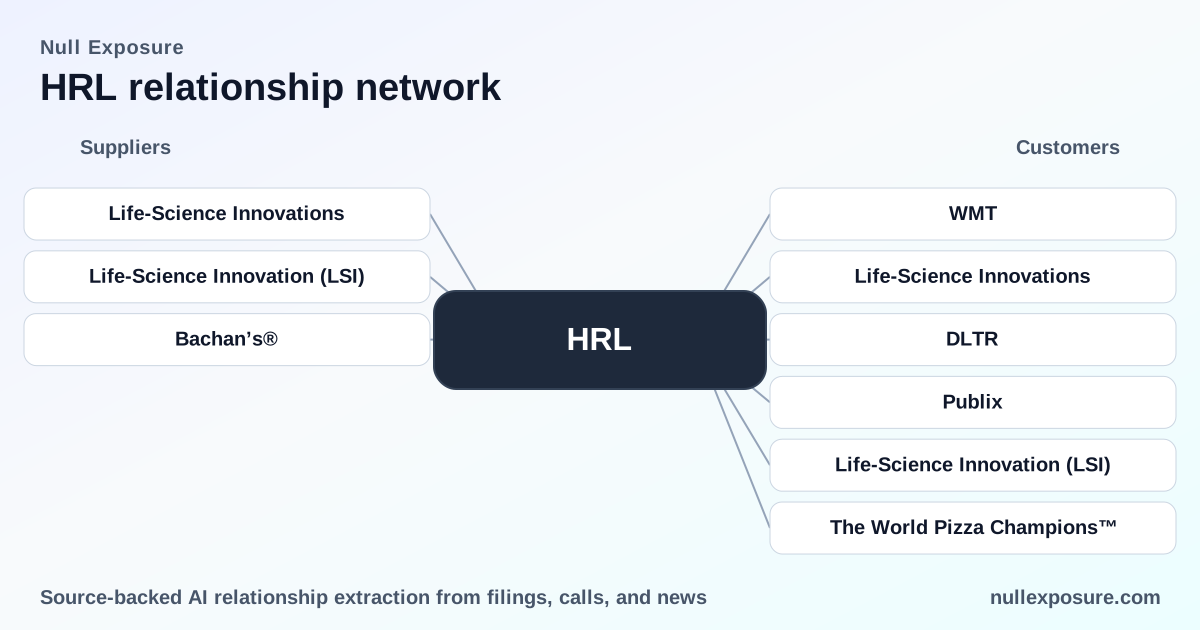
Walmart Inc / WMT / Walmart
Hormel disclosed in its FY2025 Form 10‑K that Walmart and its subsidiaries accounted for 15.6% of consolidated gross sales less returns and allowances, establishing Walmart as Hormel’s largest customer and a major driver of receivables and revenue. (Source: Hormel Foods FY2025 Form 10‑K, reported FY2025.)
Life‑Science Innovations / Life‑Science Innovation (LSI) / Life‑Science Innovations, LLC
Hormel entered a definitive agreement and subsequently completed the sale of its whole‑bird turkey business to Life‑Science Innovations, a transaction announced in early 2026 that transfers plants, a feed mill, and associated transportation assets. (Source: PR Newswire press release, May 2026; Austin Daily Herald and MeatingPlace coverage, Mar–May 2026.)
Publix
Hormel confirmed that affected recalled products were shipped to Publix distribution warehouses in several southeastern states as reported in press coverage, reflecting the company’s distribution footprint into regional grocers and the operational consequences of product quality events. (Source: USA Today report referencing Hormel, May 2024, referenced in FY2026 coverage.)
Dollar Tree / DLTR
Hormel acknowledged shipments to Dollar Tree distribution warehouses in Georgia and South Carolina in the context of a product recall reported in 2024, illustrating Dollar Tree’s role as a discount‑channel customer for certain Hormel products. (Source: USA Today report referencing Hormel, May 2024, cited FY2026.)
Kroger (KR)
Kroger and its subsidiary Ralphs were named in litigation alleging misleading in‑store claims; the complaint identified products from Hormel among those sold under challenged signage, signaling reputational and labeling exposure in large supermarket chains. (Source: LegalReader coverage of the Ralphs/Kroger lawsuit, May 2026.)
Ralphs Grocery Company
The plaintiff’s complaint specifically referenced Ralphs locations in Southern California and listed Hormel products beneath challenged “well‑raised” and “no antibiotics” signage, drawing Hormel into a regional false advertising action tied to retailer merchandising practices. (Source: LegalReader, May 2026.)
The Kroger Company
Beyond the Ralphs subsidiary mention, Kroger as the parent appeared in the complaint context, indicating retail litigation exposure that can implicate supplier‑retailer relationships across multiple brands. (Source: LegalReader, May 2026.)
The World Pizza Champions™
Hormel’s Happy Little Plants brand has a partnership positioning it as an official plant‑based pizza topping partner of The World Pizza Champions™, reflecting targeted Foodservice and promotional relationships that support brand extension. (Source: Hormel Foods press release, FY2026.)
RAVE (Pizza Inn)
Pizza Inn launched a SPAM Hawaiian Luau pizza using Hormel’s SPAM product, an example of co‑marketing and Foodservice operator collaboration that supports brand penetration in casual dining and franchise channels. (Source: Franchising.com and FSR Magazine coverage, April 2026.)
General Mills (GIS)
Co‑branded or promotional limited‑edition items (for example, a cereal collaboration) between Hormel’s bacon portfolio and General Mills highlight brand licensing and cross‑promotion opportunities in consumer packaged goods. (Source: SimplyWallSt/General Mills coverage, FY2026.)
Forward Consumer Partners, LLC
Forward Consumer Partners completed acquisition of a 51% stake in Justin’s, LLC from Hormel, reflecting Hormel’s portfolio optimization and monetization of non‑core or partially held brands as part of strategic reshape. (Source: SimplyWallSt transaction summary, Dec 17, 2025.)
Life‑Science Innovations (additional local coverage)
Multiple outlets (TradingView, AgWeek, FoodBusinessNews, InsiderMonkey) covered the LSI transaction and its exclusion from some internal forecasts, underscoring the financial and operational impact of divesting the whole‑bird turkey business. (Sources: TradingView, AgWeek, FoodBusinessNews, InsiderMonkey, Mar–May 2026.)
Investment implications and operator takeaways
- Concentration risk is real and measurable. Walmart’s ~15.6% share of gross sales creates material counterparty exposure; a shift in assortment, pricing, or private‑label dynamics at Walmart would drive immediate revenue and receivable volatility.
- Trade promotion accounting drives margin volatility. With trade promotions recognized as a reduction to revenue and an $85.9M liability on the balance sheet, marketing accruals are a lever that management uses to influence reported growth and margins.
- Portfolio reshaping reduces low‑margin exposure. The sale of the whole‑bird turkey business to LSI and the partial divestiture of Justin’s reduce complexity and free capital, but also lower headline volumes in certain categories—this is a deliberate tradeoff between scale and margin profile.
- Operational maturity, but ongoing execution risk. Hormel is a mature manufacturer with global reach, yet recalls, retailer litigation, and retailer merchandising disputes create episodic operational risks that affect earnings and reputation.
For a concise signal inventory, deeper counterparty analytics, and custom exposure screening for your portfolio, see https://nullexposure.com/.
Bottom line
Hormel’s revenue engine is volume scale sold into a concentrated retailer base, with short‑term commercial terms, significant trade promotion accruals, and active portfolio management shaping near‑term earnings and cash flow. Investors should weight durable brand cash flows against concentration and promotional liabilities when assessing HRL’s risk‑return profile.