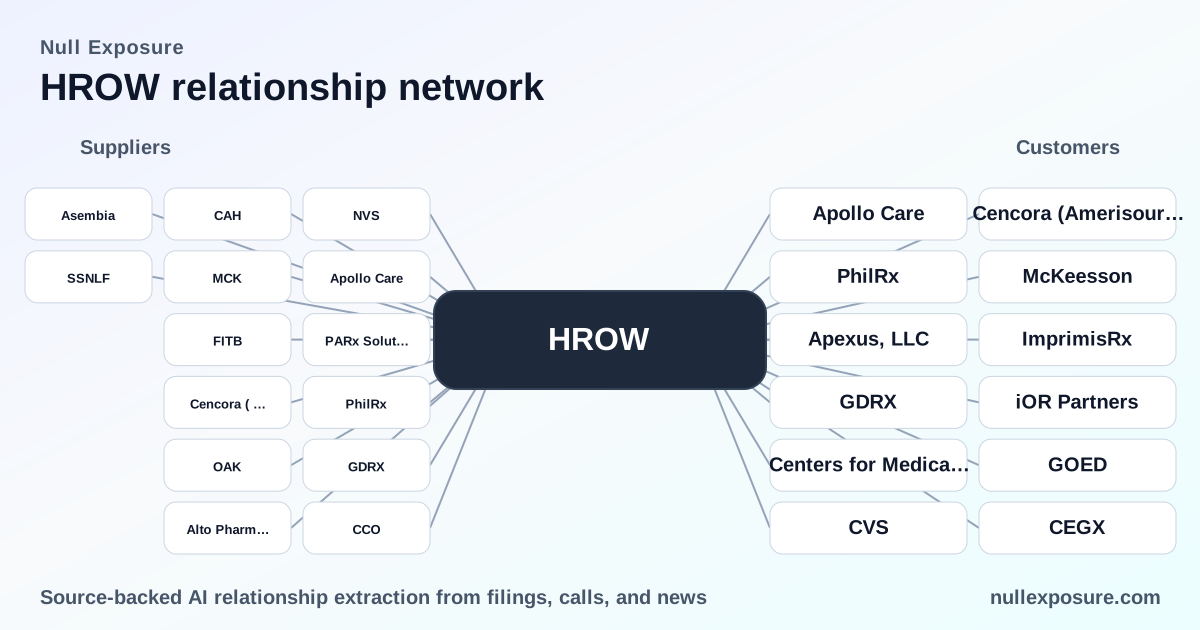
Harrow Health (HROW) — customer relationships and why they matter to investors
Harrow Health is an ophthalmology-focused commercial platform that monetizes through three principal streams: branded ophthalmic product sales (through wholesale distributors and specialty channels), compounding and mail-order pharmacy services (ImprimisRx/Imprimis operations), and licensing/royalty income from out-licensed IP. The business model depends on rapid cash conversion for transactional sales, payor and government reimbursement for higher-margin branded products, and selective licensing to extend reach without incremental manufacturing overhead. For investors, the key drivers are coverage wins and channel expansion for VEVYE and other recently acquired brands, the health of distributor and specialty pharmacy relationships, and government reimbursement dynamics that directly affect top-line realization. Learn more at https://nullexposure.com/.
How Harrow’s customer relationships shape revenue and risk
Harrow’s contract and commercial posture is a hybrid of short-term transactional sales, persistent licensing agreements, and selective spot/cash-pay compounding. Public filings emphasize licensing as a meaningful, recurring revenue engine and show that sales transfers are generally completed within a year — supporting a near-term cash focus rather than long multi-year receivables. Government payors are a material counterparty class, and Harrow’s exposure to Medicare/Medicaid pricing rules, rebate programs and 340B obligations is a foundational constraint on pricing power.
- Concentration and criticality: Harrow disclosed that a very large portion of accounts receivable came from only one or two customers in recent years, creating meaningful customer concentration risk and making distributor/wholesale relationships critical to collections and working capital.
- Contract mix and maturity: Licensing deals and out-licensing royalties sit alongside spot compounding services and FSS/340B framework participation; licensing is a mature and strategic channel while some compounding operations remain operationally sensitive to regulation and inspection outcomes.
- Geography and counterparty mix: Commercial activity and operations are U.S.-centric; counterparties range from individual cash-pay patients through specialty pharmacies up to very large payors and government agencies, underscoring multi-stakeholder reimbursement dynamics.
- Payment and spend bands: Harrow reports customer relationships and receivable balances across a broad range of spend bands, from sub-$100k reimbursements to >$100m in revenues at the company level — a mixed base that amplifies both stability and concentration risk.
If you want a concise, machine-assisted map of Harrow’s counterparties and constraints, visit https://nullexposure.com/.
Customer and channel map — each named relationship in the public record
Apollo Care
Apollo Care joined Harrow’s specialty pharmacy network late in 2025 to improve coverage for VEVYE, increasing the share of patients able to access the therapy through covered channels. Source: Harrow Q3 2025 earnings call commentary (reported 2026-03).
PhilRx
PhilRx acted as Harrow’s national mail-order specialty pharmacy and handled prescriptions through Q3 2025, and Harrow later highlighted PhilRx as the delivery channel for its VEVYE Access program across the U.S. Source: Harrow Q3 2025 earnings call and VEVYE Access launch announcement (2025–2026 reporting).
Apexus, LLC
Harrow executed a contract to make IHEEZO and other Harrow products available through Apexus’ 340B Prime Vendor Program, expanding access for covered 340B entities. Source: industry report on the Apexus 340B PVP agreement (reported July 2024; cited in FY2026 summaries).
GoodRx (GDRX)
Harrow formed a partnership with GoodRx to offer a cash-pay alternative for selected Harrow products (including VEVYE and other branded drops), lowering friction for uninsured or high-copay patients. Modern Retina reported the program in FY2024; ticker GDRX referenced in subsequent coverage.
CVS
Harrow reported a major coverage win with CVS that places VEVYE in a preferred formulary position for millions of commercial lives, a development management characterized as an important commercial catalyst. Source: Management remarks at Leerink Global Healthcare Conference and Q4/Q3 2025 call excerpts (FY2026 reporting).
BTIG (underwriters / placement agent)
BTIG acted on behalf of initial purchasers in Harrow’s $50.0 million expansion of its 8.625% Senior Notes due 2030, indicating capital markets activity to support operations and rollout. Source: transaction coverage and Harrow press release (FY2026 reporting).
Cencora (AmerisourceBergen)
Cencora is listed among the wholesale distributors — alongside McKesson and Cardinal — used to provide direct availability for Harrow-branded products under the VEVYE Access program. Source: VEVYE Access program announcement (reported FY2025).
McKesson
McKesson is one of Harrow’s primary wholesale distributors used to channel branded products into pharmacy and provider networks. Source: VEVYE Access program announcement and corporate filings (FY2025 disclosures).
Cardinal (CEGX)
Cardinal Health is identified as a major wholesaler distributor for Harrow products; filings list distributor concentration among the reasons to monitor credit and channel inventory. Source: VEVYE Access launch reporting and financial disclosures (FY2025).
Centers for Medicare & Medicaid Services (CMS)
CMS granted separate reimbursement status for TRIESENCE (ASP + 6%) in ambulatory surgery center and hospital outpatient settings, materially improving commercial economics for that product. Source: Biospace press release and Harrow disclosure of CMS action (FY2025).
ImprimisRx
ImprimisRx contributed to near-term volume and compounding revenue, and management flagged a one-time $4–6M revenue reduction from ImprimisRx in 2025 guidance adjustments while emphasizing underlying growth. Source: market commentary and company guidance discussion (FY2025–FY2026).
iOR Partners
Harrow expanded its national product supply agreement with iOR Partners, which specializes in office-based cataract surgery, strengthening distribution into surgical offices. Source: acquisition and partnership announcement (FY2022 press reporting).
GOED
GOED was referenced in the specialty pharmacy network commentary alongside Apollo Care and Alto as helping drive higher covered uptake for VEVYE. Source: Harrow Q3 2025 earnings call (reported 2026-03).
Alto
Alto joined Harrow’s specialty pharmacy network in Q4 2025, following Apollo Care, and is expected to increase covered access for Harrow therapies. Source: Harrow Q3 2025 earnings call (announced 2026-03).
Cardinal / CEGX (duplicate entry)
Separate entries in the public record reference Cardinal / CEGX as a named distribution partner for the VEVYE Access program and in Harrow’s wholesaler listing. Source: VEVYE Access announcement and filings (FY2025).
Investment implications — what investors should price in
- Coverage-driven revenue upside: Specialty pharmacy additions (Apollo Care, Alto, PhilRx) plus the CVS formulary placement materially increase addressable covered lives for VEVYE and improve the probability of converting compounding patients to branded products. These are direct levers for higher realized revenue per patient.
- Distribution concentration and working-capital risk: Harrow’s reliance on a few large distributors and concentrated receivable profiles (one or two customers representing a high share of AR) creates material counterparty concentration that investors must monitor for cash flow volatility.
- Government exposure is structural and material: Participation in Medicaid rebate programs, FSS/340B frameworks and Medicare Part B reimbursement mechanics (e.g., TRIESENCE pass-through) are core to Harrow’s realized pricing and margins; regulatory or pricing rule changes would be value-accretive or -destructive at scale.
- Channel diversification reduces payor friction: GoodRx cash-pay and Apexus 340B access broaden channels beyond PBM/formulary dependence, increasing patient access and hedging against single-payor shifts.
- Capital and balance-sheet posture: The senior notes expansion via BTIG signals active financing to support commercial scale; investors should weigh incremental interest expense against the faster uptake from expanded specialty coverage.
Key takeaways to act on:
- Monitor formulary movement (CVS and PBMs) and specialty pharmacy rollouts for VEVYE closely; these are the clearest short-term revenue levers.
- Track accounts receivable concentration and distributor credit terms as leading indicators of cash conversion risk.
- Watch government reimbursement updates (CMS/Medicare/340B) because they directly change margins on high-volume ophthalmic products.
Harrow’s customer map shows a deliberate strategy to convert compounding volume into branded, covered product sales while hedging payor friction via cash-pay and 340B channels. For a structured view of Harrow’s counterparty exposures and to track new filings and commercial milestones, visit https://nullexposure.com/.