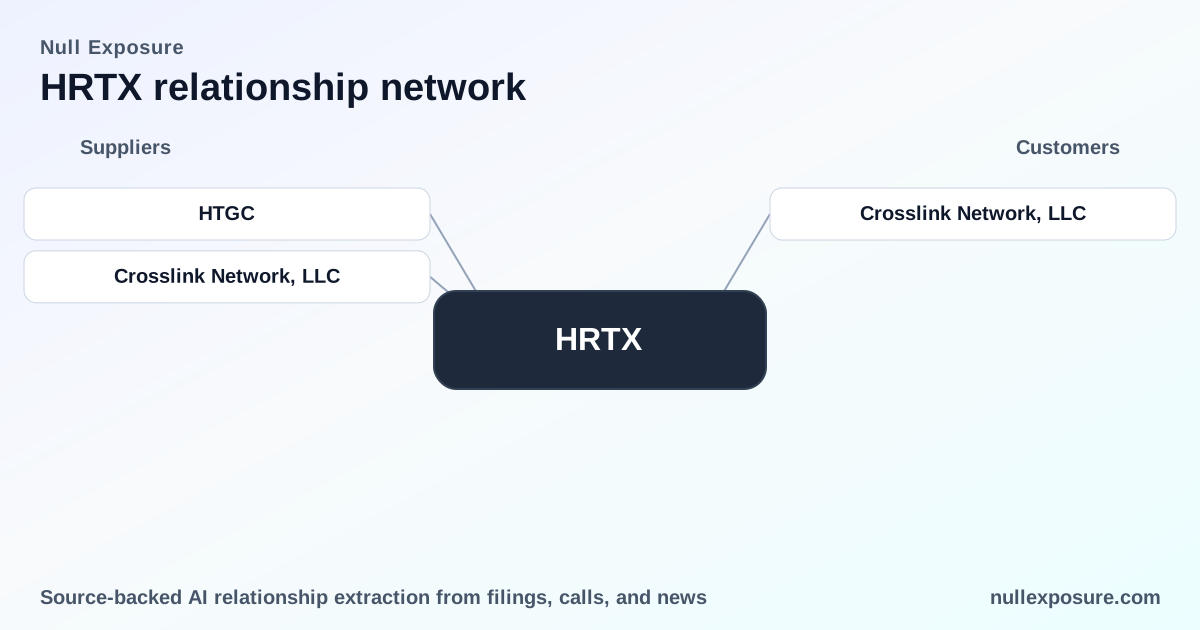
Heron Therapeutics (HRTX): Commercial Relationships, Concentration Risks, and Where Revenue Comes From
Heron Therapeutics is a commercial-stage biotechnology company that manufactures and sells a focused portfolio of acute care and oncology drugs—principally CINVANTI, ZYNRELEF, SUSTOL, and APONVIE—and monetizes through direct product sales to a limited number of specialty distributors and full-line wholesalers who resell to hospitals and healthcare providers. Revenue flows are driven by wholesale product sales, contractual distributor fees, and established rebate/allowance mechanics tied to government and commercial payors. For a concise mapping of Heron’s customer relationships and what they imply for investors, see more at https://nullexposure.com/.
How Heron goes to market and why it matters to investors
Heron operates a narrowly focused commercial engine: it manages manufacturing, inventory and commercial promotion in-house, then sells finished product into a small set of distributor customers that handle end‑user fulfillment. The company recognizes revenue on transfer of title and manages material allowances—rebates, returns, distributor fees—that are settled quickly, which influences working capital and margin volatility. Heron’s go‑to‑market is distribution-centric and therefore sensitive to distributor programs, reimbursement coding changes, and concentration among a handful of customers.
Two quick takeaways for allocators
- Concentrated customer mix is a material business risk: Heron discloses multiple customers representing >10% of net product sales, making single-distributor dynamics consequential to topline and cash conversion.
- Reimbursement and coding actions are real commercial levers: Medicare policy changes and the addition of J‑codes can materially expand hospital uptake for products like ZYNRELEF.
Explicit customer relationships and what they imply
This section covers each relationship referenced in public sources tied to Heron’s customer relationships.
Crosslink Network, LLC / CrossLink — co-promotion and distributor engagement
Heron discloses a co‑promotion agreement with Crosslink Network, LLC, identifying Crosslink as a commercial partner in the company’s FY2026 reporting; that agreement is cited as part of the company’s ability to “establish and maintain successful commercial arrangements.” (Press release, February 26, 2026).
A separate earnings call transcript in May 2026 described CrossLink’s IGNITE incentive program, the rollout of a vial access needle (VAN) and a new J‑Code for ZYNRELEF—all initiatives to improve distributor engagement, reimbursement clarity and hospital adoption (earnings call transcript, May 3, 2026). Together these items indicate CrossLink plays an active co‑promotion/distribution role that can affect uptake and reimbursement dynamics for Heron’s hospital‑facing products.
Sources: Heron corporate press release (GlobeNewswire, Feb 26, 2026) and Q4 2025 earnings call transcript coverage (InsiderMonkey, May 3, 2026).
CrossLink (same partner referenced again)
Heron’s public commentary treats CrossLink as a strategic channel partner whose commercial programs are being used to drive adoption and simplify hospital reimbursement for ZYNRELEF, implying the relationship is operational and tied to near‑term sales execution (earnings call transcript, May 2026).
Source: Q4 2025 earnings discussion (InsiderMonkey, May 3, 2026).
SGRP — historical/third‑party mention in cybersecurity reporting (low‑confidence link)
A March 2026 technology press item referenced a ransomware group’s public listing that included partners named “Spar, James Hall and Company and Heron and Brearly,” identifying “Heron” among Spar’s wholesale providers in the UK and Isle of Man; the match to Heron Therapeutics is low‑confidence but could reflect an historical FY2022 distribution or naming overlap and merits verification for geographic exposure or naming collisions (TechMonitor, March 10, 2026). Given the lower-confidence match, treat this as a potential signal requiring confirmation rather than a confirmed current commercial partner.
Source: TechMonitor report on Vice Society ransomware (March 10, 2026).
Contracting posture, concentration and operational constraints — company-level signals
- Contracting posture: Heron uses a mix of short‑term operational contracts and longer financial instruments. For example, the company disclosed short‑term subleases that expire within months and also maintains Senior Convertible Notes that mature in 2026—this combination produces a near-term refinancing and lease management focus. (Company filings and notes, various periods.)
- Concentration and criticality: Revenue recognition and cash collection depend on a limited number of specialty distributors and wholesalers, and the company states three customers each made up ≥10% of net product sales—this is a meaningful concentration risk that makes distributor relationships critical to enforcing pricing, promotional programs and returns policies.
- Maturity of commercial program: Heron is a commercial-stage company with four launched products; the product portfolio is established but still ramping market share in some segments (e.g., APONVIE launched commercially in March 2023). That puts the company in a growth but operationally sensitive phase where execution in distribution, coding (J‑codes) and hospital adoption drives revenue inflection.
- Counterparty mix and regulatory exposure: Government payors (Medicare/Medicaid) are a large influence on pricing and reimbursement, and the company cites numerous risks tied to federal/state programs and rebate regimes—this links Heron’s revenue and margins to public policy more tightly than a broad consumer business.
- Working capital mechanics: Distributor fees, rebates, product returns and accrued sales allowances are material line items that can shift near‑term profitability and cash flow; Heron reports significant accrued product sales allowances on its balance sheet.
Investment implications — what to watch next
- Monitor CrossLink programs and coding developments. J‑code adoption and distributor incentive programs are immediate revenue levers for ZYNRELEF and related hospital uptake (near‑term catalyst).
- Watch concentration metrics and receivables. Given the material customer concentration, any change in distributor terms, prompt‑pay discounts, or accounts receivable dynamics will have outsized margin and liquidity impact.
- Confirm geographic exposure. The TechMonitor mention suggests possible naming/partner overlaps in EMEA distribution channels; validate any non‑U.S. wholesale exposure that could introduce additional regulatory or cybersecurity risk.
For an investor-focused data map and continuity checks on Heron’s commercial partners, visit https://nullexposure.com/ to see how these relationship signals are tracked and updated.
Bottom line
Heron’s commercial model is highly dependent on a small set of distributor partners, government reimbursement mechanics, and targeted commercialization programs such as CrossLink’s co‑promotion and IGNITE initiatives. That structure creates clear upside levers (coding, distributor programs) and concentrated operational risk (customer concentration, allowances, reimbursement changes)—all of which should be central to any valuation or operational diligence on HRTX.