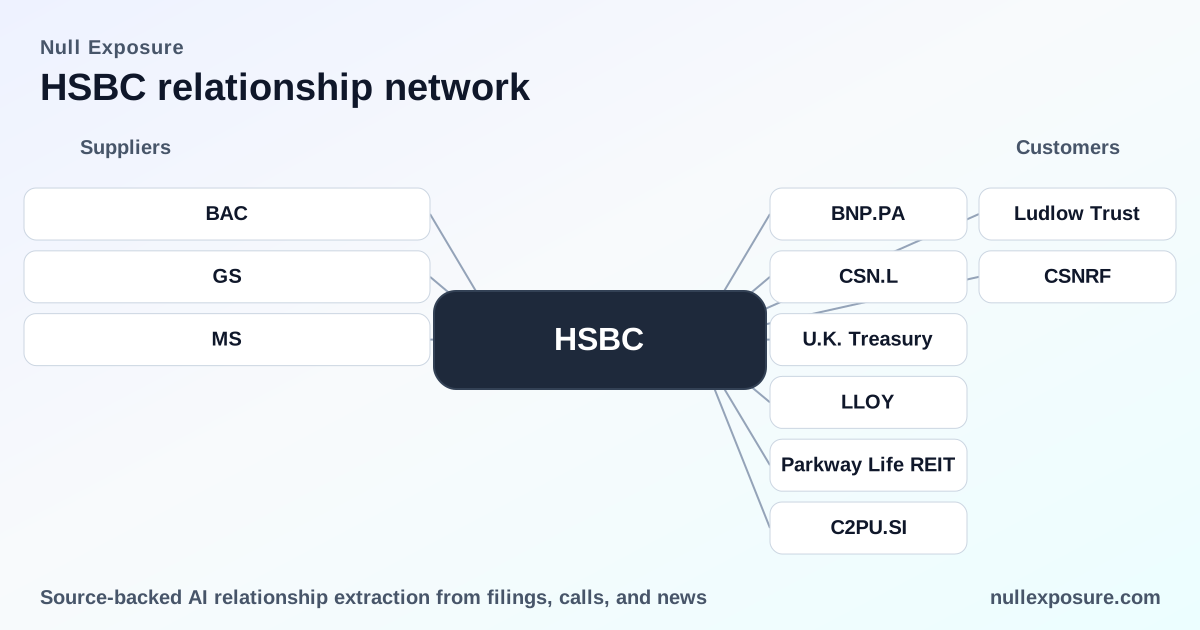
HSBC’s client footprint: who pays the fees and uses the pipes
Thesis — HSBC is a global universal bank that monetizes through a mix of interest-bearing lending, transaction and trade finance fees, and capital markets and custody fees across corporate and institutional clients; its customer relationships described below illustrate a commercial model built on recurring lending, structured finance, and deal flow that supports both net interest income and fee revenue. For a cross‑industry view of counterparties and transactional exposure, visit https://nullexposure.com/.
How to read this: the relationship set below highlights HSBC’s roles as lender, arranger, custodian and repo/custody counterparty across sectors and geographies — a pattern that underwrites diversified fee streams but also creates concentration and operational criticality in transaction banking.
H2 — What these relationships reveal about HSBC’s operating model HSBC’s customer list in the sampled reporting period illustrates a bank that sells both balance-sheet capacity (credit lines, green loans, project and corporate facilities) and platform services (custody, institutional trustee roles, supplier finance and accelerated share repurchases). The firm’s contracting posture is mixed: a combination of secured and unsecured lending plus agency/arranger roles that reduce balance-sheet intensity while preserving fee capture. The relationship mix shows broad geographic reach and sector diversification, lowering single-sector concentration but increasing dependency on continued capital markets activity and trade flows for fee income. Finally, these are mature counterparty behaviors — trade finance, custody and ASR counterparties indicate longstanding institutional workflows rather than one-off retail exposures.
H2 — Detailed relationship run‑down (one sentence per filing or report) Below are every relationship pulled from reported filings and press coverage; each line includes a plain-English summary and the original source.
-
MIND (Seamap unit): MIND’s Seamap division entered a trade finance facility with HSBC’s Singapore branch for letters of credit and bank guarantees, giving the company working-capital flexibility for project and acquisition activity (Investing.com, May 3, 2026).
Key takeaway: HSBC acting as trade finance provider to mid‑cap marine-tech. -
FINV (FinVolution Philippines): FinVolution’s Philippines business secured a multi‑million‑peso credit facility from HSBC to expand consumer lending to underserved Filipinos (IBS Intelligence / KR‑Asia / PR Newswire, March 9, 2026).
Key takeaway: HSBC providing regional consumer-credit capacity in SEA. -
CDLR (Cadeler A/S): Cadeler announced a €60m unsecured green corporate term loan arranged by HSBC and Clifford Capital to support general corporate purposes, with an accordion to €80m (SimplyWallSt, March 9, 2026).
Key takeaway: HSBC acting as arranger on sustainability‑linked corporate lending. -
WT (precious-metals custody): WT’s SEC filing states the company depends on HSBC and JP Morgan for physical custody services for precious metals that back its ETCs, making HSBC a critical custody counterparty (WT 10‑K, FY2024).
Key takeaway: HSBC provides foundational custody infrastructure for exchange‑traded metal products. -
TBBB (reverse factoring / credit line): The company disclosed a reverse factoring agreement and credit line with HSBC Mexico, S.A., formalized June 2, 2023, used for supplier finance and revolving credit (SEC filing, FY2026).
Key takeaway: HSBC operating supplier finance and credit facilities in Mexico. -
ENLT (Enlight Renewable Energy): Enlight secured $304m in project financing for a solar plus storage project with financing commitments from HSBC among other global lenders (QuiverQuant / GlobeNewswire, May 2–3, 2026).
Key takeaway: HSBC participating in syndicated project finance for renewable infrastructure. -
VRSK (Verisk Analytics): Verisk entered accelerated share repurchase agreements with HSBC Bank USA (and Wells Fargo) to deliver part of a $1.5bn buyback program, positioning HSBC as an ASR counterparty (Verisk press release / Sahm Capital, March 10, 2026).
Key takeaway: HSBC acting as principal/ASR counterparty in buyback execution. -
AVPT (AvePoint): AvePoint disclosed a loan and security agreement with HSBC Bank USA providing a revolving credit facility up to $30m with an accordion feature (SEC filing excerpt reported, FY2026).
Key takeaway: HSBC providing growth-stage revolving credit in the software sector. -
BSAC (Banco Santander Chile filings): Banco Santander Chile reported loans from Hong Kong and Shanghai Banking (HSBC) among foreign financial institution lenders, indicating cross‑border wholesale funding lines (BSAC filing, FY2026).
Key takeaway: HSBC extending cross‑border lending into Latin American banks. -
BNP Paribas (custody sale): HSBC Continental Europe agreed to sell its custody operations in Germany to BNP Paribas in a strategic simplification move (TradingView/Zacks, March 2026).
Key takeaway: HSBC rationalizing custody footprint and transacting those assets to BNP Paribas. -
Marks & Spencer (M&S Bank partnership): Marks & Spencer announced a seven‑year partnership with HSBC UK to advance credit and digital payments via M&S Bank, embedding HSBC as the banking partner for a major UK retailer (TradingView, May 2026).
Key takeaway: Retail partnership strengthens HSBC’s UK payments and personal-banking franchise. -
TE (T1 Energy): BTIG, HSBC and Société Générale served as joint bookrunning managers for a convertible notes offering, showing HSBC’s role in ECM/debt syndication (Investing.com, May 4, 2026).
Key takeaway: HSBC acting as lead underwriter in corporate capital markets. -
CSIQ (Canadian Solar): Reporting indicates HSBC arranging a proposed $350m loan for Canadian Solar’s U.S. expansion, demonstrating HSBC’s project expansion financing role (Intellectia, March 2026).
Key takeaway: HSBC arranging cross‑border corporate lending for cleantech/solar. -
U.K. Treasury (digital gilt pilot): The U.K. Treasury selected HSBC’s distributed ledger platform as the preferred platform for its UK Digital Gilt pilot, positioning HSBC on government payment/settlement infrastructure (InsiderMonkey, March 2026).
Key takeaway: HSBC engaged as strategic infrastructure provider for digital sovereign issuance pilots. -
Lloyds (green loan): HSBC provided a £135m green loan to fund redevelopment of a Lloyds office in Edinburgh, illustrating bilateral green lending and ESG‑linked financing activity (MarketBeat, March 2026).
Key takeaway: HSBC originates institutional green loans for major counterparties. -
Parkway Life REIT (institutional trust role): HSBC Institutional Trust acted as trustee to secure refinancing for Parkway Life REIT’s S$887m facility, reinforcing recurring transaction trustee fee income (MarketBeat, March 2026).
Key takeaway: HSBC capturing recurring trustee and agency fees in real‑estate finance. -
AOSL (Alpha & Omega Semiconductor): The company has a factoring agreement with HSBC to manage accounts receivable, with no outstanding balance as of June 30, 2025, signaling available liquidity arrangements (TradingView, FY2025 filing).
Key takeaway: HSBC provides receivables financing/factoring to semiconductor suppliers. -
CODA (Coda Octopus): Coda maintains a $4m revolving line from HSBC NA with no amounts outstanding at the report date, underscoring standby credit facilities for smaller cap engineering firms (TradingView, FY2026).
Key takeaway: HSBC supplies small revolvers for working capital flexibility. -
Webuild (bond deal): HSBC acted as stabilisation coordinator/manager on a €400m Webuild bond deal, evidencing ongoing ECM/debt capital markets advisory roles (MarketBeat, May 2026).
Key takeaway: HSBC supports large‑cap bond issuance and secondary market stabilization. -
Chesnara / CSN.L / CSNRF (sale of HSBC Life UK): Chesnara completed the acquisition of HSBC Life (UK) Limited after a 2025 sale announcement, reflecting HSBC’s portfolio simplification and divestiture activity (TS2/TradingView, March 2026).
Key takeaway: HSBC monetising non‑core insurance assets via disposal. -
Ludlow Trust (private client trust sale): HSBC UK sold its U.K. private client trust business to Ludlow Trust as part of its simplification program (TradingView, March 2026).
Key takeaway: Continued exit of certain private-client trust lines. -
Pepper Money (NZ mortgage sale): HSBC sold a NZ mortgage portfolio to Pepper Money as part of balance-sheet management, while simultaneously pursuing other strategic retail asset trades (TradingView, May 2026).
Key takeaway: Portfolio rebalancing and selective disposal of legacy mortgage assets.
H2 — Investment implications and risks for investors
- Revenue mix: These relationships confirm HSBC’s conveyor belt of fee and lending activities — trade finance, project finance and custody generate recurring fees that complement net interest income.
- Concentration & criticality: While client diversity across sectors mitigates single‑sector risk, custody and supplier‑finance roles represent operationally critical links for clients (WT, Parkway Life), meaning service disruption would carry outsized client impact.
- Balance‑sheet vs. agency risk: HSBC often alternates between on‑balance lending and agency/arranger roles (ASR for Verisk, trustee for Parkway), which preserves margins while managing regulatory capital usage.
- Strategic posture: Divestitures of non‑core insurance and trust businesses (Chesnara, Ludlow Trust) point to a simplification strategy that reallocates capital to priority markets and fee‑rich product lines.
H3 — Final thought and next step HSBC’s customer relationships in the sample are a cross‑section of modern universal‑bank activities: working‑capital trade finance, project and green lending, custody, trustee roles and capital markets underwriting. For analysts building counterparty exposure models or benchmarking bank fee pipelines, the practical signal is clear — HSBC is monetizing transactional scale while pruning non‑core businesses. If you want a consolidated counterparty map and historical relationship tracing, explore further at https://nullexposure.com/.