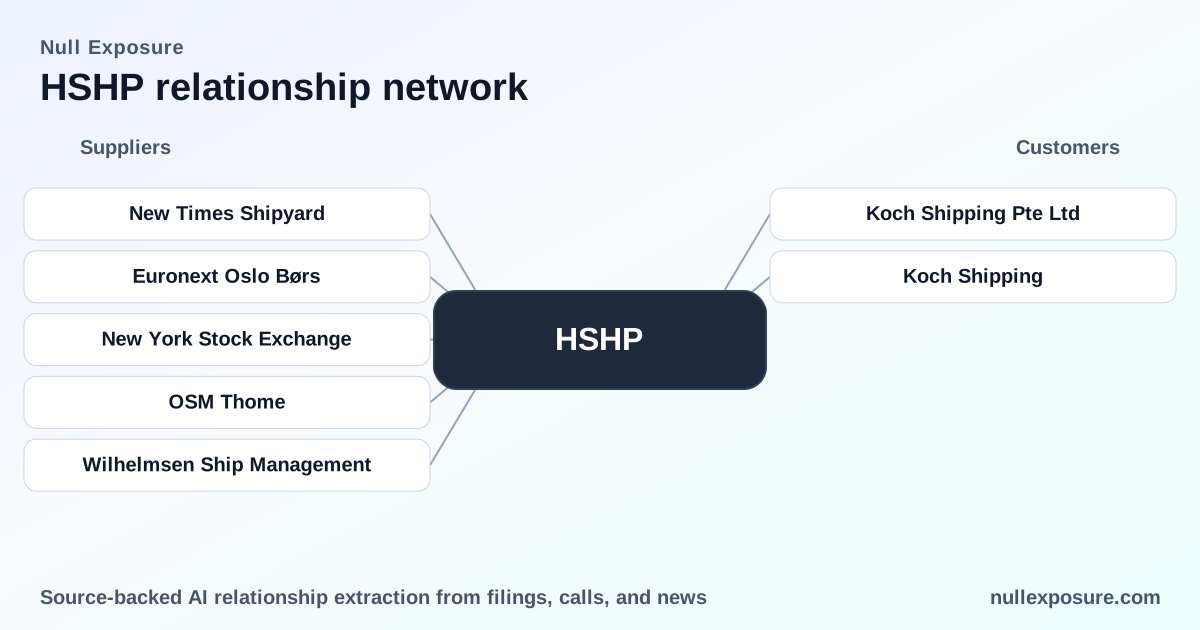
Himalaya Shipping (HSHP) — Customer relationships and what they mean for investors
Himalaya Shipping Ltd. operates and monetizes a fleet of dry-bulk vessels by chartering those ships to third‑party charterers and operating in the global dry bulk market. Revenue is driven primarily through time charter contracts and vessel utilization, which convert ship-days into predictable cashflows when multi‑month or multi‑year charters are in place; when ships return to the spot market they generate volatility in top-line performance. For investors evaluating customer relationships, the most important signal is counterparties and charter structure because those determine revenue visibility, counterparty credit exposure, and the company’s operating leverage.
Explore more analysis at https://nullexposure.com/.
Quick investment framework and where HSHP sits
Himalaya Shipping is a Bermuda-headquartered, NYSE‑listed dry bulk operator with a market cap of roughly $665.6M and trailing revenue of $131.9M (latest twelve months). Key financial signals: EBITDA ~$97.4M, operating margin ~61.8%, trailing EPS $0.39, and a forward P/E of 8.6 versus a trailing P/E of 36.33 — metrics that reflect significant earnings volatility between trailing and forward expectations. Insider ownership is material at ~43.5%, while institutions hold ~28.0%, creating concentrated ownership dynamics that affect strategic flexibility and governance.
Why charters matter here: time charters convert operating days into contracted revenue streams, improving earnings visibility versus pure spot exposure. The company’s recent charter activity is therefore a direct lever on near‑term cash flow and valuation.
Customer relationship evidence: charter deals with Koch Shipping
Koch Shipping Pte Ltd — Marinelink report (10 Mar 2026)
Himalaya Shipping announced time charter agreements for four dry bulk vessels with Koch Shipping Pte Ltd, reinforcing the company’s commercial strategy of locking-in revenue through multi-vessel charters. According to Marinelink on 10 March 2026, these deals represent incremental contracted employment for Himalaya’s expanding Newcastlemax series and will materially reduce the company’s spot‑rate exposure for those ships in the charter periods. (Source: Marinelink, 10 March 2026)
Koch Shipping — Splash247 report (10 Mar 2026)
A contemporaneous report from Splash247 confirmed that Himalaya fixed four Newcastlemax dry bulk carriers under construction in China to Singapore’s Koch Shipping, highlighting the use of forward employment for newbuild deliveries. Splash247’s coverage on 10 March 2026 notes these charters involve vessels still under construction, which secures employment at delivery and de‑risks initial operating periods. (Source: Splash247, 10 March 2026)
How these charter relationships translate into operating characteristics
The Koch bookings illustrate several company-level operating model characteristics investors must price into HSHP.
- Contracting posture — contract-first approach: Himalaya’s use of time charters for multiple vessels demonstrates a preference for contracted employment over open‑market exposure, which yields greater revenue predictability during the charter term.
- Concentration and counterparty mix: The visible counterparty in the public record is Koch Shipping; while this single counterpart confirms access to global charterers, the dataset does not show a broader list of counterparties, so investors should monitor counterparty concentration metrics in filings.
- Business criticality: Charter agreements are the primary revenue mechanism — they are operationally critical because they determine vessel utilization and cash generation.
- Maturity and fleet buildout: The deals include Newcastlemax vessels under construction, signaling an active fleet expansion strategy and the use of forward employment to secure earnings from newbuilds.
No customer‑scope constraints were reported in the public customer dataset; this absence is a company‑level signal that the providers of the data did not flag contractual limitations or counterparty disputes for the relationships captured.
Explore Himalaya’s public relationship tracking and broader insights at https://nullexposure.com/.
Risks and upside tied to customer relationships
- Upside: Time charters with established players like Koch Shipping deliver immediate revenue visibility upon vessel delivery and reduce short‑term earnings volatility. Forward employment of newbuilds accelerates cashflow contribution once the ships are delivered.
- Counterparty credit and concentration risk: Relying on a limited set of charterers concentrates exposure to counterparty credit performance and commercial renegotiation risk; absent a broader counterparty list, investors should use company filings to quantify concentration.
- Rate and delivery risk: If spot rates rise materially after charters are fixed, Himalaya foregoes upside on the employed days; conversely, if delivery schedules slip or construction issues arise, earnings and cashflows for the newbuilds can shift.
- Operational execution: Technical performance and voyage economics remain intrinsic drivers; charter revenues assume vessel availability and contractual performance standards are met.
Key takeaway: the Koch charters materially reduce short‑term revenue volatility but shift the company’s risk profile toward counterparty and execution risk rather than pure market-rate exposure.
Bottom line for investors
Himalaya Shipping’s disclosed customer activity with Koch Shipping demonstrates a deliberate commercial strategy: use time charters and forward employment of newbuilds to secure revenue visibility and de‑risk fleet growth. Financials show attractive operating margins and a meaningful swing between trailing and forward valuation multiples (trailing P/E 36.33 vs forward P/E 8.6), which implies materially different earnings expectations embedded across time.
For investors and operators evaluating HSHP, the priority is continued monitoring of:
- charter duration and rate economics disclosed in filings,
- counterparty concentration across charterers,
- delivery schedules and technical performance of the newbuild Newcastlemax vessels,
- and quarterly updates to fleet employment to reconcile forward P/E assumptions with realized earnings.
Net: Himalaya converts ship‑days into contracted revenue through time charters with market counterparties; those relationships are the principal levers of near‑term cash generation and valuation. For ongoing tracking of HSHP’s customer relationships and charter pipeline, visit https://nullexposure.com/.