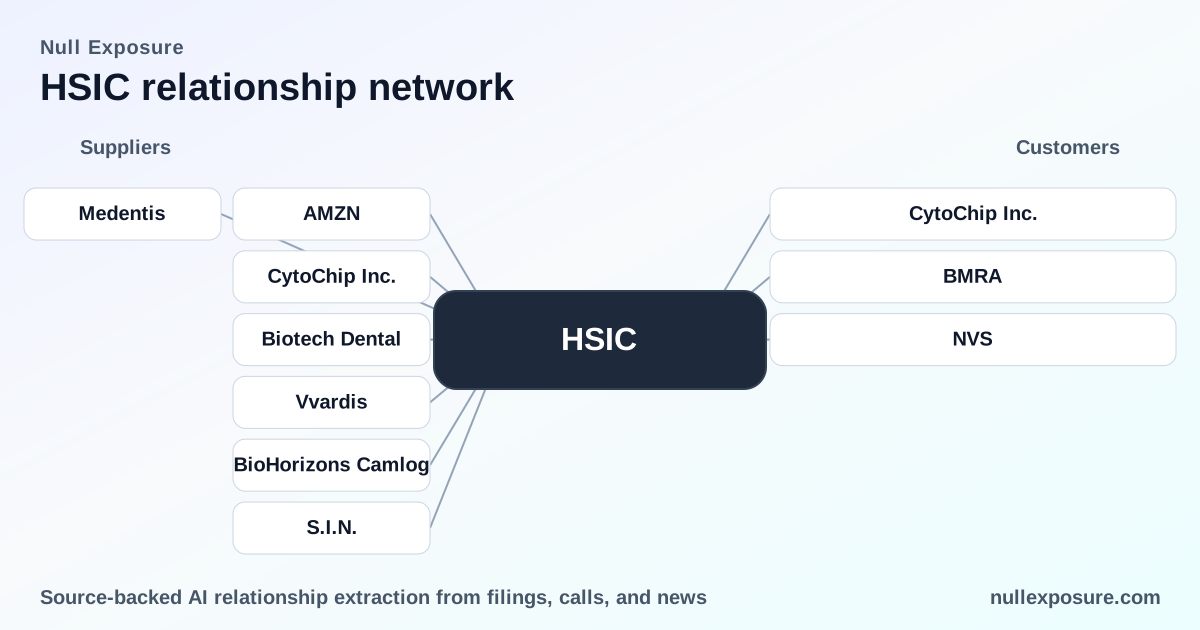
Henry Schein: distribution-first, services-enabled monetization with selective exclusives
Henry Schein operates as a global distributor of dental and medical products while also manufacturing specialty products and selling software and value-added services; it monetizes through transactional product sales, equipment contracts, recurring software subscriptions and professional services, plus marketing and distribution partnerships that create incremental channel revenue. With roughly $13.2 billion in trailing revenue and an 85% concentration in its Global Distribution and Value‑Added Services reporting segment, Henry Schein’s economics are driven by scale in distribution, recurring software economics and selective higher-margin specialty manufacturing. For a compact, relationship-level briefing on counterparties and disclosure signals, visit https://nullexposure.com/.
Why customer relationships matter for the thesis
Henry Schein’s balance between transactional distribution and recurring technology/services changes the customer-risk profile. The company’s model combines high-volume, low-margin sales to large institutional buyers with higher-margin, internally manufactured specialty products and subscription-based software sold to practices. Key operating model characteristics drawn from filings and call commentary:
- Contracting posture: The company shows a mix of licensed software and subscription revenue alongside bundled equipment-and-software arrangements; filings reference capitalized software and term licenses and long-term receivable structures. (Company filings, FY2024–FY2025; HSIC 2025 Q4 commentary.)
- Concentration and diversification: No single customer accounted for more than 2% of net sales, which supports revenue diversification; however, Global Distribution and Value‑Added Services represent ~85% of net sales, creating segment concentration risk. (HSIC annual disclosure, FY2024.)
- Role and criticality: Henry Schein functions primarily as a distributor and seller, but also as a manufacturer of selected specialty products and a service provider for equipment repair and software support; distribution remains critical to revenue. (HSIC FY2024 disclosures.)
- Maturity and geography: The business is mature and global—operations in more than 30 countries with a dominant North American footprint—so regulatory and cybersecurity exposures in EMEA and NA are relevant for counterparty risk and operational continuity. (HSIC FY2024 filings; 2025 Q4 remarks.)
Taken together, these signals mean investors should view customer-level news through the lens of scalability (how many practices a partner brings on), margin profile (distribution vs. manufactured product vs. software), and legal/regulatory exposure (government contracts, data privacy, and cybersecurity).
Relationships surfaced in recent public disclosures
Below I cover every partner mentioned in the collected results and summarize the commercial link to Henry Schein.
CytoChip Inc.
Henry Schein announced an exclusive U.S. distribution and launch agreement to distribute CytoChip’s flagship system, CytoCBC, in its U.S. medical business. This is an exclusivity deal aimed at placing a diagnostic system into Henry Schein’s channel. (According to HSIC’s 2025 Q4 earnings call, 2026.)
Biomerica, Inc. (BMRA)
Biomerica entered a marketing services agreement with Henry Schein in late 2025 to leverage more than 400 Henry Schein medical field and telesales representatives to commercialize Biomerica’s inFoods IBS test in the United States (ex‑New York). The arrangement gives Biomerica structured access to practice-level sales resources through Henry Schein’s field organization. (Reported by MarketScreener and QuiverQuant in 2025–2026; company press releases FY2025–FY2026.)
Novartis (NVS)
Henry Schein disclosed exclusive distribution rights in the U.S. and U.K. for Novartis’ Curaden product as part of its distribution portfolio. This kind of exclusive product distribution ties a proprietary brand into Henry Schein’s distribution network, supporting equipment/consumable sales motion. (Noted in HSIC’s 2025 Q4 earnings call, 2026.)
BCC (Boise Cascade / Holden Humphrey context)
A press release covering Boise Cascade’s acquisition of Holden Humphrey referenced that the deal is expected to “strengthen the distribution partnerships of Boise Cascade with CertainTeed and Henry.” This mention links Henry (the distributor referenced in the release) into a building-products distribution context; the match score in the aggregation is low, and the appearance is a third‑party news reference rather than a Henry Schein disclosure. (The Globe and Mail press release, FY2025.)
What the relationship signals mean for investors
- Incremental channel monetization: Exclusive distribution and marketing services agreements—like those with CytoChip, Novartis and Biomerica—represent higher‑value channel plays that can unlock new product flows through Henry Schein’s existing salesforce and distribution footprint. These deals are growth-enhancing at the margin because they leverage existing logistics and field coverage rather than duplicating fixed costs. (HSIC Q4 2025 remarks; Biomerica press coverage 2025–2026.)
- Economics are likely modest relative to total revenue: Company disclosures state no single customer exceeds 2% of net sales, and Global Distribution dominates revenue. That implies even visible commercial partnerships are unlikely to move consolidated revenue materially unless scaled across many agreements or tied to a high-volume product. (HSIC FY2024–FY2025 disclosures.)
- Contract mix supports recurring cash flow but introduces operational complexity: Filings describe long‑term receivable arrangements, licensing and SaaS subscriptions (Demandforce, Sesame, Lighthouse 360, DentalPlans.com), which add recurring revenue and stickiness while requiring capital and collection management. For investors, that is a positive for revenue visibility but an ongoing source of receivables and working-capital sensitivity. (HSIC FY2024 disclosures.)
- Regulatory and operational risks remain non-trivial: HSIC’s global footprint exposes it to data-protection regimes (GDPR, PIPL), government contracting rules and the operational fallout from cyber incidents. These are structural risks for any company that integrates software, payments and distribution at scale. (HSIC filings and 2023–2024 incident disclosures.)
Practical investor checklist
- Track quarterly disclosure of revenue contribution from exclusives and marketing arrangements; the absolute size matters given HSIC’s revenue base.
- Monitor software and subscription metrics (cloud users, recurring ARR guidance) since these lift gross margins relative to distribution.
- Watch working capital and receivables securitization activity—filings reference long-term receivables and receivables purchase agreements that influence liquidity and leverage.
- Continue to evaluate regulatory and cybersecurity headlines in EMEA and North America given the company’s multi‑jurisdictional exposure.
If you want a relationship‑level monitoring setup for HSIC (partners, exclusives and material counterparties) see our platform at https://nullexposure.com/ for structured alerts and signal summaries.
Conclusion: Henry Schein’s customer relationships reflect a distribution-first engine augmented by selective exclusives, subscription software and value-added services. These relationships are strategically sensible—leveraging field sales and logistics—but are unlikely to dramatically shift consolidated revenue unless scaled. Investors should prioritize margin mix (distribution vs. specialty vs. software), working-capital trends, and regulatory or cybersecurity developments that could impair the distribution platform.