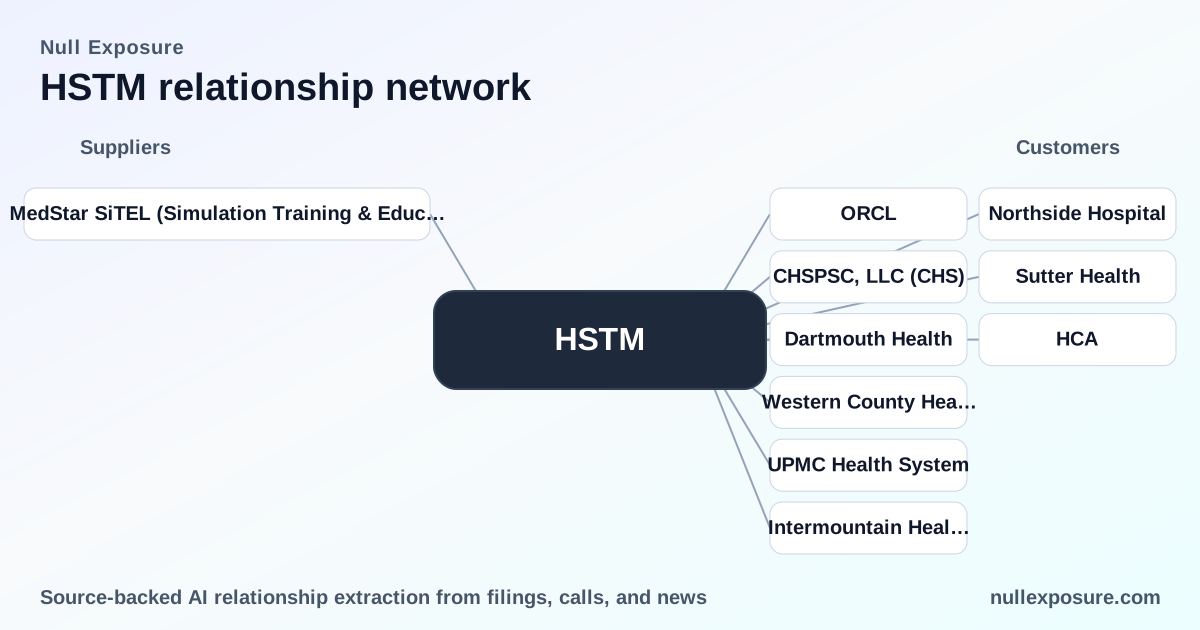
HealthStream (HSTM): Customer Relationships Drive Predictable SaaS Revenue — and Concentration Risk
HealthStream sells SaaS workforce solutions, credentialing and competency applications, and complementary professional services to hospitals, health systems, nursing schools and individual clinicians, monetizing primarily through multi‑year subscription and licensing contracts that produce highly recurring revenue and significant deferred revenue. Investors should view HSTM as a subscription-first software business with constrained but strategic professional services, meaningful customer concentration among large health systems, and contract tenors that create revenue visibility but put renewals and platform uptime at the center of execution risk. For further company-level signal extraction and client mapping, visit https://nullexposure.com/.
How HealthStream's customer model translates into cash flow and risk
HealthStream’s commercial model is dominated by subscription and licensing revenues — roughly 96% of net revenue — with professional services accounting for the balance, and typical contracts that run one to five years billed on annual, semi‑annual, quarterly or monthly schedules. This structure produces deferred revenue and remaining performance obligations that give the company forward visibility (the firm reports sizable remaining performance obligations), but it also establishes renewals and retention as primary drivers of growth or decline. The company’s software-first posture (CredentialStream, Competency Suite, hStream platform) makes HealthStream a service provider and licensor simultaneously: it sells software access and ongoing support, and it sells implementation and training services that accelerate adoption.
Operational constraints that investors must factor into valuation and monitoring include:
- Contracting posture: predominately subscription/licensing with long-ish tenors (1–5 years) and non‑cancelable features for many contracts, improving near‑term revenue predictability.
- Concentration and criticality: a meaningful share of revenue comes from a relatively small number of large healthcare customers; the product set is positioned as mission‑critical for workforce, credentialing and compliance workflows.
- Maturity: software is the core segment supported by a modest professional services business; international exposure exists but North America remains the primary market.
- Billing and collection: predictable billing schedules and a DSO that historically sits in the 40‑day range, but customer bankruptcies and receivable risk are cited as episodic headwinds.
Customer relationships that matter (what the sources show)
Below are the customer and counterparty relationships surfaced in public reporting and news, with concise, source‑attributed takeaways.
Oracle / ORCL — Corporate sublease at HealthStream property
Oracle subleased roughly 60,000 square feet — two full floors — in a Capitol View office building at 500 11th Ave North from HealthStream, an arrangement reported in local commercial real estate coverage. This transaction indicates HealthStream’s ability to monetize real estate holdings and to engage with large technology tenants. (The Real Deal / Nashville Business Journal, March 19, 2025; reporting linked at theRealDeal article.)
Dartmouth Health — Competency Suite sale
Dartmouth Health was cited among “top health care organizations” that purchased HealthStream’s Competency Suite in Q4, representing enterprise uptake of the company’s clinical competence offerings. (InsiderMonkey transcript of HealthStream Q4 2025 earnings call, reported March 2026.)
Intermountain Health — Enterprise Competency Suite adoption
Intermountain Health is named explicitly as a purchaser of the Competency Suite during Q4, reflecting HealthStream’s traction with large integrated systems that buy workforce competency tools at scale. (InsiderMonkey transcript of HealthStream Q4 2025 earnings call, March 2026.)
Northside Hospital — Competency Suite buyer
Northside Hospital appears on the list of major buyers of the Competency Suite in the company’s latest quarter, underscoring the product’s cross‑market appeal in high‑volume hospital systems. (InsiderMonkey transcript of HealthStream Q4 2025 earnings call, March 2026.)
Western County Health Services Board — Five‑year training contract (small market)
Western County Health Services Board approved a five‑year contract with HealthStream for continuing education, policy content and skills training, capped at $104,592.22, illustrating penetration into smaller, government or public health entities via multi‑year subscriptions. (CitizenPortal.ai coverage of the Western County Board decision, FY2025.)
CHSPSC, LLC (Community Health Systems affiliate) — VR pilot through Resuscitation Innovation Lab
CHSPSC launched a pilot of HealthStream’s virtual reality‑based education program via HealthStream’s Resuscitation Innovation Lab, demonstrating the company’s ability to pilot simulation and immersive learning with large hospital operators. (HITConsultant, January 15, 2020 — CHS pilot announcement.)
UPMC Health System — CredentialStream migration
UPMC is cited among large systems that successfully transitioned to HealthStream’s CredentialStream application, showing traction for the credentialing and privileging stack with leading health networks. (InsiderMonkey transcript of HealthStream Q4 2025 earnings call, March 2026.)
Sutter Health — CredentialStream adoption
Sutter Health is noted as a major system that moved to CredentialStream, reinforcing enterprise validation of HealthStream’s provider lifecycle capabilities. (InsiderMonkey transcript of HealthStream Q4 2025 earnings call, March 2026.)
HCA — Large‑scale competency suite purchases and career network engagement
HCA is called out as a major buyer implementing the competency suite at scale and engaging with HealthStream’s career networks, highlighting cross‑sell opportunities between competency tools and recruitment/onboarding products. (InsiderMonkey transcript of HealthStream Q4 2025 earnings call, March 2026.)
What these relationships imply for investors
- Revenue quality is high: multi‑year subscription and licensing contracts produce recurring cash flow and deferred revenue that smooths near‑term results; the company reported subscription services as ~96% of revenue.
- Growth is enterprise‑driven: wins at Intermountain, HCA, UPMC, Sutter and Dartmouth are the type that can expand ARR materially via seat and module expansion, credentialing rollouts and career network monetization.
- Concentration is a two‑edged sword: large system wins accelerate scale but also increase exposure to client consolidation, pricing pressure and renewal outcomes; HealthStream flags a relatively small set of customers as material to revenue.
- Product criticality reduces churn risk but raises execution stakes: credentialing, compliance and scheduling tools are operationally significant to hospitals, which reduces casual churn but elevates the importance of uptime, data security and implementation quality.
- Non‑core monetization exists: the Oracle sublease signals an opportunistic source of non‑operating cash flow tied to real estate assets, but the core investment thesis remains subscription software. (See the Real Deal / Nashville coverage, March 2025.)
Risk checklist for monitoring management’s execution
- Renewals for multi‑year contracts and the company’s ability to maintain pricing and penetration across modules.
- Platform reliability, cybersecurity posture and compliance with evolving privacy regimes, given HealthStream’s role as a data custodian for credentials and training records.
- Customer concentration and receivable quality; watch deferred revenue conversion and DSO trends.
- Impact of regulatory changes to continuing education requirements that can alter demand dynamics.
- International expansion execution: current footprint is North America‑heavy with targeted presence in Canada, Australia and New Zealand.
For a structured breakdown of these customer relationships and how they affect risk and valuation, see the HealthStream customer coverage at https://nullexposure.com/.
Bold takeaways: HealthStream is a subscription-centered SaaS company selling into mission‑critical healthcare workflows; large-system wins validate the platform and accelerate ARR, but customer concentration and renewal execution are the primary investment risks.