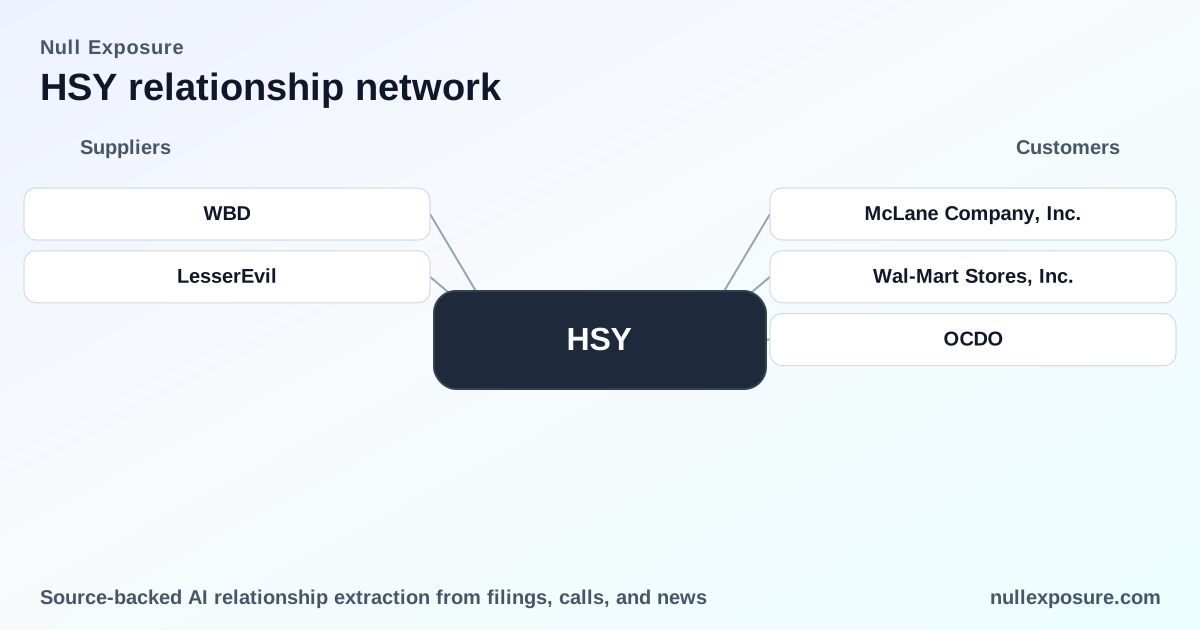
Hershey (HSY): Customer Relationships Driving Cash, Concentration, and Seasonal Leverage
Hershey monetizes its heritage brands by manufacturing and selling branded confectionery and snack products through a network of wholesale distributors and retailers, plus a small licensing and owned‑retail channel; revenue is recognized at point of delivery for short‑term, single‑obligation sales and royalties contribute less than 1% of consolidated net sales. The company’s operating model is volume‑driven, seasonally skewed, distribution‑heavy and exposed to a concentrated wholesale partner that materially affects working capital.
Explore deeper relationship intelligence at https://nullexposure.com/ for investor-grade signals.
How Hershey actually sells and why that matters for investors
Hershey runs a classic branded consumer goods model: manufacture for stock, sell into a mix of large wholesale distributors and national retailers, and support demand with significant trade promotions. The 2024 10‑K shows the majority of contracts are point‑in‑time product sales, fulfilled and invoiced upon delivery, which produces highly predictable cash conversion in normal trading weeks but also creates measurable concentration and seasonal stress during peak quarters. Company disclosures emphasize short‑term, spot‑like contracts and a reliance on trade promotion accruals (>$220 million), which together shape working capital volatility and counterparty credit exposure.
- Contract posture: predominantly short‑term, delivery‑based fulfillment with single performance obligations and a small, steady royalty/licensing stream (<1% of sales).
- Concentration: McLane is material and critical — explicitly named as Hershey’s largest customer and primary distributor to Walmart, responsible for ~27% of consolidated net sales in 2024 and ~23% of trade receivables at year‑end.
- Geographic mix: heavily North America‑centric (over 80% of sales from North America segments), with strategic international exposure across LATAM, EMEA and APAC that is managed separately and carries regulatory risk (for example, EUDR diligence on cocoa).
- Commercial maturity: relationships are active and mature, with most accounts operating on established buying patterns and seasonal peaks in Q3–Q4.
- Spend profile: material promotional liabilities (trade promotion accruals >$220 million) indicate large, recurring marketing spend with major retail partners.
Relationship map — the customer entries from public results
McLane Company, Inc.
Hershey identifies McLane as its largest customer, responsible for approximately 27% of consolidated net sales in 2024 and accounting for roughly 23% of trade accounts receivable at December 31, 2024, highlighting both revenue concentration and receivables exposure. (Source: 2024 Form 10‑K, FY2024)
Wal‑Mart Stores, Inc.
Hershey’s public filing describes Walmart as a key retail endpoint that benefits from McLane’s distribution role; Walmart is therefore an indirect but strategically important customer channel for Hershey’s mass distribution. (Source: 2024 Form 10‑K, FY2024)
DNUT — Krispy Kreme (Quantisnow, Mar 9, 2026)
A March 2026 article quoted Krispy Kreme executives describing a co‑branded product return that uses HERSHEY’S chocolate, signaling active brand licensing and product partnerships that extend Hershey’s consumer reach into foodservice and outlets. (Source: Quantisnow article, March 9, 2026)
DNUT — Krispy Kreme (MarketScreener, Jan 26, 2026)
MarketScreener reported Krispy Kreme’s global menu expansion that included doughnuts glazed with HERSHEY’S chocolate, underscoring recurring promotional collaborations and co‑branding that leverage Hershey ingredients and IP. (Source: MarketScreener press coverage, Jan 2026)
MYPS — playstudios, Inc. (FinancialContent press release, Aug 2023)
Playstudios reported entering partnerships that included Hershey’s for in‑platform promotion (playAWARDS), demonstrating Hershey’s licensing of trademarks for digital and reward‑based consumer engagement. (Source: playstudios second‑quarter results press release, FY2023)
FBYD — Falcons Beyond (CityBiz, Mar 2026)
Falcons Beyond announced a global licensing agreement with The Hershey Company to create Hershey‑themed experiential attractions and retail experiences, reflecting Hershey’s strategic but small‑scale licensing expansion into experiential retail. (Source: CityBiz, March 2026)
GIS — General Mills (SimplyWall/May 2026)
General Mills’ product news cites use of Hershey’s cocoa and Reese’s ingredients in a new cereal SKU, which corroborates Hershey’s role as an ingredient supplier and co‑marketing partner with large CPG peers. (Source: SimplyWall.St / Markets coverage, May 2026)
Ocado (CBS News, Mar 2026) — first entry
British online grocer Ocado listed a Hershey product with description implying formulation or packaging language; this highlights e‑commerce retail listing nuances and the importance of global retailer channels for product presentation and compliance. (Source: CBS News coverage, March 2026)
Ocado (CBS News, Mar 2026) — second entry
A duplicate public mention reiterated Ocado’s online listing detail; multiple press mentions emphasize the visibility of Hershey brands in European e‑commerce and the attendant reputational and labeling considerations. (Source: CBS News coverage, March 2026)
What the constraints tell us about Hershey’s customer economics
Company‑level signals from filings and public evidence create a clear commercial profile:
- Licensing is real but immaterial to revenue — royalty income is under 1% of consolidated sales; licensing supports brand extension and experiential deals but does not drive core margins.
- Short‑term/spot contracts dominate — Hershey manufactures for stock and recognizes revenue on delivery, so receivables and inventories move quickly with sales.
- Large enterprise counterparties anchor distribution — the business sells through large distributors and retailers; this structure enables scale but concentrates counterparty risk.
- Geographic footprint is global but North America‑led — international growth is a strategic objective, yet the majority of net sales remain in North America, with targeted exposure across LATAM, EMEA and APAC.
- Material operational levers include trade promotion spend and seasonal demand — accrued trade promotions exceed $220 million, and seasonal cycles concentrate revenue and working capital needs in the back half of the year.
Where a constraint explicitly names a relationship, Hershey assigns outsized importance to that partner — for example, the 10‑K directly identifies McLane as critical for both revenue and receivables.
Investment implications and a short checklist for monitoring
Hershey’s business is stable, brand‑driven and cash generative, but concentrated distribution and promotional intensity create key monitoring priorities.
- Key risk: counterparty concentration (McLane/Walmart distribution) and receivables exposure — monitor days sales outstanding and any changes in distribution agreements.
- Working capital: trade promotion accruals and seasonality impact free cash flow — watch quarter‑end accrual trends and promotional liabilities.
- Regulatory / supply risk: EMEA regulatory diligence on cocoa and global sourcing merits attention for international margins and compliance costs.
- Growth vectors: licensing and co‑branding (Krispy Kreme, General Mills, experiential licenses) broaden routes to market with limited revenue scale today but useful brand leverage.
Actionable checklist: track McLane receivable trends, quarterly trade promotion accruals, announced distribution or supply‑chain changes with Walmart, and new licensing announcements for topline lift or margin dilution.
For ongoing monitoring, see relationship analytics and signals at https://nullexposure.com/.
Bold, clear customer dynamics and the public citations above provide a compact view for investors and operators assessing counterparty risk, working capital sensitivity and promotional intensity in Hershey’s commercial model.