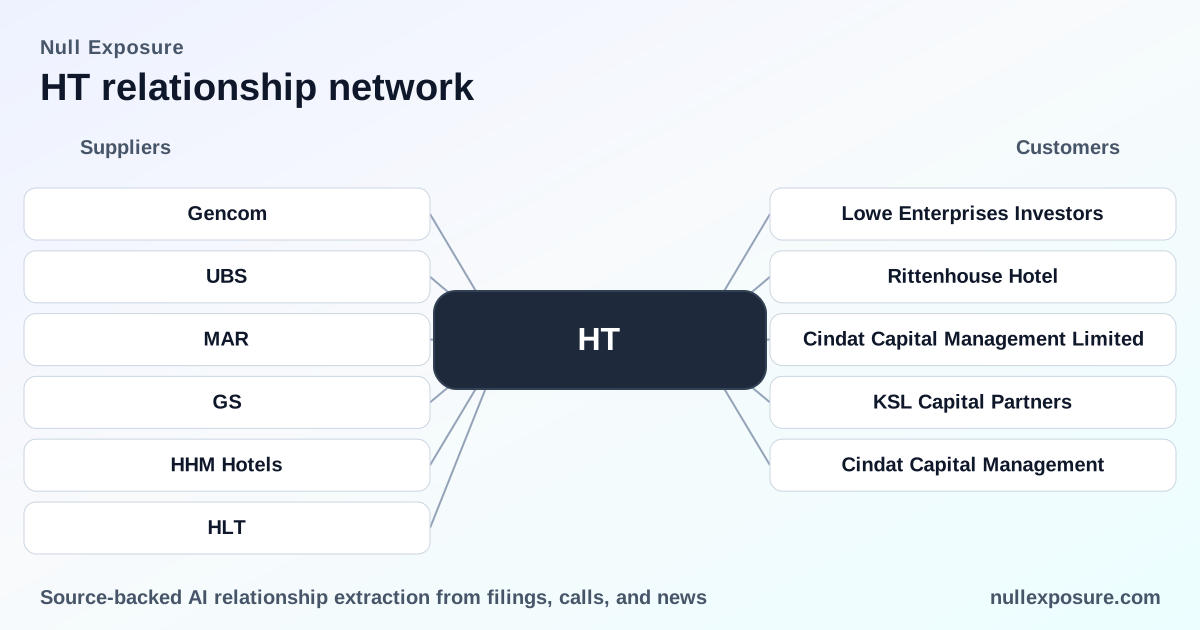
Hersha Hospitality Trust (HT) — customer and partner map investors should parse now
Hersha Hospitality Trust operates as an urban-focused hotel owner and operator that monetizes through hotel operations, fee income on management/branding, and opportunistic asset sales and joint ventures—frequently funding acquisitions through 1031 exchange proceeds and capital partnerships. The company’s cash flows are driven by room and F&B revenue in higher-barrier city submarkets, while balance-sheet activity (dispositions, JVs, and M&A interest) materially shapes growth and liquidity. For investors evaluating customer and partner dynamics, the pattern is clear: Hersha leverages institutional capital partners and local corporate demand to underwrite value creation and liquidity events. Learn more at https://nullexposure.com/.
Why partners and customers matter for valuation
Hersha’s operating model is built on two complementary levers: operating cash flow from upscale urban hotels and financial engineering through selective dispositions and joint ventures. That posture yields a set of predictable characteristics for investors:
- Contracting posture: Hersha actively forms JVs and conducts 1031 exchanges to recycle capital rather than funding every acquisition from balance-sheet cash, indicating a deliberate partnership-first approach to growth.
- Concentration: The company works with a small set of institutional buyers and JV partners, concentrating counterparty exposure but deepening transaction economics when deals close.
- Criticality: Disposition and JV counterparties are functionally critical to Hersha’s capital recycling strategy; the failure to execute those transactions would compress growth and liquidity options.
- Maturity: Relationships span a decade-plus timeline, demonstrating repeated use of similar capital structures and counterparties rather than one-off counterpart relationships.
Relationship roll call: the counterparties you need to know
Below I summarize every relationship surfaced in the reviewed material and provide the source for each assertion.
Lowe Enterprises Investors
Hersha sold two Boston-area Residence Inns to Lowe Enterprises Investors in a transaction publicized in November 2016, reflecting Hersha’s use of third-party buyers to monetize limited-service assets. Source: Hotel Online press release, Nov. 7, 2016 (https://www.hotel-online.com/news/hersha-hospitality-trust-completes-acquisition-of-the-ambrose-hotel-in-sant).
Rittenhouse Hotel
The Rittenhouse Hotel engaged in talks with Hersha in 2011, signaling early-market negotiation activity around potential asset- or management-related opportunities in premium urban locations. Source: The Philadelphia Inquirer, Dec. 25, 2011 (https://www.inquirer.com/philly/business/20111225_Wooing_Rittenhouse_Hotel.html).
the Cindat joint venture
Hersha funded the acquisition of the Courtyard Sunnyvale using proceeds from the sale of seven Manhattan limited-service assets to a joint venture with Cindat, illustrating the company’s recurring strategy of using JV proceeds to fund acquisitions at attractive capitalization rates. Source: HotelManagement.net, FY2016 transaction coverage (https://www.hotelmanagement.net/own/hersha-adds-two-california-hotels-to-its-portfolio).
Cindat Capital Management Limited
An affiliate of Cindat Capital Management provided 1031 exchange proceeds via a joint venture that funded Hersha’s acquisition of the Envoy Hotel in Boston’s Seaport, under a trailing full-year 5.4% economic capitalization rate—showing a deliberate capital recycling loop with institutional partners. Source: Hotel Online press release on the Envoy acquisition, FY2016 (https://www.hotel-online.com/news/hersha-hospitality-trust-acquires-the-envoy-hotel-in-bostons-seaport).
Cindat Capital Management (alternate citation)
Industry coverage reiterated that the Envoy acquisition was funded by a joint venture with an affiliate of Cindat Capital Management at a trailing 5.4% cap rate, corroborating the structure and economics of the transaction across multiple trade publications. Source: HotelManagement.net transaction note, FY2016 (https://www.hotelmanagement.net/transactions/hersha-hospitality-acquires-boston-s-envoy-hotel).
KSL Capital Partners
In 2023, KSL Capital Partners announced an all-cash bid to acquire all outstanding common shares of Hersha for approximately $10 per share—representing a substantial control-premium and signaling strategic private-equity interest in Hersha’s portfolio and operating platform. Source: Lodging Magazine coverage, FY2023 (https://lodgingmagazine.com/2023-person-of-the-year-executive-chairman-jay-shah-positions-hersha-for-mega-deal-future-success/).
GE (corporate demand)
Hersha’s Boston assets, including the Envoy, benefit from corporate demand generated by major corporate relocations such as GE’s move into the Seaport Innovation District, directly supporting weekday room demand and enterprise travel revenue. Source: New England industry coverage on the Envoy acquisition, FY2016 (https://indianewengland.com/hersha-acquires-envoy-hotel-boston-seaport-112-5-million/).
Vertex Pharmaceuticals (corporate demand)
Vertex Pharmaceuticals is cited alongside other corporate headquarters relocations that underpin demand for Hersha’s urban properties in Boston’s Innovation District, reinforcing the revenue-side importance of nearby high-growth employers. Source: New England industry coverage on the Envoy acquisition, FY2016 (https://indianewengland.com/hersha-acquires-envoy-hotel-boston-seaport-112-5-million/).
You can review Hersha’s counterparty map and related research at https://nullexposure.com/.
What these relationships imply for investors
- Balance-sheet-light growth: The repeated use of 1031 exchange proceeds and JVs with institutional capital partners shows Hersha prefers to recycle capital with partners rather than fund every acquisition directly—this reduces leverage pressure but increases reliance on execution of disposition and JV transactions.
- Concentrated counterparty exposure: A small group of capital partners (notably Cindat and buyers like Lowe) provides large transactional liquidity; that concentration raises execution risk if counterparties pull back, but it also enables faster deal cadence when markets are receptive.
- Revenue resilience tied to corporates: Corporate tenants and headquarters relocations (GE, Vertex) are integral to weekday demand at key urban assets, making Hersha’s top-line sensitive to local corporate hiring and occupancy trends.
- Takeover premium risk/reward: The KSL transaction demonstrates that Hersha’s portfolio can trigger control-premium offers, which is a material optionality value to minority shareholders and an important valuation anchor for bids.
Key investment takeaways and risk checklist
- Positive: Hersha’s partnership-first capital strategy enables disciplined portfolio recycling, unlocking acquisition opportunities without over-levering the balance sheet.
- Negative: Execution risk on JV and disposition strategies is high—failed transactions compress growth and liquidity quickly.
- Operational: Local corporate demand (e.g., GE, Vertex) materially supports revenue per available room in urban submarkets; monitor tenant/corporate activity as a revenue signal.
- Strategic: The KSL bid illustrates latent M&A value and potential for control premiums; activist or strategic bids are a realistic path to value realization.
Bottom line
Hersha runs a capital-efficient, partner-driven model that trades balance-sheet leverage for transactional reliance on institutional JV and buyer relationships. For investors and operators, the critical focus is on the company’s ability to consistently execute dispositions and JV funding and on tracking corporate demand in its urban markets—both determine near-term liquidity and longer-term valuation upside. For deeper mapping of Hersha’s counterparty network and to monitor similar REIT partner dynamics, visit https://nullexposure.com/.