HT-P-D Customer Relationships: Clear implications after KSL’s takeover
Hersha Hospitality Trust operates and monetizes through ownership and active management of upper-upscale and lifestyle hotels in gateway and resort markets: it generates cash flow from room nights, food & beverage, and event spaces, collects management fees where it acts as operator, and opportunistically realizes value through asset sales or portfolio transactions. The recent sale to KSL repositions the capital structure and removes public-market governance, while management and property-level arrangements continue to determine near-term cash generation and operational risk. For a focused view on counterparties and deal aftermath, read on. For additional relationship intelligence, visit https://nullexposure.com/.
How the privatization reshapes the counterparty map
The defining event in the relationship set is KSL Capital Partners’ acquisition of Hersha, which centrally changes how counterparties are contracted and how cash flows will be reallocated going forward. KSL’s acquisition is a classic sponsor-led privatization: it consolidates equity, simplifies capital allocation decisions, and enables asset-level repositioning without public disclosure constraints. Investors should treat counterparties—managers, franchise brands, and third-party vendors—as the lever through which KSL will extract operating upside or execute dispositions.
Relationship roll call: direct summaries and sources
Hersha’s reported relationships in this review are limited but material; each is summarized below with the supporting source.
-
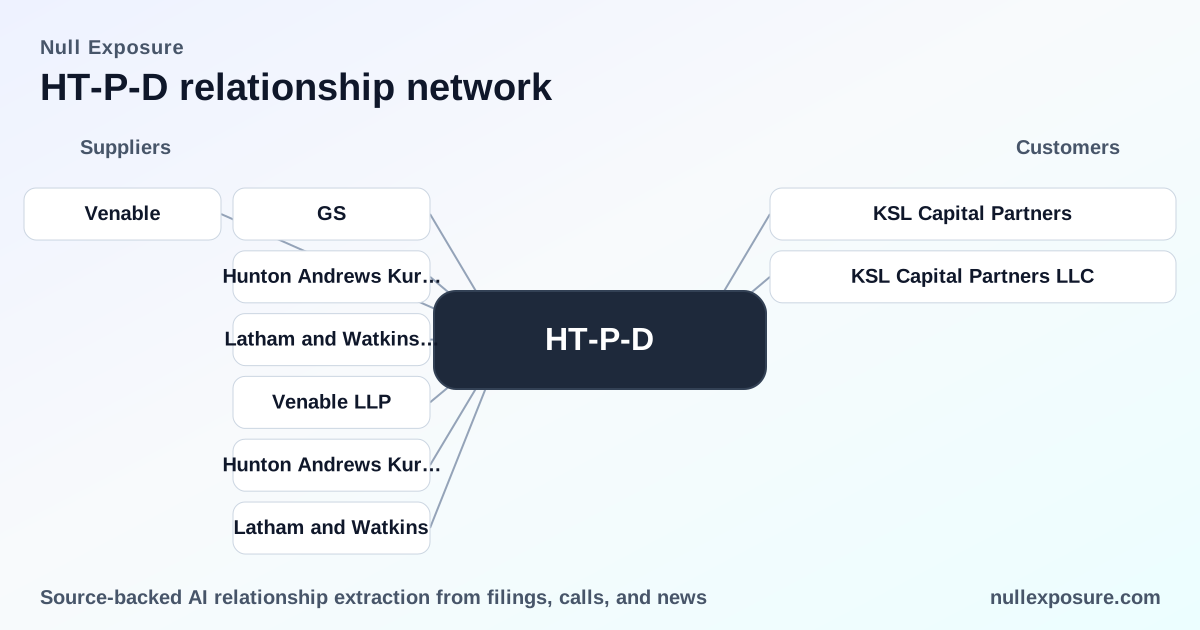
KSL Capital Partners — FY2026: Hersha sold its portfolio of hotels to KSL Capital Partners as part of its privatization, transferring ownership and strategic control of Hersha’s hotel assets to the sponsor. This transaction completes the public-to-private transition and concentrates decision authority with KSL. Source: Hotels Magazine coverage of the transaction, March 2026 (HotelsMag.com).
-
Hampton Inn–Manhattan — FY2025: Hersha’s operating platform managed the second Hampton Inn in Manhattan, a property that opened in February and is run by Hersha Hospitality Management, indicating Hersha’s continued role as an operator/manager on certain assets even while pursuing portfolio transactions. This reflects a mixed ownership/management posture across the portfolio. Source: Spa Business report on the Manhattan property, reported in 2026 (SpaBusiness.com).
-
KSL Capital Partners LLC — FY2023: Affiliates of KSL entered a definitive merger agreement to acquire all outstanding common shares of Hersha for $10 per share in an all-cash transaction valued at approximately $1.4 billion, formalizing the sponsor’s buyout terms and valuation. That agreement set the economic basis for the privatization and framed the priorities for subsequent asset-level actions. Source: Hotel Business reporting on the merger agreement, March 2026 (HotelBusiness.com).
What these relationships collectively tell investors
-
Sponsor control is now the dominant counterparty dynamic. With KSL holding equity control, capital allocation decisions—capex, dispositions, brand repositioning—flow from the sponsor’s strategic playbook rather than public-shareholder pressures.
-
Dual operating modes: owner and manager. Hersha historically combined ownership with in-house management (Hersha Hospitality Management), which continues to appear on individual assets such as Hampton Inn–Manhattan; expect KSL to retain or redeploy existing management arrangements where they produce operating leverage.
-
Transaction-led monetization is active. The $1.4 billion transaction and subsequent portfolio sale language show that capital recycling and strategic disposals are primary monetization levers, rather than incremental organic growth alone.
Operational constraints and company-level signals
The available results include no discrete contract terms, exclusivity clauses, or supplier constraints. Presenting that absence as a signal:
-
No explicit contract constraints surfaced in the reviewed results, which is a company-level signal that public reporting (in the sampled items) did not include vendor-specific binding terms or long-term purchase commitments that would materially restrict repositioning.
-
Concentration risk shifts to sponsor strategy rather than public scrutiny. With privatization complete, counterparty concentration risk—particularly relationships with franchise brands, lenders, and large management agreements—will be governed privately by KSL’s priorities and is less visible to public investors.
-
Criticality and maturity are asset-driven. Management continuity on properties like Hampton Inn–Manhattan shows operational maturity in Hersha’s platform, but the criticality of any single property is limited in a diversified hotel portfolio unless KSL elects to concentrate or spin assets.
Investment implications and risk framing
-
Upside through active asset management: KSL’s acquisition implies a path toward value creation via repositioning, capex optimization, or targeted dispositions—each of which depends on existing operating relationships and brand contracts.
-
Execution risk concentrates on sponsor decisions: Risk to cash flow now ties directly to the sponsor’s transaction timetable and disposition choices; counterparty flexibility (ability to rebrand, re-contract, or sell) becomes an operational advantage.
-
Visibility is reduced for public investors: The shift to private control reduces public disclosure frequency, elevating the importance of early intelligence on property-level management and brand arrangements.
Final takeaways for analysts and operators
- Primary takeaway: KSL’s full acquisition of Hersha is the structural event that redefines HT-P-D’s counterparty exposure; ownership and operational decisions will be driven by sponsor priorities rather than public-market incentives.
- Operational takeaway: Hersha maintained active property-level management (e.g., Hampton Inn–Manhattan) even amid transactions, indicating the platform remains an operational conduit for value capture.
- Risk takeaway: With no explicit contract constraints disclosed in these results, the flexibility for asset-level change is high—but so is the dependence on KSL’s execution.
For more detailed relationship mapping and tailored due diligence on counterparties and contract exposure, visit https://nullexposure.com/ to explore how sponsor-level events transform operational counterparties and cash-flow pathways.