HomeTrust Bancshares (HTB): Customer relationships, operating posture and a branch sale that matters
HomeTrust Bancshares operates as a regional bank holding company focused on retail and commercial banking across the Southeast; it monetizes through net interest income on a loan portfolio concentrated in commercial real estate and one‑to‑four family mortgages, supplemented by noninterest income from mortgage sales, SBA activity, equipment and municipal lease programs, and deposit fees. For investors and operators evaluating customer relationships, the bank’s business model is a classic community‑bank profile: relationship‑driven lending, a large core deposit base, active loan sales, and targeted niche finance lines that generate fee income.
For a concise, structured view of HTB’s customer linkages and operating constraints, see more at the NullExposure homepage: NullExposure.
How HTB contracts with customers and what that implies for credit and funding risk
HomeTrust’s operating posture is a hybrid of short-term funding and long‑duration lending. The company funds an asset base that includes $3.6 billion of loans held for investment with a material concentration in commercial real estate—commercial real estate loans totaled $1.8 billion, or 49.5% of the loan portfolio as of December 31, 2024—while its deposit profile includes significant short‑dated certificates of deposit (CDs) with $976.9 million maturing within one year. Those two facts together define the bank’s core structural trade-off: asset duration and concentration risk against near‑term liability roll‑over.
Contracting characteristics:
- Short‑term elements: heavy share of deposits and CD maturities within one year and common short payment deferrals used for customer relief (e.g., Hurricane Helene programs).
- Long‑term elements: mortgages, construction‑to‑permanent loans with amortizations to 25–30 years, HELOC draw/amortization structures and SBA loans extending up to 25 years.
- Hybrid/usage pricing: fee income and servicing are typically charged on a fixed or activity basis, giving the bank recurring noninterest revenue to offset interest‑rate volatility.
- Framework commitments: outstanding loan commitments and unused lines of credit represent contingent exposure and off‑balance sheet funding risk.
Investor takeaway: the funding mismatch—short deposit maturities vs. long loan durations—combined with high CRE concentration creates a predictable sensitivity to liquidity and CRE market cycles; monitoring deposit roll‑off and CRE performance is essential.
Relationship inventory: the items in public view
Below I cover every relationship reported in the available results and provide a plain‑English summary with source attribution.
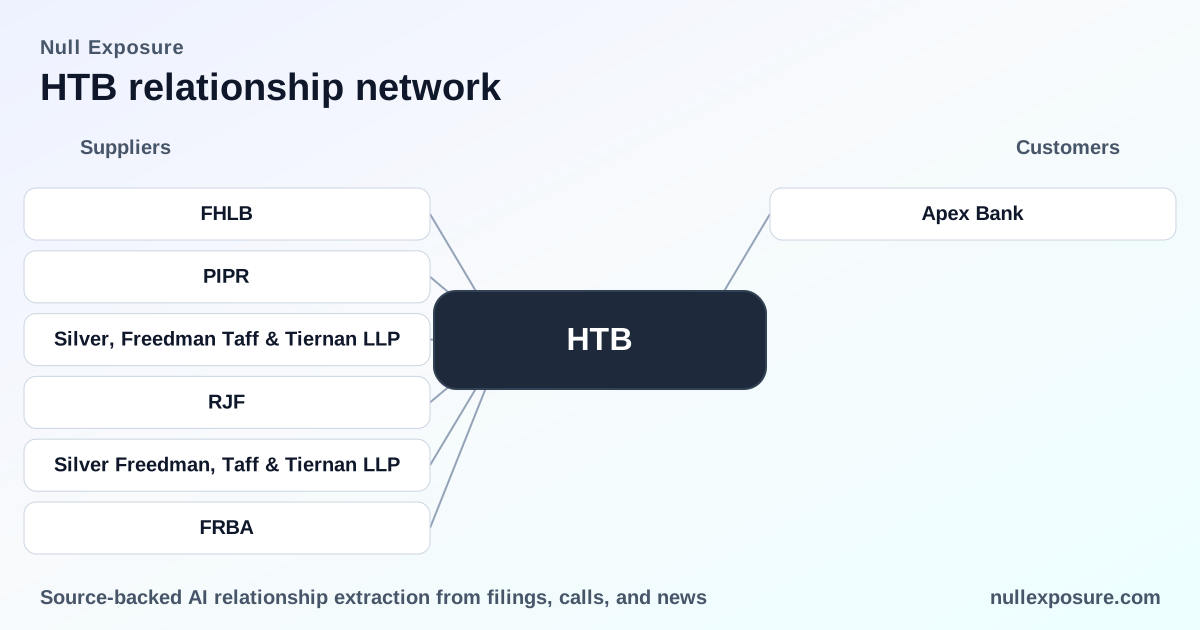
Apex Bank — sale of Knoxville branches
HomeTrust executed a purchase and assumption agreement to sell its two Knoxville, Tennessee branches to Apex Bank; the buyer will acquire the branch physical locations and assume substantially all associated customer deposit accounts. This branch divestiture was reported in March 2026 and follows the company’s prior disclosure of the definitive purchase and assumption agreement earlier in 2025. (News coverage: WGRV, March 10, 2026; company disclosure: definitive agreement dated January 27, 2025).
Portfolio and relationship roles that drive earnings and risk
HomeTrust operates across several customer types and business lines that are material to revenue and capital allocation:
- Service provider and seller roles are core to earnings. The bank originates loans to hold and to sell; mortgage gains on sales and SBA loan guaranty sales supply a significant portion of noninterest income. Servicing retention and sales/contracts affect income volatility.
- Buyer and seller behavior in branches and portfolios. The Knoxville branch sale to Apex Bank illustrates active footprint management—branches and related deposits are assets that the bank will buy or sell to optimize deposit cost and market focus.
- Counterparty mix is broad but community‑centric. Customers include individuals (consumer deposits and one‑to‑four family mortgages), small businesses and mid‑market commercial borrowers, municipal entities (notably municipal leases to fire departments), and non‑profits. Municipal leases totaled approximately $166 million (4.5% of loans) at year end, a meaningful niche exposure.
- Geographic concentration matters. Primary markets: North Carolina, South Carolina, Tennessee, Virginia and Georgia; this regional footprint concentrates economic and disaster risk (e.g., Hurricane Helene effects reported in FY2024).
Materiality and critical controls — constraints that shape execution
The public disclosures surface several company‑level constraints that define operational discipline and capital sensitivity:
- Concentration risk is material. CRE represents almost half the loan book, exposing the bank to regulatory scrutiny and cyclic CRE valuation risk.
- Short‑term funding reliance is operationally relevant. Large CDs maturing within 12 months create liquidity management pressure that competes with loan growth and capital deployment.
- Allowance for Credit Losses (ACL) is a critical estimate. Management treats the ACL as a key accounting judgment that is sensitive to economic conditions and loan performance; this is a critical factor for capital planning.
- Contract mix is heterogeneous. The balance of short‑term (deferrals, CDs), long‑term (mortgages, SBA, HELOCs), subscription/fee and activity‑based pricing shapes revenue stability.
- Spend and exposure bands are wide. The loan book includes both sub‑$100k retail relationships (average deposit balances ~$35k) and high‑value CRE and municipal leases in the tens to hundreds of millions.
What investors and operators should monitor now
Focus your monitoring on a small set of high‑leverage indicators that will surface stress or upside quickly:
- CRE loans as a percentage of total loans and delinquency trends in CRE vintages.
- Short‑term deposit runoff rates, CD re‑pricing and the bank’s cost of funds versus peer group.
- ACL trajectory and provisioning cadence relative to charge‑offs and loan modifications.
- Noninterest income drivers: mortgage gain on sale trends and SBA servicing fees.
- Municipal lease performance and geographic concentration (Western NC and East TN exposure).
- Branch footprint rationalization outcomes (deposits, cost savings, and retention after sales such as the Knoxville transaction).
If you want to track HTB relationship signals and branch/activity news on a daily basis, visit our platform for continuous coverage: NullExposure.
Conclusion — concise investment view
HomeTrust is a regional, relationship‑driven banking franchise with profitable core spreads supported by mortgage and SBA activity, but the business model is sensitive to CRE cycles, short‑term deposit dynamics and ACL adequacy. The sale of two Knoxville branches to Apex Bank is a tactical step to optimize footprint and deposit mix; investors should weigh the benefits of focus against the bank’s larger structural exposures—notably CRE concentration and short‑term funding—when assessing risk‑adjusted returns.