Heritage Commerce (HTBK): deposit-rich Bay‑Area community bank at a strategic inflection
Heritage Commerce Corp (HTBK) operates as the holding company for Heritage Bank of Commerce, a San Jose‑headquartered community bank that earns its margins from lending spreads, deposit funding and ancillary fee income (including SBA loan sales and servicing). The business model monetizes through a large base of commercial and consumer loans, relationship deposits (including ICS/CDARS balances), and a growing stream of servicing and factoring revenue via its Bay View Funding subsidiary. For active investors, the near‑term valuation narrative is now dominated by a proposed strategic sale to CVB Financial that effectively sets an acquisition floor for equity value.
For direct access to connected company intelligence, visit https://nullexposure.com/.
How Heritage actually runs the franchise — the operating posture that matters to returns
Heritage runs a classic community‑bank playbook but with modern funding dynamics. Core deposits are the company’s primary funding source and therefore operationally critical; management emphasizes relationship banking to secure large business accounts and relied on ICS/CDARS to keep uninsured balances in play. Loans are the largest earning asset (~62% of assets), concentrated in commercial and commercial real estate, with meaningful exposure to small and mid‑market businesses and owner‑occupied CRE. That mix creates a blended contracting posture: short‑term transactional flows (demand and money‑market deposits, short commercial lines) coexist with long‑dated term exposures (CRE and term loans amortized over 15–25 years with balloons).
Key business model characteristics investors should internalize:
- Concentration: operations and collateral are geographically concentrated in the San Francisco Bay Area, exposing earnings and credit quality to local economic cycles and real‑estate dynamics.
- Counterparty mix: heavy tilt to small businesses and individual borrowers, with a material role for SBA lending and some mid‑market commercial relationships.
- Criticality of deposits: deposit retention and pricing materially influence net interest margin and liquidity; the top 100 relationships account for a large share of deposits.
- Maturity profile: a blend of short‑term and long‑term contractual cash flows creates asset/liability management sensitivity to rate moves, while the bank’s “relationship” orientation implies relatively mature, stickier deposit relationships.
Public mentions and counterparties you need to know
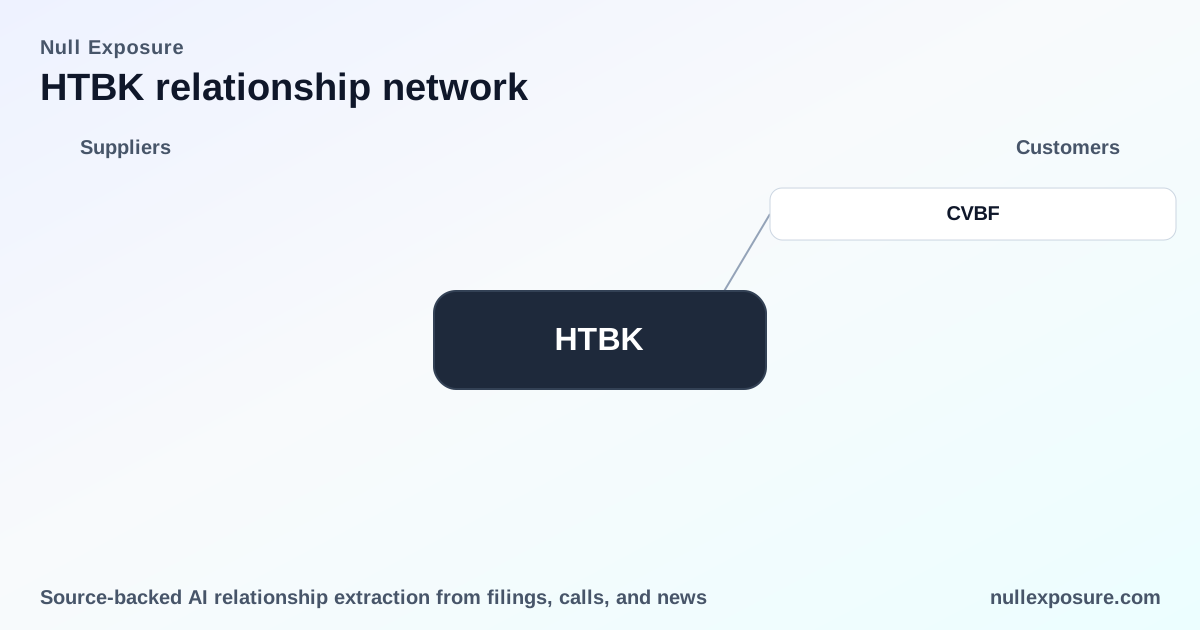
The feed of customer‑scope relationships in the record is narrowly focused on a single counterparty — CVB Financial — but appears across multiple press items and investor alerts. Below are each of the entries captured in the source feed, stated plainly with the originating source.
- AIJournal investor alert (March 10, 2026): AIJournal published an investor alert that Kahn Swick & Foti LLC is investigating the proposed sale of Heritage Commerce Corp to CVB Financial Corp. The article frames the sale as the subject of a shareholder‑process review. Source: aijourn.com investor alert (first seen March 10, 2026).
- AIJournal copy referencing CVB Financial Corp. (March 10, 2026): The same AIJournal item also directly references CVB Financial Corp. as the proposed acquirer, confirming the counterparty identity in the public discussion. Source: aijourn.com (March 10, 2026).
- PR Newswire release by Kahn Swick & Foti, LLC (March 10, 2026): PR Newswire carried KSF’s investor notice that the law firm is investigating the adequacy of price and process in the proposed transaction between Heritage Commerce and CVB Financial. This is a formal advisor‑led investor action item. Source: PR Newswire press release (March 10, 2026).
- PR Newswire mention of CVB Financial (March 10, 2026): The PR Newswire release explicitly names CVB Financial Corp. as the counterparty in the proposed sale, echoing the legal review. Source: PR Newswire (March 10, 2026).
- MarketScreener item (March 10, 2026): MarketScreener reported that CVB Financial plans to acquire Heritage Commerce for $811 million in stock, citing the announced transaction terms. That figure provides a clear market reference for deal value. Source: MarketScreener (March 10, 2026).
- MarketScreener repeat referencing CVB Financial (March 10, 2026): A second MarketScreener mention reiterates the $811 million stock consideration and CVB Financial as the acquirer, underscoring transaction confirmation in financial news feeds. Source: MarketScreener (March 10, 2026).
What the relationships tell investors about strategic optionality
All captured relationship mentions point to the same strategic outcome: an acquisition by CVB Financial that establishes a public valuation anchor and introduces governance and process scrutiny from shareholder counsel. For investors this does three things: (1) it creates an effective takeover floor near the disclosed consideration, (2) it places operating performance under short‑term regulatory and integration scrutiny, and (3) it focuses attention on deposit retention and client migration risk during transition.
Constraints and risk signals that shape operating leverage
Use these company‑level signals to judge execution risk — none of these constraints are assigned to any single counterparty unless noted in the company text.
- Contracting posture: mixed short‑term and long‑term exposure. Heritage funds activity with short‑dated deposits and transactional fees while underwriting long‑dated CRE and term loans; this increases interest‑rate and reinvestment sensitivity. Evidence shows commercial loans with maturities from 30 days to two years alongside CRE maturities of five to ten years.
- Concentration: geographically concentrated in the SF Bay Area with a loan book heavily secured by California real estate; CRE metrics were flagged relative to regulatory capital. This spatial concentration elevates local real‑estate cycle risk.
- Counterparty concentration and materiality: no single client accounts for >10% of revenue (an immaterial revenue concentration signal), but the top 100 deposit relationships represent nearly half of total deposits, a material funding concentration that makes deposit retention critical.
- Criticality: deposits are the most important source of funds; deposits not only supply low‑cost funding but also determine liquidity and lending capacity. Loss of deposits or sustained migration to higher‑yield alternatives would materially compress margins.
- Model and operational risk: the firm emphasizes servicing income (SBA loan servicing) and factoring revenue; servicing is a stable noninterest income stream but depends on active sales into the secondary market and ongoing servicing performance.
Valuation context and investor takeaways
Heritage’s listed market capitalization is roughly $828 million with a trailing P/E near 17 and a forward P/E around 11, while analysts show a consensus target price of $14.50 and book value of $11.55. The announced CVB Financial consideration of ~$811 million in stock effectively aligns with Heritage’s market cap and provides a near‑term market‑value reference (MarketScreener, March 2026). Key investor implications:
- Catalyst: the acquisition process and any legal review by shareholder counsel are the dominant near‑term catalysts that will determine financing, integration terms, and potential breakup or re‑pricing dynamics.
- Risk: deposit retention through an ownership transition and concentration in CRE are the two largest operational risks that can alter expected synergies and credit performance.
- Return profile: with a transaction in motion, upside is tied to deal completion and integration; downside is concentrated in deposit flight or CRE deterioration that either forces a price renegotiation or depresses pro‑forma earnings.
For investors and operators evaluating counterparty exposure or the market story around HTBK, these are the precise operational levers: deposits, CRE credit, SBA servicing income, and the execution of the sale process.
If you want systematic monitoring and a short, actionable brief on counterparties and deal flow for HTBK, start here: https://nullexposure.com/.
Conclusion: Heritage is a deposit‑rich, relationship bank with a clear monetization engine and concentrated geographic exposure; the proposed CVB Financial acquisition sets an immediate valuation benchmark, but the ability to retain deposits and manage CRE credit post‑announcement will determine whether that benchmark holds or re‑prices materially.