Horizon Technology Finance (HTFB): Customer Relationships and What They Signal for Investors
Horizon Technology Finance (HTFB) is a specialty finance company that originates secured term loans to venture-backed technology, life sciences and healthcare companies and monetizes through interest, arrangement and servicing fees, prepayment/commitment charges and equity upside via warrants; it further packages loans into asset-backed notes and sells or services securitizations to scale capital deployment and recycle balance sheet capacity. For investors evaluating HTFB’s customer footprint, the firm combines an active origination/servicing posture with recurring fee streams and periodic balance-sheet sales — a business model that rewards deal structuring and portfolio monitoring as much as pure credit selection. For a concise, structured view of HTFB’s customer exposures and documents, see Null Exposure. (https://nullexposure.com/)
What the contract signals tell you about HTFB’s operating posture
HTFB’s public filings and transaction documents establish a clear operating profile: long-term contractual exposure is the norm, capital structure uses securitizations and note issuances, and the firm plays multiple commercial roles across its relationships.
- Contracting posture and maturity: HTFB relies heavily on long-dated instruments — convertible notes, term loans and asset-backed notes with multi-year horizons — and routinely structures senior term loans secured by first‑lien collateral, indicating a lending business that values contractual protection and predictable cashflow profiles (company filings across 2019–2024 referenced in recent SEC exhibits).
- Revenue diversification and fee capture: The company generates coupon income plus commitment, amendment, non‑utilization and servicing fees, and receives warrants on many loans, giving upside on successful exits; securitizations provide liquidity and fee income for servicing roles.
- Concentration and criticality: Top-five investments represent roughly 22–23% of the portfolio, which creates material exposure to large facilities even though no single loan exceeded 10% of total investments at year‑end filings; that makes individual large outcomes meaningful for quarterly income.
- Role breadth: HTFB acts as originator, servicer, seller and buyer across transactions — it originates loans, securitizes and sells pools, and services trusts — increasing operational complexity but allowing multiple fee streams.
- Geography and regulatory footprint: While lending is US‑centric, HTFB’s legal and tax notes anticipate global counterparty and withholding considerations, and regulatory developments (including anti‑ESG policies) are treated as corporate‑level risk factors.
These signals collectively describe a lender that structures durable, fee‑rich loans while relying on securitizations and capital markets to scale — advantageous for yield capture but sensitive to funding cycles and credit volatility.
Deal-by-deal: the customer roll call investors need to know
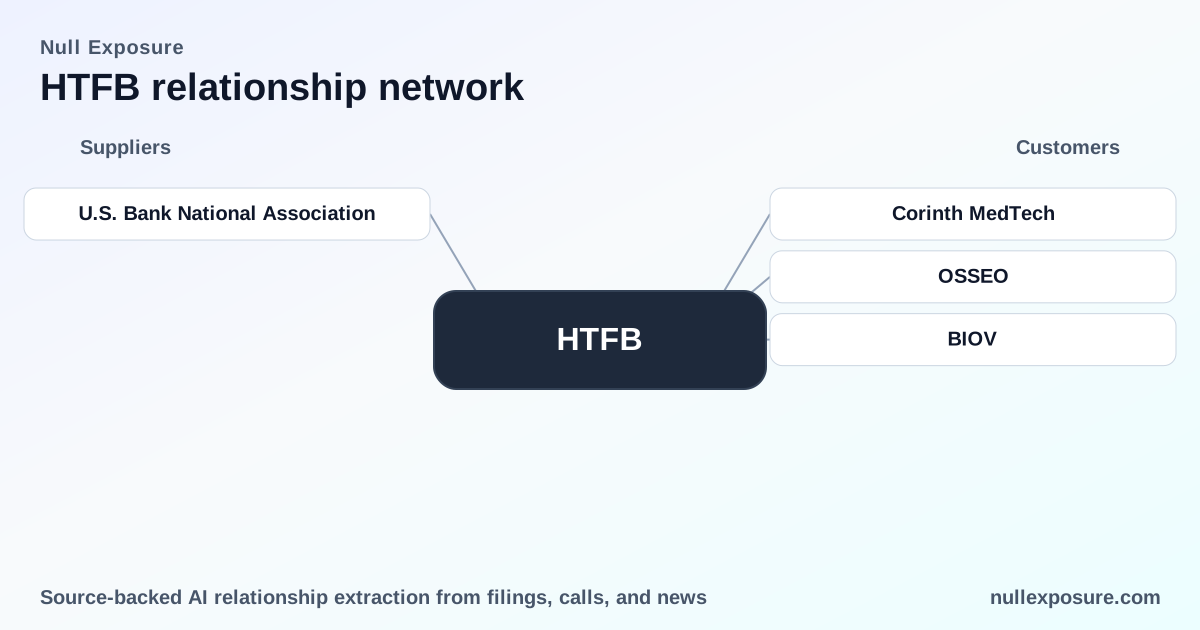
Corinth MedTech
Horizon provided a $5.0 million venture loan to Corinth MedTech as part of its portfolio financing activity; the transaction was reported in industry press describing the company as a borrower in HTFB’s venture lending program. Source: MassDevice news report on HTFB’s financing activity (article published March 2026 referencing the loan).
Osseo (entry 1)
HTFB disclosed a first‑quarter co‑investment with Monroe in a venture loan to Osseo on its Q4 2025 earnings call, signaling continued use of co‑lenders to syndicate risk on select venture loans. Source: HTFB Q4 2025 earnings call transcript (filed/released March 2026).
OSSEO (entry 2 — duplicate listing)
The earnings commentary repeated that HTFB participated alongside Monroe in a venture loan to OSSEO during Q1, underscoring the firm’s syndication and co‑investment approach on larger transactions. Source: HTFB Q4 2025 earnings call (March 2026).
BIOV (ticker entry)
A PR Newswire release reports that HTFB executed a supplemental amendment to an Asset Purchase Agreement with BioVaxys Technology Corp. related to acquiring assets built on the DPX immune‑education platform, reflecting HTFB’s involvement in structured IP/asset transfers tied to biotech assets. Source: PR Newswire announcement (March 2026).
BioVaxys Technology Corp. (expanded name)
The company press release describing an amendment to the 2024 Asset Purchase Agreement confirms HTFB’s role in a formal transaction to acquire biotech assets, a deal form aligned with its practice of taking secured positions and occasionally acquiring or restructuring borrower assets. Source: PR Newswire release (March 2026).
(Note: the results list included duplicate entries for Osseo and for BioV/BioVaxys; both entries are documented above to reflect every listed relationship in HTFB’s customer data.)
How these relationships map to credit and operational risks
HTFB’s customer set and contract templates reveal several investor‑level implications:
- Credit sensitivity to interest‑rate environment — A large portion of HTFB’s book is floating‑rate senior term loans; in a high‑rate regime borrowers face escalating service costs, elevating default risk and stressing NAV. This is a portfolio‑level structural risk identified in HTFB’s filings.
- Liquidity and securitization dependency — HTFB uses asset‑backed notes to fund originations; inability to securitize could limit growth and compress earnings. Company disclosures treat future securitization access as material to strategy execution.
- Operational concentration — The firm’s role as servicer and originator concentrates operational counterparty exposure (repurchase obligations, servicing covenants), increasing operational and reputational stakes if portfolio performance deteriorates.
- Revenue resiliency via fees and warrants — Beyond coupon income, HTFB benefits from diverse fee streams and warrant upside, which buffers near‑term income volatility but ties long‑term return to portfolio exit events.
What investors and operators should watch next
- Monitor HTFB’s securitization cadence and any changes in the size or pricing of Asset‑Backed Notes; constrained capital markets will reveal funding stress quickly.
- Track large loan repayments or prepayments: HTFB explicitly notes that repayment events materially change quarterly income, so large exits can compress reported yields.
- Watch regulatory developments (U.S. anti‑ESG measures and global withholding/FATCA rules) because HTFB flags these as company‑level risks that affect investor demand and cross‑border payments.
For a compact, structured repository of HTFB customer relationships and supporting documents, visit Null Exposure. (https://nullexposure.com/)
Bottom line
HTFB runs a structured venture‑lending franchise that extracts yield through secured term loans, fee income and occasional equity upside while leveraging securitizations to scale. Strengths: diversified fee streams, secured lending posture and active servicing. Key risks: dependence on securitization markets, sensitivity to borrower credit under a high‑rate environment, and non‑trivial concentration among top loans. Investors evaluating HTFB should weigh the durability of fee income against market funding cycles and monitor disclosure around large client exits and securitization capacity.