HTFC Customer Relationships: A Clear View for Investors and Operators
HTFC operates as a specialty finance vehicle that originates, holds and syndicates secured loans to development-stage companies across technology, life sciences, healthcare information and sustainability sectors. The firm monetizes through floating-rate interest on senior term loans, a steady stream of borrower fees (commitment, amendment and prepayment fees), warrant upside on many deals, and ancillary servicing and securitization revenue when it sells pools of loans into trust structures. For investors, the return profile is fee and interest-driven with embedded upside from warrants and periodic capital markets activity. Learn more at https://nullexposure.com/.
How the business actually works — contracting posture and portfolio dynamics
HTFC’s operating model is characterized by a tilt toward secured, long-dated term loans to development-stage issuers. Public disclosures indicate the portfolio is dominated by Senior Term Loans (86.1% of debt investments at fair value as of December 31, 2024), and the firm routinely structures loans with borrower warrants and occasional equity features. The company also acts as servicer for securitizations (multiple sale-and-servicing agreements and note purchase arrangements are documented), enabling both fee income and balance-sheet flexibility when it sells pools into trusts.
- Contracting posture: long-term, secured credit with standard protections; occasional framework commitments to provide follow-on capital.
- Concentration and criticality: portfolio concentrated in senior term loans, which are financially critical to NAV and distributions.
- Maturity and stage: a mix of active portfolio loans and a steady pipeline of prospective borrowers; many counterparties are development-stage or small businesses.
- Monetization levers: floating-rate interest, recurring borrower fees, warrants, and securitization/service fees.
These company-level signals underpin the risk/reward trade-off: credit performance of small, development-stage firms drives loan returns, while securitization and equity distributions complement cash generation.
What constraints say about the firm’s exposure and operational risks
Company evidence shows long-term contractual commitments are the norm — multiple term loans and convertible notes with multi-year maturities populate the portfolio. HTFC’s unfunded commitments (reported at $181.0 million as of December 31, 2024) and the use of securitizations to manage balance-sheet risk create liquidity and execution dependencies. The firm acknowledges material risk from borrower credit stress, interest-rate sensitivity for floating-rate borrowers, and reputational/ESG scrutiny that could affect investor appetite. At the same time, some contract features (like certain ETPs) are currently immaterial in dollar terms. Overall: credit risk and underwriting quality of small, development-stage borrowers is the primary operational lever.
The active and prospective relationships you need to know
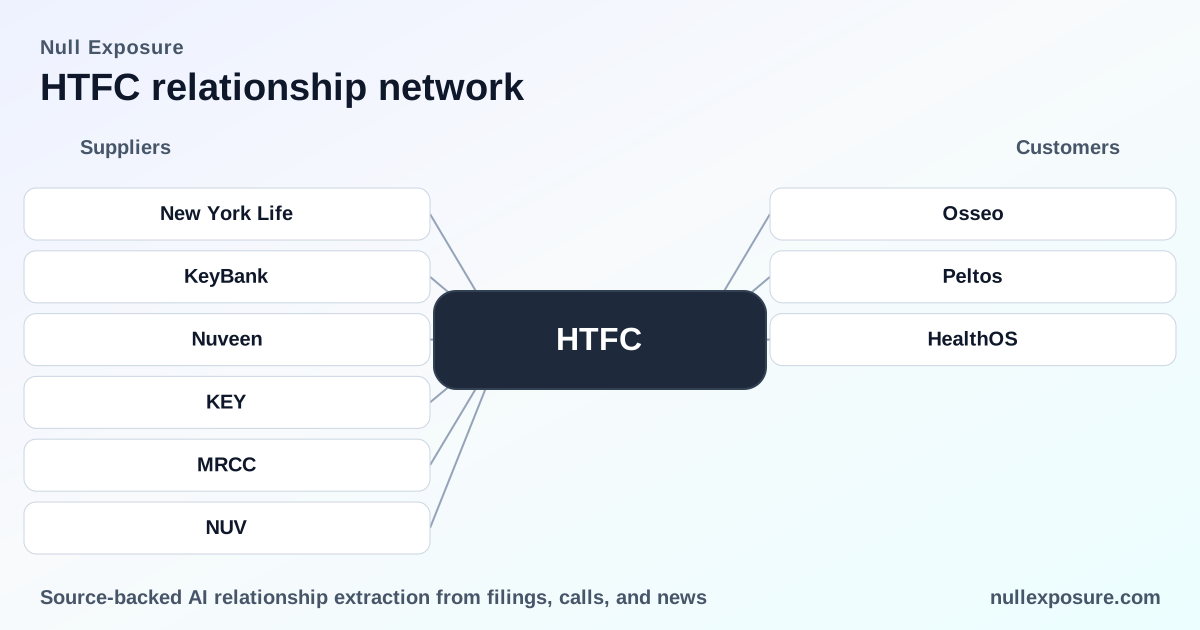
Below I summarize every customer relationship surfaced in the available mentions — concise, investor-focused, and source-linked.
Osseo — a closed venture loan in 2026
HTFC participated in a co-investment venture loan to Osseo alongside Monroe in Q1 2026, reflecting the firm’s continued activity in the life sciences venture lending market. According to an earnings call transcript published March 10, 2026, Osseo was one of the early 2026 closings. Source: InsiderMonkey Q4 2025 earnings call transcript (published Mar 10, 2026) — https://www.insidermonkey.com/blog/horizon-technology-finance-corporation-nasdaqhrzn-q4-2025-earnings-call-transcript-1709621/.
Peltos — evidence of life-science pipeline deployment
HTFC cited loans to Peltos as part of a constrained life-science IPO market that creates venture loan originations; the company positioned Peltos alongside Osseo as an example of deal activity as of early 2026. Source: InsiderMonkey Q4 2025 earnings call transcript (published Mar 10, 2026) — https://www.insidermonkey.com/blog/horizon-technology-finance-corporation-nasdaqhrzn-q4-2025-earnings-call-transcript-1709621/.
Pelthos Therapeutics Inc. — a $50 million venture facility
Pelthos Therapeutics secured a $50 million venture loan facility from HTFC, a sizeable single-name commitment that reflects the firm’s capability to underwrite larger life‑science financings. This was reported in SEC filing coverage published May 3, 2026. Source: Investing.com, SEC filings summary (May 3, 2026) — https://m.investing.com/news/sec-filings/horizon-technology-finance-announces-amendments-to-loan-and-servicing-agreements-93CH-4501450?ampMode=1.
Kodiak AI, Inc. — a new $30 million debt facility
Kodiak AI established a $30 million debt facility with HTFC, highlighting the company’s activity in the software/AI financing vertical and illustrating that HTFC originates larger facilities across its target industries. This transaction was disclosed in SEC filing coverage published May 3, 2026. Source: Investing.com, SEC filings summary (May 3, 2026) — https://m.investing.com/news/sec-filings/horizon-technology-finance-announces-amendments-to-loan-and-servicing-agreements-93CH-4501450?ampMode=1.
HealthOS — pipeline to closed through early 2026
HealthOS was identified as a pipeline opportunity that closed in 2026, demonstrating the firm’s ability to convert pipeline opportunities in healthcare IT into funded engagements. This was mentioned in the company’s earnings call commentary in March 2026. Source: InsiderMonkey Q4 2025 earnings call transcript (published Mar 10, 2026) — https://www.insidermonkey.com/blog/horizon-technology-finance-corporation-nasdaqhrzn-q4-2025-earnings-call-transcript-1709621/.
Strategic takeaways and portfolio implications
- Core exposure is credit-first, with most economic value delivered by senior secured, floating-rate loans and borrower fees; warrants provide incremental upside.
- Securitization and sale-and-servicing arrangements are an explicit part of capital management, creating fee revenue but also counterparty and servicing obligations that are operationally important.
- Concentration in senior term loans is material and critical to NAV; underwriting discipline on development-stage borrowers is the principal risk to monitor.
- Deal sizes are heterogenous — from sub-million funding to facilities in the tens of millions — so exposure is diversified by ticket size but concentrated by instrument type.
Risk checklist for operators and investors
- Monitor borrower liquidity and the health of floating-rate exposures (escalating rates can stress cash burn).
- Track securitization performance and repurchase obligations tied to sale-and-servicing agreements.
- Watch unfunded commitments and the company’s capacity to meet them without over-levering; unfunded commitments stood at $181.0 million as of year-end 2024.
- Evaluate ESG/reputational exposure in key investor constituencies due to heightened regulatory scrutiny.
For deeper diligence on HTFC’s loan schedules, securitization documents and recent deal notices, visit https://nullexposure.com/ for reports and filings.
Bottom line
HTFC is a specialist lender whose return profile is driven by secured, long-term senior loans to development-stage companies, borrower fees and warrant upside, complemented by servicing and securitization activity. Investment performance will track underwriting quality and execution of securitization and capital markets strategies; credit outcomes across small, development-stage borrowers are the single largest determinant of return volatility.