HeartFlow (HTFL): Payer Coverage Expansion Turns Clinical Validation into a Commercial Growth Story
HeartFlow sells AI-driven, non-invasive coronary plaque and FFR-CT analysis to hospitals and health systems and collects fees through payer reimbursement and institutional contracts; the company monetizes by converting diagnostic studies into reimbursable clinical services that replace more invasive tests. Recent, broad national payer coverage decisions materially increase the addressable and reimbursable volume for HeartFlow’s Plaque Analysis product and shift the company from clinical validation toward routine commercial utilization. For a focused view of customer momentum and what it means for the business, see NullExposure’s research hub: https://nullexposure.com/.
Why payer wins are the principal lever for HTFL’s model
HeartFlow operates as a vendor whose unit economics rely on payer reimbursement and institutional adoption rather than on large hardware sales or recurring software subscriptions in the traditional SaaS sense. Coverage by national insurers converts clinical utility into repeatable revenue because it reduces out-of-pocket friction for ordering physicians and hospital procurement. The company’s go-to-market therefore depends on three operating characteristics:
- Contracting posture: HeartFlow sells into a payer-driven market where national policy decisions determine steep changes in utilization; winning coverage from major commercial insurers is a direct revenue catalyst for fee-per-study services.
- Concentration and scale: National commercial insurers and large health systems account for large swaths of covered lives; coverage rollouts from a handful of payers disproportionately expand the company’s addressable market.
- Criticality and maturity: HeartFlow’s technology reduces downstream invasive procedures and duplicated testing; evidence of cost savings and FDA 510(k) clearance have pushed the product from pilot studies into mainstream payer policy as of late 2025–early 2026.
These dynamics make payer relationships the central valuation hinge for HTFL: successful commercial scaling is governed by adoption curves among major insurers and the company’s ability to translate those policies into higher study volumes and durable reimbursement rates.
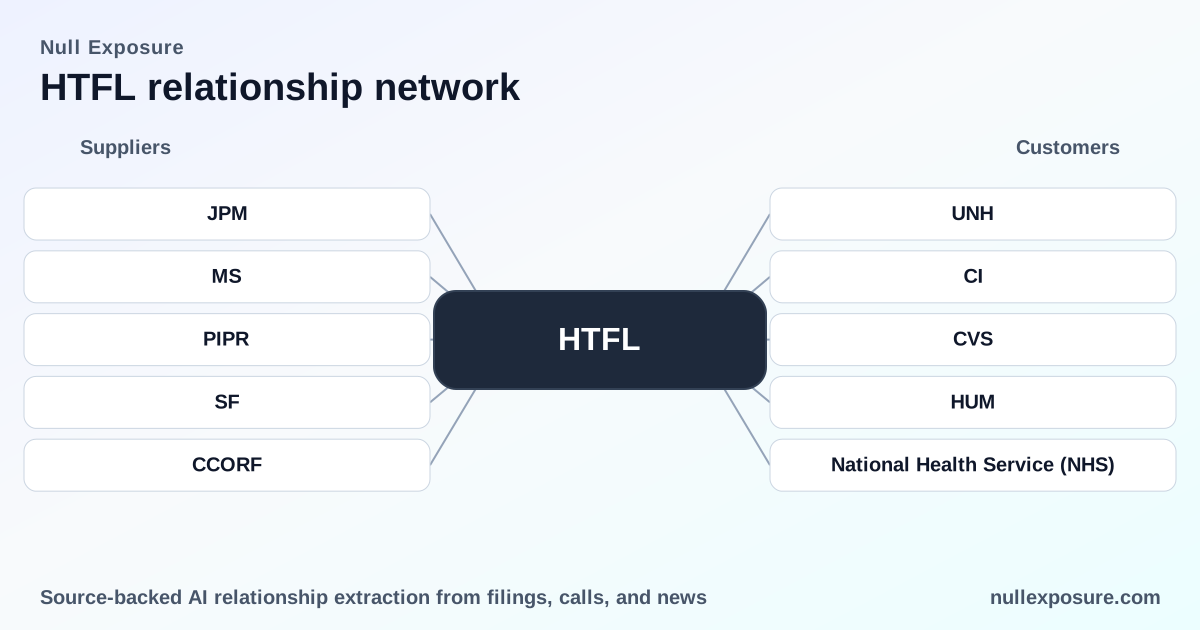
Customer relationships: who just expanded coverage and what it means
Aetna (CVS Health / Aetna) — Coverage across Commercial, Medicare Advantage and Medicaid
Aetna announced nationwide coverage of HeartFlow Plaque Analysis across Commercial, Medicare Advantage and Aetna Better Health Medicaid plans, extending HeartFlow’s reach to a majority of insured lives and bringing total U.S. covered lives for Plaque to about 75%. Source: HeartFlow press release carried by GlobeNewswire and reported via The Manila Times, Jan 6, 2026; and company earnings commentary reported on TradingView/Investing.com, Q4/FY2026 reporting.
UnitedHealthcare (UNH) — Early national payer decision that set a precedent
UnitedHealthcare updated its policy to cover HeartFlow Plaque Analysis prior to Cigna’s and Aetna’s decisions, establishing an early national benchmark payer policy that others followed. Source: Company press coverage in connection with HeartFlow’s 510(k) announcement and subsequent market reporting, Sept–Oct 2025 (GlobeNewswire, BioSpace, DiCardiology).
Cigna (CI) — National coverage across Commercial and Medicare Advantage
Cigna committed to covering HeartFlow Plaque Analysis across all lines of business, including Commercial and Medicare Advantage plans beginning October 2025, aligning its policy with radiology benefit manager guidance and broadening HeartFlow’s commercial footprint. Source: HeartFlow’s Sept 22, 2025 GlobeNewswire announcement and corroborating coverage in DiCardiology and Radiology Business, FY2025–FY2026 reporting.
Humana (HUM) — Part of the major payer cohort now covering Plaque Analysis
Humana is one of the large national commercial insurers that updated policy to cover HeartFlow Plaque Analysis prior to Aetna’s announcement, contributing to the aggregation of major-payer coverage that drives national utilization. Source: Market reports referenced alongside HeartFlow’s coverage announcements (ManilaTimes/GlobeNewswire coverage citing Humana as an earlier decision), FY2026 reporting.
National Health Service (NHS, UK) — Demonstrated cost and utilization benefits in public systems
The NHS experience with HeartFlow FFR-CT Analysis produced fewer avoidable tests, lower inpatient and outpatient costs and measurable savings for hospitals and patients, demonstrating the real-world cost-offsets that underpin payer willingness to reimburse. Source: DiCardiology coverage of FFR-CT study outcomes and NHS rollout results, FY2025 reporting.
The collective commercial implication: converting policy into revenue
The recent cluster of national payer coverage decisions is a material commercial inflection for HeartFlow. With UnitedHealthcare, Cigna, Humana and Aetna now aligned on coverage for Plaque Analysis, HeartFlow has cleared a critical commercialization barrier that historically constrained adoption. Investors should treat these coverage decisions as an accelerator of study volumes and revenue per study rather than as a headline alone—the economic payoff depends on utilization growth within covered populations and HeartFlow’s operational capacity to scale to higher study throughput.
Business model constraints and operating signals (company-level)
There are no explicit contractual constraints listed in the customer relationship feed. Treat the following as company-level operating signals rather than relationship-specific facts:
- High dependency on payer policy decisions. Revenue growth is sensitive to the pace at which national payers and regional plans adopt coverage and to any changes in reimbursement rules.
- Revenue concentration risk. A small number of national payers now define coverage for a large share of insured lives; concentration of payer agreements increases sensitivity to policy reversals or rate pressure.
- Commercial maturity is improving. FDA 510(k) clearance and multiple national coverage policies indicate the product has moved from proof-of-concept to mainstream reimburseable service, reducing clinical adoption barriers.
- Criticality to clinical pathways. Demonstrated cost-savings in NHS and reduced invasive testing provide payers and hospitals with a tangible value proposition that supports durable adoption and pricing negotiations.
Key investor takeaways and near-term monitorables
- Coverage removes a major adoption barrier; the next value inflection is utilization. Monitor study volumes, ARPU per study, and payer mix in quarterly disclosures.
- Watch reimbursement rates and any managed care carve-outs. Policy coverage does not guarantee uniform reimbursement; negotiated rates and benefit-manager rules can materially affect revenues.
- Operational scaling will determine margin recovery. HeartFlow needs to convert payer coverage into higher throughput without proportionally increasing costs to restore path to profitability.
- Public-market multiples already price growth expectations. Given HeartFlow’s negative margins and high Price/Sales metrics, execution on utilization and reimbursement is essential to justify current valuation.
For ongoing tracking of payer developments and customer-level signals, NullExposure maintains a rolling feed of coverage events and market impact analysis at https://nullexposure.com/.