HomesToLife (HTLM): Customer Relationships That Matter — a focused investor brief
HomesToLife Ltd operates a proptech marketplace that connects buyers, sellers and brokers and monetizes through platform services, transaction facilitation and value-added subscriptions and merchant partnerships that capture both listing and fulfilment economics. The company’s financials through the 2025 fiscal year show a profitable marketplace at scale — Revenue TTM $377.9m, EBITDA $21.1m, and a trailing P/E of 9.78 — and its customer and distribution relationships are central to understanding growth durability and downside risk. For a concise independent view of HTLM relationship intelligence, visit the NullExposure home page: https://nullexposure.com/.
How HomesToLife actually generates value and why customer links matter
HomesToLife’s platform is fundamentally a two-sided marketplace augmented by data services and merchant partnerships. The company captures value in three principal ways: transaction and listing fees, service and subscription revenue for brokers and power users, and merchant/referral economics when physical goods or fulfilment are sold through platform partners. The business translates platform scale into gross profit — Gross Profit TTM $105.3m — while operating margins are modest but positive, reflecting a marketplace still investing in distribution and product.
Two corporate structural facts are critical for reading customer relationships: insider control is extremely concentrated (Insiders ~96% of shares) and institutional ownership is effectively nil (~0.001%), while the public float is very limited. That ownership profile makes large strategic customer or channel decisions highly dependent on insider strategy and less likely to be driven by institutional investor pressure.
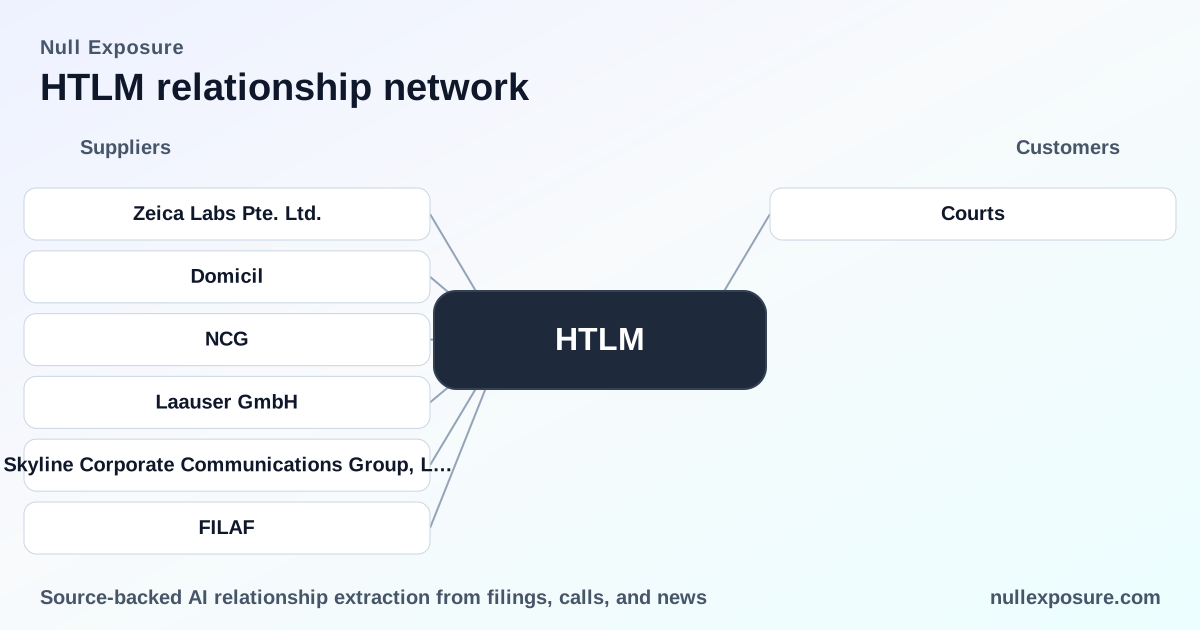
Customer relationship detail: Courts (retailer channel)
HomesToLife’s sourced customer mentions in the record point to a retail channel relationship with Courts, a regional furniture and electronics retailer.
-
FY2024 — The Straits Times reported that HomesToLife’s antecedent business supplied sofas to local retailers such as Courts, highlighting an early go-to-market channel that leveraged retail partners to move product and build brand recognition. The Straits Times coverage dated May 2026 recounts the company’s evolution and its use of retail partners to capitalise on demand for upholstered furniture.
Source: The Straits Times, May 3, 2026. -
FY2025 — Vulcan Post documented the same retail linkage, noting the brothers who founded the business supplied white‑label PVC sofas to retailers including Courts, establishing a reputation for craftsmanship that underpinned the company’s expansion. That coverage (March 2026) frames Courts as an early distribution customer in the company’s growth story.
Source: Vulcan Post, March 10, 2026.
Key takeaway: Courts is identified in multiple contemporaneous news sources as a retail channel partner used in HomesToLife’s early product distribution; the relationship is described as supplier-to-retailer rather than a strategic exclusive alliance. Both media references underline Courts’ role in building product provenance and distribution reach.
What the Courts relationship implies for investors
The documented Courts links are evidence of channel-based customer acquisition and product distribution rather than a large, exclusive commercial contract. For investors this translates into three practical implications:
- Distribution depth over strategic exclusivity. The relationship reads as one of many distribution touchpoints that helped scale HomesToLife’s physical product credibility; it is not presented as a single critical revenue line in the public reporting available here.
- Channel credibility and brand signaling. Supplying established retailers such as Courts gives HomesToLife retail validation that supports marketplace trust and merchant onboarding.
- Limited counterparty concentration risk from the documented items. The records do not show Courts as a dominant revenue source; the relationship functions as complementary distribution rather than a sole dependency.
For an investor due diligence package that tracks channel partners and retail distribution across time, more granular contract-level disclosures would be required; the public news coverage provides clear directional context but not revenue splits.
Constraints and operating-model signals (company-level)
The customer-relationship extraction for HTLM returns no explicit constraints in the relationship constraints feed. At the company level that absence of reported constraints should be read as a neutral signal combined with these operational characteristics observed in the public financials and shareholder structure:
- Contracting posture: Public information and media references describe transactional supplier-to-retailer arrangements rather than long-term strategic procurement contracts; the posture is therefore predominantly transactional and distribution-focused.
- Concentration: Insider ownership is extremely concentrated (Insiders ~96.17%), and public float is limited relative to shares outstanding, which creates governance concentration risk and can suppress market liquidity and institutional influence.
- Criticality of documented customers: The media-identified customer (Courts) is functionally a distribution partner that provides product reach and credibility; it is not presented in the public accounts as a systemically critical or single-source customer.
- Maturity: Financial metrics (positive EBITDA, modest operating margins, profit margin ~4.38%) point to a company that has moved past early cash burn and operates with commercial maturity, although growth rates are modest (quarterly revenue growth YOY +7% most recently).
These indicators are company-level signals and are not attributed to any single relationship unless explicitly named in constraints (none were).
Investment implications and risk checklist for operators and investors
HomesToLife’s customer references and corporate profile together create a balanced investment case with distinct operational cautions:
- Upside: Marketplace model with validated retail distribution channels, positive EBITDA and gross profitability supports reinvestment into tech and geographic expansion. Revenue TTM $377.9m and Gross Profit $105.3m validate scale.
- Risks: Very high insider concentration and tiny institutional ownership create governance and liquidity risks; small public float amplifies volatility. Reliance on distributed retail partners requires monitoring for margin pressure and inventory dynamics.
- Actionable monitoring items: Track public contract disclosures for any move from transactional retail supply to exclusive or long-term merchant agreements; watch insider selling or any increases in institutional participation as signals of strategic shifts.
For immediate access to curated relationship intelligence on HTLM and comparable proptech names, visit NullExposure for updated feed and analysis: https://nullexposure.com/.
Bottom line
HomesToLife has converted retail channel relationships such as Courts into credible distribution and product provenance while operating a profitable marketplace at scale. The reported relationships are distribution-first and not presented as single-source revenue dependencies, and the company-level signals of insider concentration and positive EBITDA create a clear risk-reward profile for institutional investors and operators. Monitor contract disclosures and any shift toward strategic, multi-year retail partnerships to re-assess concentration and criticality risk going forward.