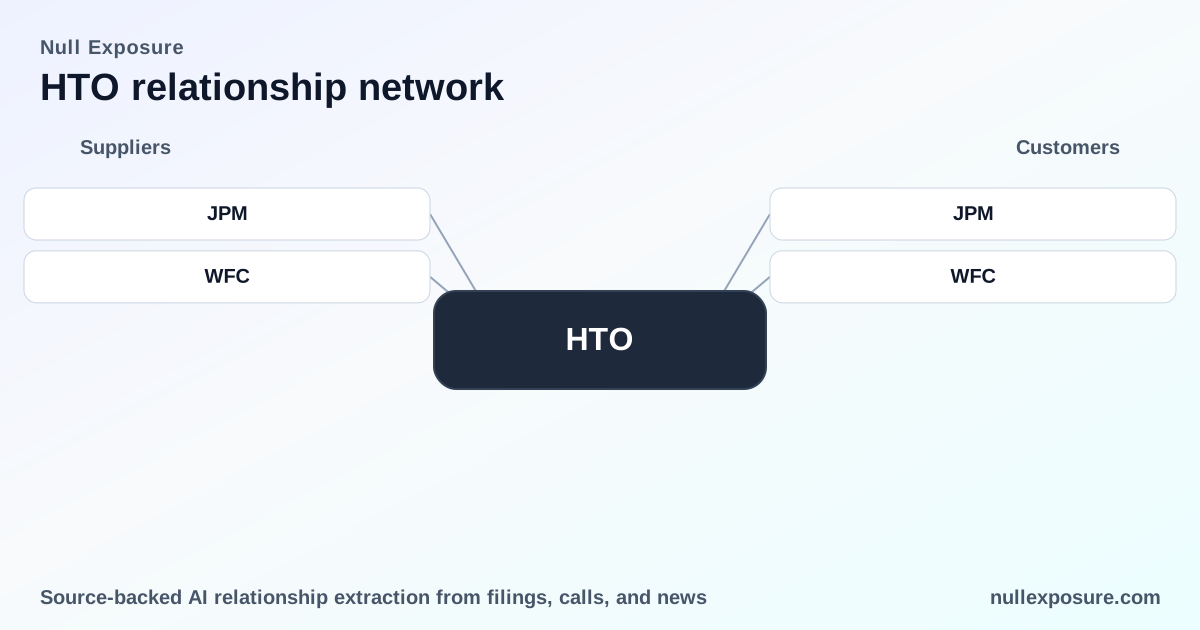
HTO (H2O America) — Forward-sale Counterparties and the Customer Footprint Investors Should Price In
H2O America operates regulated water utilities and related services across California, Connecticut, Maine and Texas, monetizing through regulated tariffed water sales, targeted surcharges and non-tariff service contracts, while accessing capital markets to fund infrastructure and working capital. The company’s business model combines predictable regulated cash flows with episodic regulatory rate remedies and balance-sheet actions — including a recent planned equity offering with a forward component that uses major banks as forward purchasers — that together determine near-term liquidity and long-term capital intensity. For a concise research gateway to this profile, see NullExposure’s coverage at https://nullexposure.com/.
Why the forward-sale counterparties matter to investors
H2O America announced a proposed equity offering that includes an aggregate $400 million forward-sale piece. Using large banks as forward counterparties converts capital markets execution risk into bilateral counterparty exposure and potential dilution timing, so the identity and role of the forward purchasers is a near-term credit and governance datapoint for investors. The banks named in public notices are the same institutions that routinely execute equity financing overlays for utilities; their participation signals standard underwriting and hedging arrangements rather than exotic financing.
- Liquidity driver: the forward-sale structure gives the company optionality between cash settlement and physical settlement, smoothing timing of equity issuance relative to market conditions.
- Counterparty credit and execution risk: counterparties are large, regulated banks whose credit terms and settlement mechanics determine ultimate dilution and proceeds.
For additional context on the firm and its customer-driven cash flows, see NullExposure’s home page for related coverage: https://nullexposure.com/.
The explicit counterparties disclosed (each relationship in the record)
JPM
H2O America expects to enter into forward sale agreements with JPMorgan Chase Bank acting as a forward purchaser for a portion of the $400 million forward component of the proposed offering, agreeing to sell shares at an initial forward price tied to the offering underwriters’ purchase price with the company retaining certain settlement election rights. This disclosure was reported in March 2026 in offering notices reproduced by Bitget and a GlobeNewswire distribution as carried by Manila Times. (Bitget, March 10, 2026; GlobeNewswire/ManilaTimes, March 3, 2026)
JPMorgan Chase Bank, National Association, New York Branch
The company specifically names the New York Branch of JPMorgan Chase Bank as a forward counterparty in the same forward-sale arrangement; the branch is identified as a contractual buyer under the forward agreements that can receive shares upon physical settlement or accept cash/net-share settlement depending on H2O America’s election. The detail appears in the same March 2026 offering disclosures and press distributions. (GlobeNewswire/ManilaTimes, March 3, 2026; Bitget, March 10, 2026)
Wells Fargo Bank, National Association
Wells Fargo Bank is also named as a forward purchaser alongside JPMorgan Chase in the planned forward-sale agreements, taking on the bilateral forward counterparty role for a portion of the aggregate $400 million commitment and therefore sharing the credit and settlement exposure associated with the offering’s forward leg. This was disclosed in the company’s March 2026 offering announcement and carried in the same press reports. (GlobeNewswire/ManilaTimes, March 3, 2026; Bitget, March 10, 2026)
How these counterparties change the investment calculus
- Dilution timing vs. market execution: the forward-sale counterparties convert what would be immediate share issuance into a structured timing decision, enabling H2O America to monetize equity over time while locking in counterparties for execution.
- Standard counterparty risk: counterparties are systemically significant banks; credit risk is low relative to smaller counterparties, but settlement mechanics and price adjustments embedded in forward agreements determine realized proceeds and potential anti-dilutive protections for investors.
- Signaling: the choice of major investment banks indicates a traditional capital markets process rather than distress financing.
Company-level relationship constraints and what they reveal for customers and investors
H2O America’s customer and contract profile is shaped by a mix of regulated franchise economics and service contracts. Present across disclosures are consistent signals that define the operating model:
-
Contracting posture — predominantly long-term, regulated relationships with targeted short-term adjustments. The company’s utilities hold long-term franchises and multi‑decade service arrangements (for example, 12‑year municipal agreements and franchise permanency in certain territories), while also relying on 12‑month surcharges and balancing accounts to reconcile short-term cost and demand swings. This structure stabilizes revenue but embeds lag between cost incurrence and allowed recovery (company-level disclosure, regulatory filings through 2024–2026).
-
Revenue drivers are usage-based but supported by regulatory mechanisms. Customers pay a mix of fixed service charges and consumption-based volumetric rates; decoupling and balancing mechanisms (e.g., WRA, WICA, MWRAM) adjust realized revenue to the regulators’ authorized revenue, preserving recoverability of capital and some operating costs.
-
Concentration and geography: a substantial majority of earnings and rate-setting sensitivity are concentrated in California and Connecticut, exposing investors to state-level regulatory decisions, weather and water supply risks that can influence authorized returns and timing of cost recovery.
-
Criticality and materiality: Water Utility Services is the company’s single reportable segment and represents material core earnings and assets, meaning regulatory outcomes and infrastructure failures have direct, substantive effects on consolidated results.
-
Relationship roles and stages: the company functions both as an essential seller of utility service and as a service provider through operations & maintenance contracts and non-tariff offerings; most customer relationships are active and mature, with periodic renewals and targeted acquisitions to grow the customer base.
-
Capital intensity and spend bands: customer-funded advances and surcharges demonstrate capital recovery mechanics in the $100k–$10m range, and the business runs substantial multi‑year infrastructure capex, necessitating recurring access to capital markets.
Collectively, these constraints show a regulated utility with high revenue predictability from core customers, regulated recovery levers to mitigate demand volatility, and periodic capital-market dependence for infrastructure financing.
Investment implications — risk and upside for HTO stakeholders
-
Upside: regulated rate base with balancing mechanisms provides durable cash flow and the forward-sale financing gives management timing flexibility to issue equity on favorable terms. Analyst coverage and buy recommendations (consensus buy/strong buy skew) indicate positive market expectations around execution and rate recovery.
-
Key risks: regulatory decisions in core states, drought/natural disasters affecting supply, and the structure/settlement terms of the $400 million forward component that will determine effective dilution and realized capital. Investors should prioritize disclosure around forward agreement pricing adjustments, cash vs. physical settlement election mechanics, and the schedule for any material rate case outcomes.
Final takeaway
H2O America is a classic regulated utilities investment with stable, usage-linked cash flows and active regulatory levers that both protect and constrain earnings. The named forward purchasers — JPMorgan (including its New York Branch) and Wells Fargo — convert execution risk into counterparty exposure for the company’s $400 million forward-sale element, an important financing detail that affects dilution timing and liquidity. For investors and operators evaluating HTO customer relationships, the combination of long-dated franchise economics, short-term surcharge tools, and the recent capital markets overlay are the primary determinants of near‑term valuation and long‑run operational flexibility.
For a deeper dataset-backed profile and ongoing monitoring of counterparties and customer-level signals, visit NullExposure’s research center at https://nullexposure.com/.