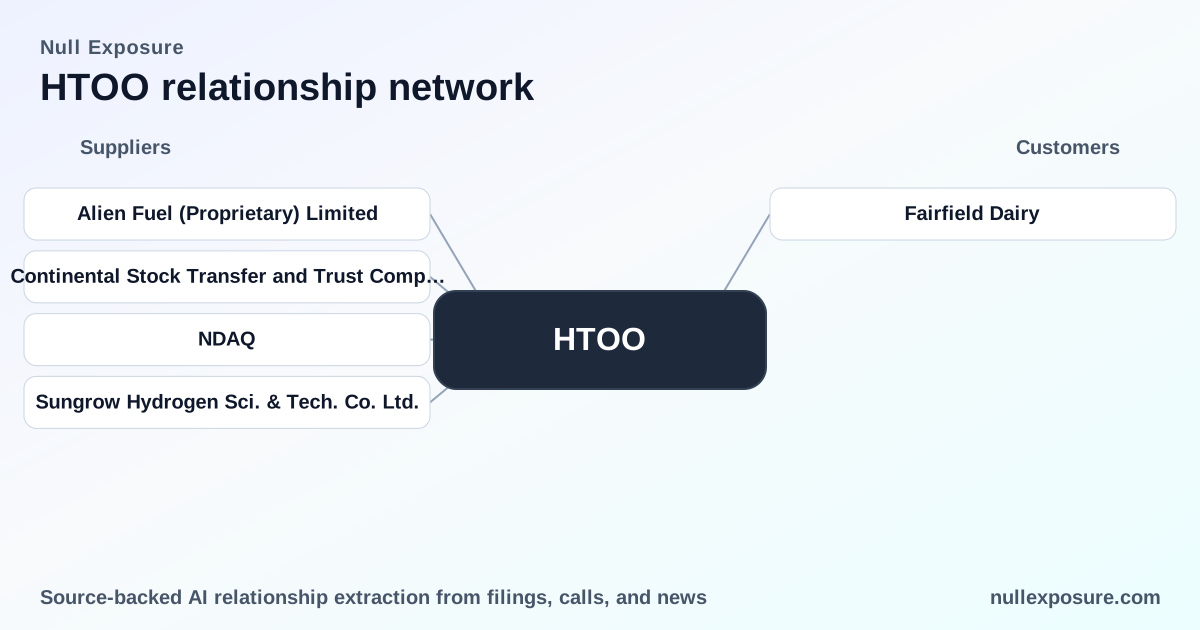
Fusion Fuel Green (HTOO) — Customer Relationships and the Fairfield Dairy decarbonization win
Fusion Fuel Green operates as a green hydrogen technology and project developer headquartered in Dublin, monetizing through project sales, joint-venture operations, long‑term offtakes and ancillary environmental revenue streams such as verified carbon credits. The company increasingly structures revenue as recurring service contracts and JV-managed plant operations rather than one‑off equipment sales, expanding into biomass steam and integrated decarbonization services to secure predictable cashflows. For investors evaluating customer exposure, the recently announced Biosteam Energy joint venture and its steam supply arrangement with Fairfield Dairy is the most material customer linkage in the public record for FY2025. Learn more at https://nullexposure.com/.
The deal in plain English: what Fusion Fuel is selling now
Fusion Fuel and partner Alien Fuel created a joint venture, Biosteam Energy, to finance, build and operate a biomass steam plant that replaces a fossil‑fuel boiler at Fairfield Dairy in South Africa. The commercial model moves beyond hydrogen to recurring steam offtake contracts and carbon-credit generation tied to landfill avoidance and fuel switching—two separate, ongoing revenue levers that support long‑term cashflow visibility.
This transaction signals a clear shift in contracting posture: Fusion Fuel is acting as a project developer/operator that accepts construction and operating responsibilities through JV vehicles, with counterparties contracted for long‑duration energy supply rather than a simple equipment purchase.
Relationship entries (every disclosed item)
-
Quiver Quant reported (May 3, 2026) that Biosteam Energy is expected to generate long‑term recurring revenues through a steam supply agreement with Fairfield Dairy, in addition to income from verified carbon credits created by landfill avoidance and fuel switching. Source: Quiver Quant news item, May 3, 2026 — https://www.quiverquant.com/news/Fusion+Fuel+Green+PLC+Partners+with+Alien+Fuel+to+Launch+Biosteam+Energy+Joint+Venture+for+South+Africa%27s+Fairfield+Industrial+Decarbonization+Project
-
MarketScreener noted (March 10, 2026) that Biosteam Energy will manage the financing, construction and operation of a biomass‑powered steam generation system to replace Fairfield Dairy’s fossil‑fuel boiler, positioning the JV to capture the plant’s capital and operating margin. Source: MarketScreener press coverage, Mar 10, 2026 — https://www.marketscreener.com/news/fusion-fuel-green-plc-signs-definitive-joint-venture-agreement-with-alien-fuel-for-landmark-industri-ce7d5adcda8df724
-
Sahm Capital covered the announcement (reported Mar 10, 2026) emphasizing that Biosteam Energy expects recurring revenues under a steam supply agreement and incremental verified carbon credit income tied to landfill avoidance and fuel‑switching benefits. Source: Sahm Capital news release, Mar 10, 2026 — https://www.sahmcapital.com/news/content/fusion-fuel-green-plc-signs-definitive-joint-venture-agreement-with-alien-fuel-for-landmark-industrial-decarbonization-project-in-south-africa-2025-10-16
-
A second MarketScreener posting (March 10, 2026) reiterated that the JV’s commercial model combines long‑term steam offtake with environmental revenues, positioning the project as a turnkey decarbonization service for one of South Africa’s major dairy processors. Source: MarketScreener press item, Mar 10, 2026 — https://www.marketscreener.com/news/fusion-fuel-green-plc-signs-definitive-joint-venture-agreement-with-alien-fuel-for-landmark-industri-ce7d5adcd88df024
What investors should read into a single‑customer announcement
The Fairfield Dairy engagement is material for three reasons:
- Revenue type diversification — Fusion Fuel extends from hydrogen engineering into biomass steam supply and monetizes through long‑duration service contracts and carbon credits, both of which are recurring and can improve revenue quality.
- Execution risk concentrated at project level — the firm takes on construction and operational roles via a JV, which increases near‑term execution and capex exposure but also preserves upside from operating margins.
- Customer concentration remains a headline risk — public disclosures list Fairfield Dairy as the principal customer tied to this JV; absent a broader roster of comparable offtakes, single‑project dependence elevates counterparty and execution risk.
Key investment implications:
- Positive: recurring steam contracts and verified carbon credits provide predictable revenue streams that improve cashflow visibility once the plant reaches steady state.
- Negative: outcomes depend on JV execution, the credit quality and contract length with Fairfield Dairy, and the timing of carbon credit verification and monetization.
- Neutral: the move into biomass is strategically logical for industrial decarbonization, but it widens Fusion Fuel’s technological and operational scope, increasing management bandwidth requirements.
Learn more about how these relationship signals are tracked at https://nullexposure.com/.
Company‑level constraints and operating posture
There are no explicit contractual constraints disclosed in the provided relationship data. That absence is itself a signal: public reporting around these customer relationships is limited to transaction announcements and press coverage rather than detailed, binding contractual terms. From those company‑level signals we infer:
- Contracting posture: Fusion Fuel favors JV structures and partner‑led project finance to de‑risk balance‑sheet exposure while retaining operational upside.
- Concentration: current, public customer exposure is concentrated at the project level, increasing single‑counterparty importance until additional offtakes are announced.
- Criticality: commercial steam supply is a mission‑critical service for industrial processors like Fairfield Dairy; successful delivery establishes Fusion Fuel as a utility‑like supplier in that locale.
- Maturity: the relationship is at project/development stage in FY2025 press coverage; revenue realization depends on construction completion, commissioning and carbon‑credit certification timelines.
Execution risks to monitor and the follow‑up checklist
Investors should watch for:
- Detailed steam purchase agreement terms and contract length.
- Project financing close and capital commitments from the JV parties.
- Construction milestones and commissioning dates.
- Carbon‑credit methodology, registration, and expected cash realization timing.
- Any further offtake contracts that reduce single‑customer concentration.
Bottom line
The Biosteam Energy JV with Alien Fuel and the steam offtake with Fairfield Dairy demonstrates Fusion Fuel’s strategic pivot toward recurring, service‑based green energy income and environmental revenue capture. That structural shift improves long‑term revenue quality if the JV executes, while elevating near‑term execution and concentration risk. Active monitoring of contract disclosures and JV performance milestones will be decisive for assessing the investment case going forward.
For a broader view of corporate relationship signals and comparable transaction coverage, visit https://nullexposure.com/.