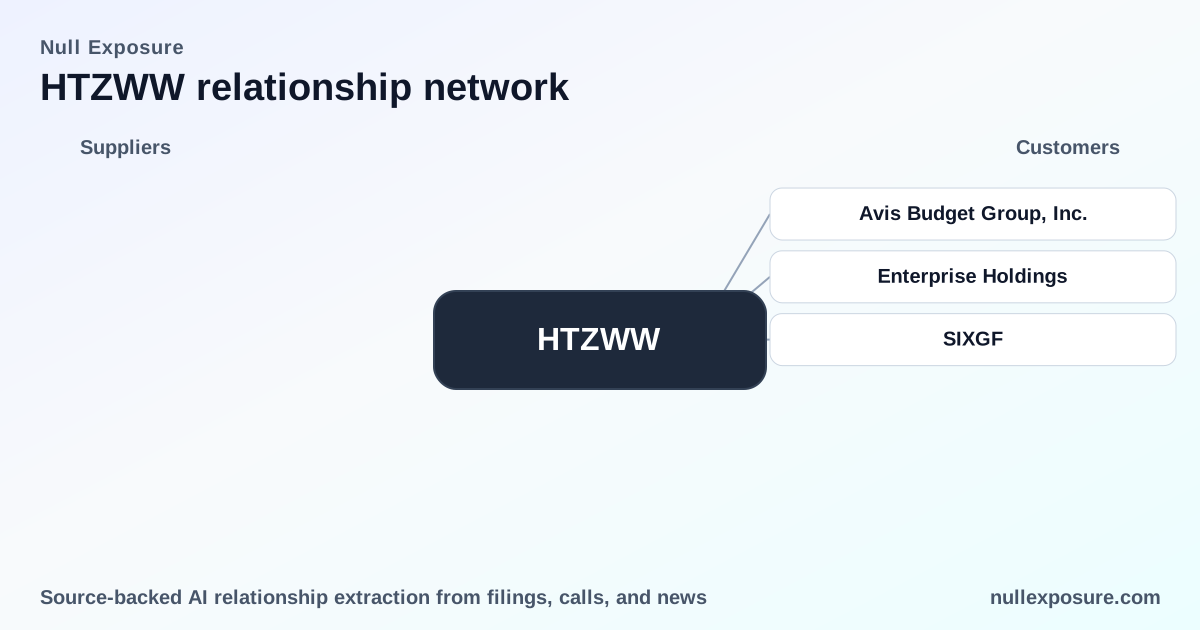
Hertz (HTZWW) — Customer Relationships and Commercial Risk Profile
Hertz operates a global vehicle rental business under the Hertz, Dollar and Thrifty brands and monetizes through transaction-based rentals, value‑added ancillaries and fleet dispositions. The company records revenue at the point of rental and captures incremental margin from insurance products, fuel/charging pass‑throughs, equipment rentals and retail vehicle sales; its reported trailing twelve‑month revenue was roughly $8.5 billion with positive EBITDA but negative operating margins, illustrating a high‑volume, low‑margin services business. For practitioners mapping counterparty exposure and commercial risk, the FY2024 10‑K is the authoritative source for the company’s customer relationships and operating constraints. For a broader partner mapping platform, see https://nullexposure.com/.
Competitive set: who Hertz calls its peers and why that matters
Hertz explicitly identifies a narrow set of global competitors in FY2024. These firms define pricing dynamics, channel strategies and product positioning for the rental market, and they are central to any counterparty or competitive risk analysis.
Avis Budget Group, Inc.
Hertz names Avis Budget Group as a principal vehicle rental industry competitor, noting Avis operates the Avis, Budget, Zipcar and Payless brands; this highlights direct competition across price points and the shared channel mix of airport and off‑airport locations. According to Hertz’s FY2024 Form 10‑K, Avis Budget Group is listed among principal competitors (FY2024, 10‑K).
Enterprise Holdings
Enterprise Holdings is identified by Hertz as a principal competitor that operates Enterprise Rent‑A‑Car, National and Alamo brands, underscoring competitive pressure on corporate and replacement rental channels. Hertz lists Enterprise Holdings explicitly in its FY2024 Form 10‑K as a primary peer (FY2024, 10‑K).
SIXGF
Hertz’s FY2024 disclosure refers to SIXT (captured in the data feed with the inferred symbol SIXGF), identifying the SIX group as a principal competitor in global markets and signaling competition in Europe and other international markets where fleet mix and pricing choices differ materially. The FY2024 Form 10‑K includes SIXT in its competitor list (FY2024, 10‑K).
SIXT
SIXT is separately recorded in the relationship results and is also listed in the FY2024 10‑K as a principal vehicle rental competitor, reinforcing the importance of European and international pricing dynamics and regulatory regimes on Hertz’s international margins. Hertz names SIXT specifically in its FY2024 Form 10‑K (FY2024, 10‑K).
How Hertz’s contracts and commercial posture shape counterparty economics
Hertz’s customer contracts are dominated by short‑term, usage‑based transactions, but the company’s disclosures also reflect long‑term financing instruments and franchise licensing arrangements that introduce longer maturity exposures into the business.
- Short‑term, transaction economics dominate. The 10‑K repeatedly describes rental periods as daily, weekly or monthly and defines “Transaction Days” as the basic unit of revenue recognition, establishing a transactional revenue model driven by utilization and price per day (FY2024, 10‑K).
- Usage‑based pricing is core. Rental charges are computed on limited/unlimited mileage or time‑plus‑mileage bases and Hertz explicitly charges variable services (tolls, refueling, recharging) as pass‑throughs, reinforcing per‑use revenue variability (FY2024, 10‑K).
- Longer‑dated financial obligations coexist with transactional sales. The company’s filings document multi‑year financing instruments (e.g., HVF III notes and long‑dated public warrants), indicating a capital structure with longer maturity liabilities alongside highly variable operating cash flows (FY2024, 10‑K).
- Licensing/franchise channels exist at scale. Franchise licenses are contractually structured with fees and limited transferability, creating a mixed company‑operated and licensee distribution model for international coverage (FY2024, 10‑K).
These attributes create a commercial profile: high transaction volume, seasonal demand swings, and an operating cash flow profile sensitive to utilization, pricing and fleet residual values.
Geography, concentration and materiality — where counterparty risk concentrates
Hertz is a global operator with a material concentration in the Americas and heavy exposure to airport travel patterns.
- Global footprint with U.S. concentration. The company runs roughly 11,200 locations across ~160 countries, but Americas revenues dominate — U.S. revenues accounted for the majority of the $9.0 billion reportable total in 2024 (FY2024, 10‑K).
- Airport channel is material. Airport revenues represented 69% of segment revenue in 2024, a single channel concentration that links Hertz’s fortunes tightly to airline passenger volumes and airport concession regimes (FY2024, 10‑K).
- Loyalty program drives repeat business. Hertz Gold Plus Rewards accounted for approximately 30% of worldwide rental transactions in 2024, making loyalty members a predictable revenue cohort and a material commercial asset (FY2024, 10‑K).
These geographic and channel concentrations are company‑level signals that influence counterparty exposure — suppliers and institutional partners should price for seasonal volatility and airport‑driven demand shocks.
Operational roles, spend scale and relationship lifecycle
Hertz’s disclosures identify multiple commercial roles and spend scales that are relevant when sizing exposure.
- Seller of services (primary). Hertz’s core role is the seller of vehicle rentals and value‑added services; the company recognizes revenues at point of sale and passes through many operating fees to customers (FY2024, 10‑K).
- Service provider and license granularity. Hertz is both a service provider to end customers and a licensor to franchisees; franchise license economics and royalties create recurring, contractually defined cash flows (FY2024, 10‑K).
- High spend bands tied to fleet economics. Proceeds from vehicle disposals and large fleet expenditures put Hertz into the >$100 million transactional class for vehicle capital flows in 2024, indicating counterparty relationships with significant notional volumes (FY2024, 10‑K).
- Relationship stage: active, with pockets winding down. Most customer and channel relationships are active; the company also recorded an EV disposal program in 2024 that is in the later stages of execution, signaling tactical portfolio rebalancing (FY2024, 10‑K).
Key operational risk: fleet residual value and utilization drive free cash flow; investors and partners must underwrite variability rather than fixed recurring revenue.
What investors and operators should watch next
- Monitor airport passenger volumes and regulatory changes affecting concession pass‑throughs and pricing disclosure; airport concentration is the single biggest channel risk (FY2024, 10‑K).
- Track fleet lifecycle and residual values, particularly EV disposition progress, because fleet economics are the largest driver of depreciation and cash flow (FY2024, 10‑K).
- Follow loyalty program adoption and digital check‑in rollout as retention levers that support pricing power and reduce transaction frictions (FY2024, 10‑K).
For teams mapping counterparty concentration and supplier exposure, Null Exposure’s partner analytics can accelerate due diligence and screening: https://nullexposure.com/.
Bottom line — commercial grading of Hertz’s customer profile
Hertz operates a transactional, usage‑priced services business with significant channel concentration and global scale. Competitive pressure from Avis, Enterprise and SIXT constrains pricing power, while the company’s mix of short‑term rentals and large‑scale fleet capital flows creates both high revenue throughput and sensitivity to macro travel cycles. Investors and commercial partners must underwrite seasonal volatility, concentrated airport exposure and fleet residual risk when sizing counterparty limits or negotiating terms.
All relationship references above are drawn directly from Hertz’s FY2024 Form 10‑K (filed as the 2024 annual report), which provides the primary source text for the competitor list, contract descriptions and the operational excerpts cited throughout this review.