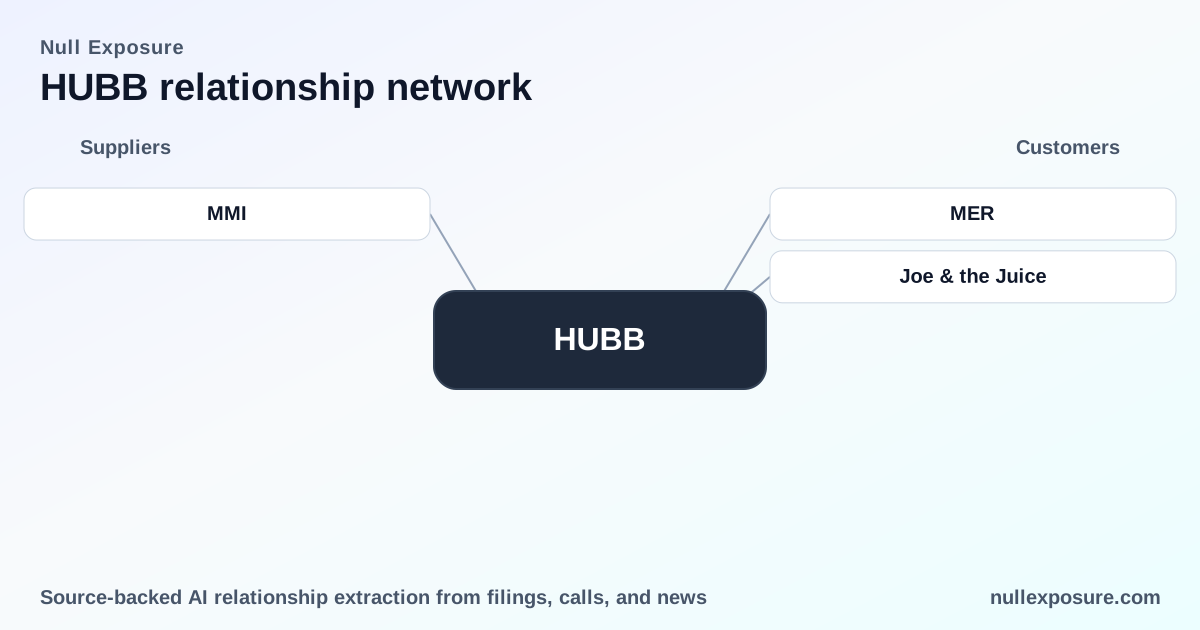
Hubbell (HUBB) — customer relationships that drive recurring utility work and distributor reach
Hubbell Inc. designs, manufactures and sells electrical and electronic products and monetizes through a dual model: volume sales of critical electrical hardware to distributors and contractors plus targeted, longer-duration utility programs that include smart meters and installation services. The company captures margin through branded component sales and recurring utility deployment contracts, while its top customers and distributor network concentrate revenue and create predictable backlog in the Utility Solutions segment.
For a concise institutional view of Hubbell's customer footprint and how it translates to revenue risk and runway, read on — and for deeper relationship analytics, visit https://nullexposure.com/ for additional coverage.
How Hubbell’s customer model actually works
Hubbell’s core commercial engine is straightforward: product-led distribution with strategic utility contracts. Approximately two-thirds of net sales flow through distributors who resell Hubbell’s electrical and industrial products into commercial, industrial and residential channels, while the Utility Solutions segment wins multi-month and multi-year contracts to deliver and often install meters and grid-monitoring devices. Revenue recognition is primarily point-in-time for shipped product, while a distinct but smaller portion of business carries multi-year contractual obligations and post-shipment service performance.
Key financial characteristics reinforce this model: top ten customers account for roughly 42% of sales, signaling meaningful concentration, while international sales are modest (about 7–8% of net sales). Services-related revenue is negligible as a share of total (<1%), implying hardware-driven margin dynamics and a reliance on distributors and utility contract wins for growth.
What the recent relationship signals tell investors
Below I summarize every customer relationship item surfaced in the underlying results, with the original source noted for verification.
-
MER (inferred symbol MER): A Hubbell subsidiary, Aclara Meters, signed a major supply agreement to deploy over 72,000 smart meters in 2026 as part of a grid modernization program. According to an ABS-CBN News social post on March 10, 2026, the contract is structured as a supply agreement for a large-scale meter rollout. (ABS‑CBN News / Facebook, Mar 10, 2026)
-
Meralco: The Manila Electric Company (Meralco) engaged Hubbell’s Aclara Meters for the deployment of 72,000+ smart meters in 2026 to modernize distribution infrastructure. This is a direct utility-supply relationship that aligns with Hubbell’s Utility Solutions backlog and meter-delivery capabilities. (ABS‑CBN News / Facebook, Mar 10, 2026)
-
Joe & the Juice: A retail tenant, Joe & the Juice, occupies a 1,550‑square‑foot ground-floor retail space under a corporate‑guaranteed lease through December 31, 2032 in a property sold by HUBB NYC; the lease provides stable retail cash flow tied to Hubbell’s property transaction noted in a YieldPro article. (YieldPro, Feb 2026)
Interpreting these relationships for revenue and risk
-
Utility contracts drive predictable, higher‑value backlog. The Meralco/Aclara meter rollout illustrates how Hubbell converts utility modernization demand into measurable units of backlog and revenue recognition during shipment and installation windows. Utility engagements of this type are consistent with the company’s stated multi-year, install-and-deliver contracts in the Utility Solutions segment.
-
Distributor concentration amplifies scale but concentrates counterparty risk. With roughly two-thirds of net sales routed through distributors and the top ten customers representing about 42% of sales, Hubbell’s model scales efficiently but creates reliance on a limited set of large buyers. This concentration increases the impact of any material variability in purchases by utilities or major distributors.
-
International exposure is limited and not a major volatility driver. Foreign operations accounted for around 7–8% of net sales across recent years, keeping Hubbell primarily exposed to North American demand cycles.
Constraints that shape Hubbell’s contracting posture and maturity
Hubbell’s own disclosures and the extracted constraints paint a cohesive picture of operating dynamics:
-
Contracting posture: Mixed — predominantly spot product sales with pockets of long-term contracts. Most product revenue is recognized at shipment (point-in-time), but the Utility Solutions backlog includes longer-term contracts, with approximately $20 million of multi‑year backlog tied to meter and grid sensor delivery and installation. This hybrid posture supports steady cash conversion while enabling higher-margin multi-year utility programs.
-
Concentration: Notable at the top end. The top ten customers drive ~42% of net sales, which is a material concentration even as management states the company is not dependent on any single customer.
-
Criticality: High for infrastructure customers and utilities. Products serve critical electrical infrastructure and building operations — failure or supply disruption would have outsize operational impacts for end customers, reinforcing Hubbell’s importance to its buyer base.
-
Maturity and spend profile: Mature market with mid-to-high spend utility contracts. The $20 million multi-year backlog in Utility Solutions positions Hubbell to capture mid-range program spend (estimated in the $10–100M spend band for program-level commitments) while the dominant business remains transactional hardware sales.
-
Channel structure: Distributor/reseller-led go-to-market. Approximately two-thirds of net sales pass through distributors, and products are commonly sold through industrial distributors, retailers and home centers. Services and post-shipment obligations are a small fraction of total revenue, concentrated in Utility Solutions.
These constraints support a thesis that Hubbell will continue to generate predictable, hardware-driven cash flow with episodic upticks from utility meter programs, while facing concentration and distributor-channel risks that investors must monitor.
Practical takeaways for investors and operators
-
Growth lever: Utility modernization programs — like the Meralco meter rollout — are the most direct route to above-trend revenue and higher backlog visibility for Hubbell. Such wins validate Aclara’s position in the utility market and translate into near-term shipments.
-
Risk lever: Customer concentration and reliance on distributor networks create cyclical exposure; a substantial drop in purchases by top customers or utilities would meaningfully affect results.
-
Balance sheet implication: The mix of point-in-time revenue and a modest pool of multiyear utility contracts supports strong cash conversion but limits high-margin recurring revenue, keeping valuation sensitive to top-line growth assumptions.
For a deeper mapping of Hubbell’s customer relationships and contractual exposure, see more analysis at https://nullexposure.com/.
Final judgment
Hubbell’s relationships combine scale through distribution with targeted utility contracting that lifts revenue certainty during program cycles. Investors should view the company as a hardware-centric industrial with predictable core cash flows, punctuated by utility contract-driven growth opportunities and measurable concentration risk that requires ongoing monitoring of top-customer activity and utility program awards.