HUBCZ: Blue-chip clients anchor a services-heavy cyber security profile
Hub Cyber Security monetizes through a combination of legacy professional services and ongoing cyber consultancy alongside its product offerings, selling to customers in Israel and internationally; the company’s services business provides a relatively stable revenue base while product-led growth determines future scalability. For investors and operators evaluating HUBCZ customer relationships, the most actionable signal is that Hub explicitly cites high-profile clients (Visa and Boeing) in its services book, which supports revenue predictability but also highlights concentration and disclosure gaps worth monitoring. Visit https://nullexposure.com/ for related intelligence and monitoring tools.
How Hub Cyber Security operates and where revenue comes from
Hub Cyber Security is a Tel Aviv–headquartered cyber security provider that generates revenue from a mix of consulting, professional services, and security solutions sold to enterprise customers. The company reports Revenue TTM of $28.97 million and Gross Profit TTM of $4.83 million, while operating metrics remain under pressure—EBITDA is negative at -$27.99 million and operating and profit margins are negative—signaling that the business still invests heavily in go-to-market and product development. HUBCZ trades as a warrant instrument on NASDAQ, which complicates direct market-cap comparisons; reported shares outstanding are listed as zero while reported float is 12,380.
Client roster: Boeing and Visa — what the filings say
Hub’s most visible customer references are concentrated in its descriptions of the legacy professional services business. The company explicitly names Boeing and Visa as long-term, blue-chip customers in investor-facing commentary.
-
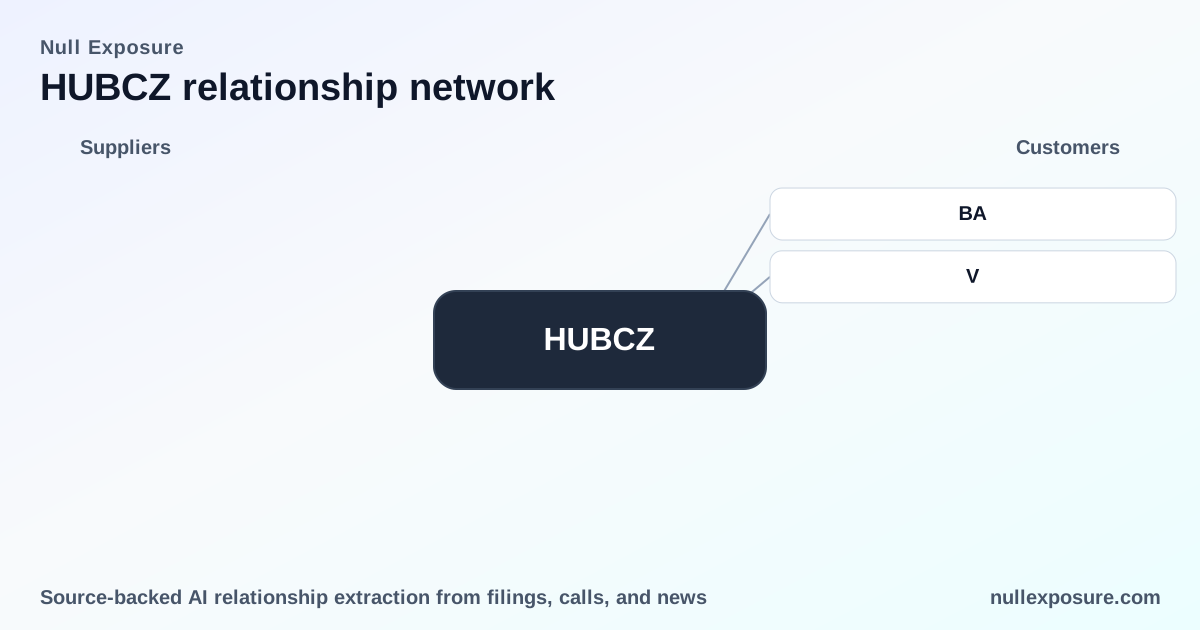
Boeing — Hub lists Boeing among its blue-chip professional services customers, describing legacy consultancy work that provides a stable revenue stream for the company. This disclosure comes from the company’s earnings call covering fiscal period 2024 Q2, where management highlighted strong long-term relationships with clients like Boeing.
Source: earnings call (2024 Q2), company commentary published March 2026. -
V (ticker V) — One results entry lists the entity "V" with inferred symbol V, reflecting the same earnings-call language that groups Visa and Boeing as blue-chip clients within Hub’s professional services practice. The reference reinforces that Hub positions payments-industry relationships as part of its stable services book.
Source: earnings call (2024 Q2), company commentary published March 2026. -
Visa — Visa is explicitly named alongside Boeing in Hub’s earnings-call narrative as an example of a blue-chip client driving stable professional services revenue; the mention signals penetration into payments infrastructure and related security assignments.
Source: earnings call (2024 Q2), company commentary published March 2026.
Each of the three result entries in the customer record references the same earnings-call language; Hub frames these customers as components of a stable, legacy services revenue stream rather than as product-platform anchors.
What the customer list implies about contracting posture and concentration
The public references and financial profile together paint a clear operating posture:
- Contracting posture — relationship-oriented, services-first. The company emphasizes legacy consultancy relationships, indicating long-duration engagements and retainer-style or project-based contracts rather than purely transactional product sales.
- Concentration — meaningful single-client risk potential. With blue-chip names singled out in investor communications but limited public contract detail, revenue concentration is a possible risk given the company’s modest absolute revenue base (~$29M TTM).
- Criticality — client-specific and situational. Engagements with Visa and Boeing signal access to mission-critical environments, but the disclosure does not confirm whether Hub provides core security infrastructure or supplemental, specialized consultancy—so investor focus should be on contract scope and renewal visibility.
- Maturity — legacy services stabilizing base revenue, products needed for scale. Management’s own wording frames these clients as part of a legacy services business; that suggests a revenue floor that can sustain operations while products and platform efforts are scaled.
No explicit contractual constraints or public constraint excerpts are available in the reviewed customer records, which is itself an important company-level signal: limited public detail on contract length, revenue share by customer, or termination provisions increases investor reliance on relationship disclosures and management commentary.
Financial implications and operational levers investors should track
Hub’s customer disclosures interact directly with its financial profile:
- Stability vs. scale trade-off. Blue-chip services clients provide recurring project and consultancy revenue that stabilizes near-term cash flows, but the company’s negative EBITDA indicates that service revenue alone has not produced operating leverage. Growth to meaningful profitability requires successful product adoption or materially larger service engagements.
- Visibility risk. Because client names are promoted without contract specifics, investors must monitor renewal cadence, contract size, and cross-sell potential to assess revenue durability.
- Instrument-level complexity. HUBCZ is a warrant, not common equity; reported shares outstanding are zero and float is extremely small, which affects liquidity and complicates valuation comparisons to equity peers.
Key metrics to watch in subsequent filings and calls: customer-level revenue breakdown, contract durations, percent revenue from top customers, and movement of gross margin as product revenue scales.
Risks and catalysts framed for investors
- Risk — customer concentration and disclosure opacity. The company’s explicit naming of Visa and Boeing indicates important relationships, but the absence of contract detail leaves renewal and concentration risk inadequately quantified.
- Risk — financial leverage of growth. Negative EBITDA and margins imply Hub is funding growth or restructuring; continued losses without accelerating product revenue pose dilution or financing risks.
- Catalyst — converting services relationships into platform sales. If Hub translates its consultancy footprint at Visa, Boeing and similar customers into recurring product contracts, margins and valuation multiples will re-rate upward.
- Catalyst — public disclosure of contract economics. Improved transparency on revenue by client and contract terms would materially reduce investor uncertainty.
Practical next steps for operators and allocators
Operators performing diligence should prioritize direct verification of contract terms, renewal schedules, and the extent to which Hub’s services deliveries are embedded into client operational security stacks. Allocators should demand customer-level revenue disclosures and monitor upcoming earnings commentary for explicit conversion metrics from services to product revenue.
For continuous monitoring and deeper customer-relationship mapping, consider vendor intelligence tracked across earnings calls and filings at https://nullexposure.com/. A mid-cycle check on the company’s next investor presentation or quarterly release will likely reveal whether the Visa and Boeing mentions translate into measurable, predictable revenue streams.
Conclusion: Hub Cyber Security’s public customer narrative emphasizes blue-chip, services-driven stability, which is valuable for downside protection; however, concentration, limited contract disclosure, and continued negative operating performance keep upside contingent on product adoption and improved financial leverage. Investors should treat the Visa and Boeing mentions as meaningful relationship signals, and seek concrete contract data before assigning material revenue certainty.