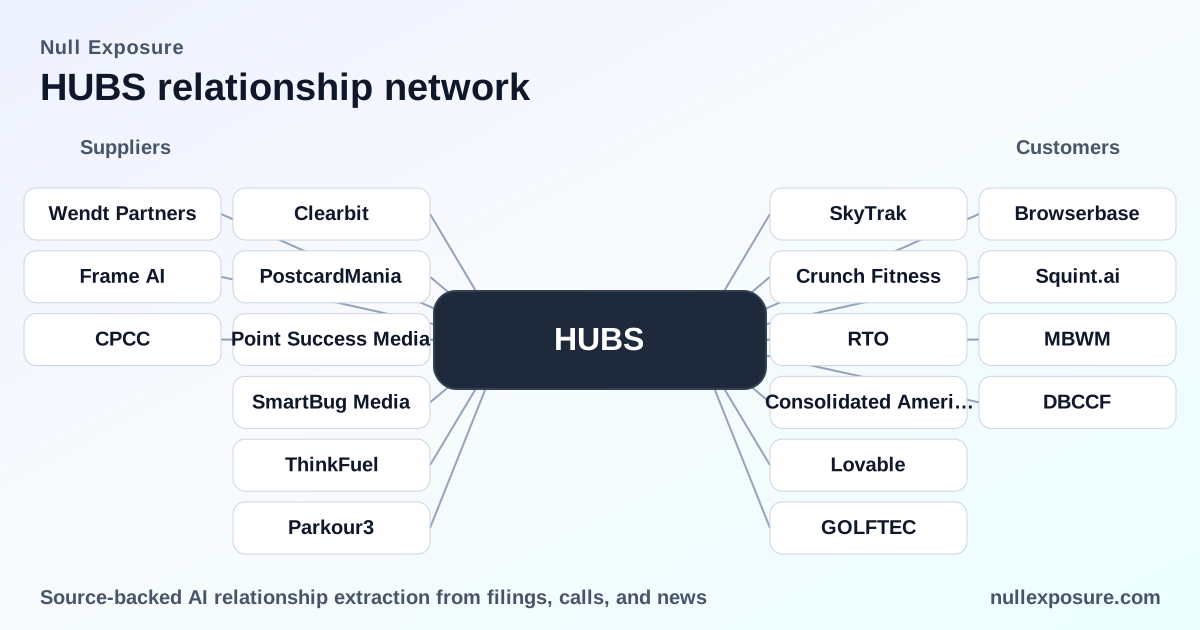
HubSpot’s customer map: monetization through scale, subscriptions and platform expansion
HubSpot operates a cloud-native CRM and growth platform sold primarily on a subscription basis to B2B customers across the Americas, EMEA and APAC; the company monetizes through recurring license fees supplemented by onboarding, professional services and premium modules (Marketing, Sales, Service, Content). For investors, the business is a high-velocity, mid-market SaaS engine with a global footprint, rapid product-led expansion into enterprise use cases and a large installed base driving cross-sell. Learn more at https://nullexposure.com/.
How the customer disclosures reveal the operating model investors should value
HubSpot’s disclosures and call commentary show a consistent operating posture: subscription-first, short-duration contracts, concentrated mid‑market focus, and global scale. Subscription revenue accounted for 98% of total revenue, signaling that recurring fees are the company’s critical cash engine. The company counts 288,706 paid customers across more than 135 countries and reports an average subscription revenue per customer roughly consistent with a sub-$100k spend band, which supports a high-volume go-to-market model that prioritizes product adoption and automated expansion.
Other important company-level signals:
- Contracting posture: The platform is sold primarily as annual subscriptions, with many contracts one year or less, supporting predictable near-term revenue and ongoing upsell prospects.
- Customer mix: HubSpot targets mid-market B2B customers (2–2,000 employees) while retaining exposure to both small businesses and large enterprises, enabling both scale and occasional enterprise deal economics.
- Product mix and motion: The value proposition combines software with professional services and customer success to accelerate adoption and drive multi-hub expansion.
- Geographic diversification: Revenue streams are global (Americas, EMEA, APAC), reducing single-region dependence while creating execution complexity for localized sales and compliance.
If you want a consolidated analysis and access to the underlying relationship signals, visit https://nullexposure.com/ for full coverage.
Client-level evidence from recent filings and call transcripts
Below are the customer relationships disclosed in HubSpot’s Q4 2025 earnings commentary and related coverage. Each entry is a plain-English take with the cited source.
Crunch Fitness
Crunch Fitness used HubSpot to execute high-volume, personalized email programs—sending more than 15 million targeted emails per month and generating 2 million leads in a year, demonstrating HubSpot’s capacity for marketing scale in multi-location retail brands. Source: HubSpot Q4 2025 earnings call (transcript, March 2026).
SkyTrak
SkyTrak piloted HubSpot’s Customer Agent, starting with 10,000 support chats per month, illustrating an early-stage use of HubSpot’s conversational service tooling for product-led customer support. Source: HubSpot Q4 2025 earnings call (March 2026).
Vault‑Tec
Mentioned alongside SkyTrak in the pilot program, Vault‑Tec participated in the Customer Agent pilot with similar volumes, showing HubSpot’s traction with brands that require high-frequency chat support. Source: HubSpot Q4 2025 earnings call (March 2026).
Rentokil Initial (RTO)
Rentokil used Marketing Hub to increase leads by 76% and realize a 671% ROI, then expanded HubSpot enterprise capabilities across more than 100 teams, signaling a clear path from marketing success to enterprise-wide adoption. Source: Q4 2025 earnings call transcript as reported by The Globe and Mail and InsiderMonkey (March 2026).
Consolidated American Telbank
Consolidated American Telbank consolidated six separate solutions onto Marketing Hub, then expanded to Sales Hub, Service Hub and Content Hub while replacing a legacy CRM, showing HubSpot’s ability to displace legacy systems and create a unified customer view for financial institutions. Source: The Globe and Mail coverage of HubSpot’s Q4 2025 earnings transcript (March 2026).
Mercantile Bank (MBWM)
Mercantile Bank consolidated six different solutions onto Marketing Hub, saw immediate efficiency gains and expanded into additional hubs—mirroring HubSpot’s bank/financial-institution play where cost reduction and personalization drive expansion. Source: HubSpot Q4 2025 earnings call and InsiderMonkey transcript (March 2026).
Browserbase
Browserbase is cited as an AI-native growth customer choosing HubSpot to drive go-to-market expansion, indicating HubSpot’s resonance with emerging software-first companies. Source: The Globe and Mail transcript of HubSpot’s Q4 2025 earnings (March 2026).
Lovable
Lovable is listed among AI-native adopters selecting HubSpot’s platform to support growth, which confirms HubSpot’s positioning as the growth stack for digital-native startups. Source: HubSpot Q4 2025 transcript coverage (The Globe and Mail / InsiderMonkey, March 2026).
Squint.ai
Squint.ai, another AI-native company referenced in call coverage, underscores adoption momentum among companies focused on AI-driven customer experiences. Source: The Globe and Mail transcript of the Q4 2025 earnings call (March 2026).
GOLFTEC
GOLFTEC participated in the Customer Agent pilot alongside SkyTrak, using HubSpot to handle 10,000 support interactions per month, validating HubSpot’s suitability for service-heavy consumer brands with centralized support operations. Source: The Globe and Mail and HubSpot Q4 2025 earnings call (March 2026).
Decibel (DBCCF)
Decibel, an AI-powered learning platform with over 1,000 employees, shifted toward AEO strategies and used HubSpot to improve LLM visibility, with 13% of leads coming from new AI-driven sources—evidence that HubSpot’s platform supports discovery in modern AI search channels. Source: HubSpot Q4 2025 earnings call and InsiderMonkey transcript (March 2026).
ZM (Zoom reference)
An SEC filing from FY2019 for another company’s marketplace mentions HubSpot as an integrated app in an app marketplace (alongside Microsoft Teams and YouTube), illustrating HubSpot’s early ecosystem presence in platform app markets. Source: SEC filing (S-1, FY2019).
NIXXW
A FY2024 10‑K for NIXXW references HubSpot among commercially available recruiting, communications and marketing systems, showing HubSpot’s common inclusion in enterprise software inventories. Source: NIXXW 10‑K (FY2024).
What this customer evidence implies for investors
- Expansion motion is real and repeatable. Case studies (Rentokil, Mercantile Bank, Consolidated American Telbank) show Marketing Hub often initiates multi-hub enterprise rollouts, which drives higher lifetime value per customer.
- Scale across customer sizes: HubSpot’s product supports both AI-native startups and large, multi-team enterprise deployments, consistent with the company’s stated mid-market core but demonstrated enterprise credibility.
- Revenue predictability with active upsell channels: The combination of annual subscriptions, services, and measurable ROI examples supports a recurring revenue base with durable expansion opportunities.
Risk and monitoring checklist for operators and investors
- Concentration on subscription economics: With subscription revenue representing 98% of total revenue, any material change in renewal behavior or large-scale downgrades will directly pressure top-line stability.
- Short-term contract exposure: Many contracts are one year or less, making the business sensitive to churn cycles and quarter-to-quarter retention.
- Execution complexity from global scale: Operating across 135+ countries generates currency, compliance and go-to-market execution risks that investors must monitor.
For institutional users who want a consolidated playbook—customer signals, contractual posture and expansion vectors—Nillexposure’s platform provides chronological relationship evidence and analytics at scale: https://nullexposure.com/.
Key takeaway: HubSpot’s customer narrative is a virtuous loop—product-led adoption, measurable marketing ROI, and multi-hub expansion—anchored by a subscription-first model that is both the firm’s primary strength and its primary exposure.