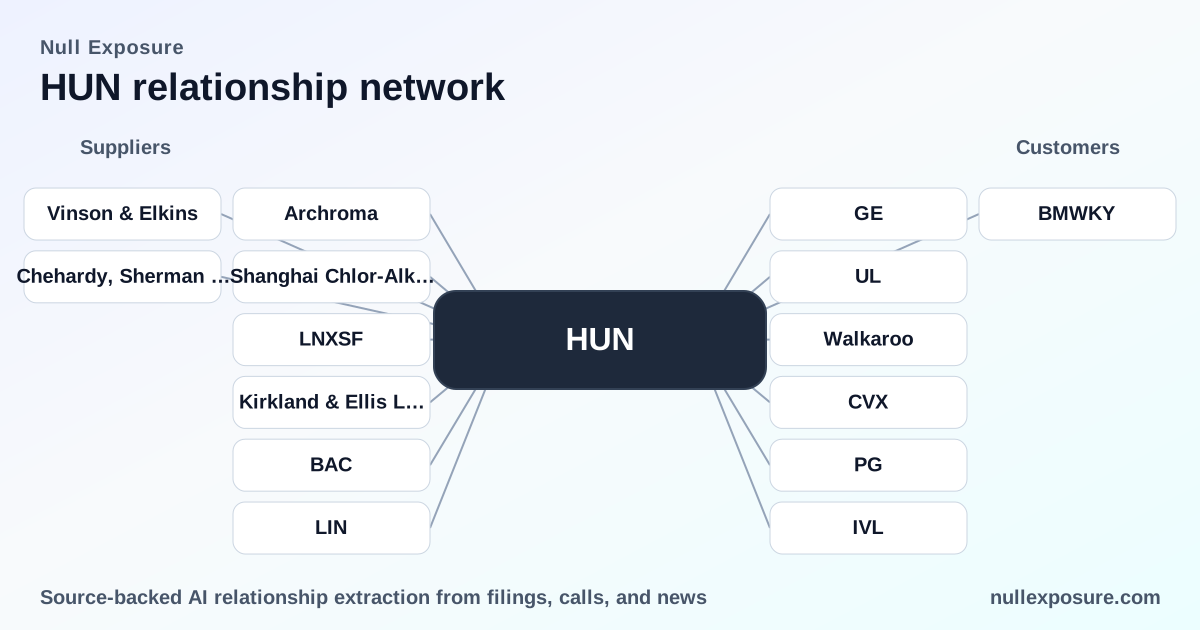
Huntsman Corporation (HUN): customer relationships that underwrite a differentiated chemicals franchise
Huntsman manufactures and sells differentiated organic chemicals—MDI, polyols, TPUs and specialty resins—monetizing through a combination of spot product sales and long-term supply agreements with industrial customers and formulators around the world. The company operates global manufacturing and formulation assets and captures value by selling engineered chemical building blocks and branded formulations to large OEMs, consumer goods firms and smaller downstream converters. For investors, the customer map is a mix of high-quality, large enterprise relationships that secure volume and technical lock‑in, plus a long tail of smaller accounts that smooth exposure to end‑market cyclicality.
For an investor-oriented view of Huntsman’s customer exposures and relationship signals, see https://nullexposure.com/.
What the customer list tells you in one line
Huntsman’s customers span major industrial conglomerates and consumer names—large-enterprise, strategic supply positions coexist with thousands of small and regional buyers, producing revenue resilience but leaving the firm exposed to cyclical end markets and localized production risk.
How Huntsman contracts and where the risk lives
Huntsman’s disclosures and public reporting convey a hybrid contracting posture:
- Long-term supply agreements exist for engineered and qualified materials that require technical support and reliable global supply; revenue from these is often recognized at a point in time at shipment.
- Short payment terms and receivables programs are used operationally (U.S. and EU A/R SPEs and trade receivable transfers), signaling active working capital management and some dependence on structured receivables financing.
- Huntsman licenses IP selectively and sub‑licenses technology where relevant, and also sells through a network of distributors to reach smaller end users.
- Geographically diversified revenue streams (North America, EMEA, APAC) reduce single‑market concentration but increase exposure to currency and regional regulatory risk.
- Relationship maturity skews mature and active: the company emphasizes long-standing customer supply positions and technical service as competitive strengths.
These characteristics create a commercial profile where strategic large customers drive predictable volumes, while the long tail and cyclicality in commodity components generate margin volatility.
See more on commercial signals at https://nullexposure.com/ (company profile and relationship analytics).
Relationship inventory — every mention in the public results
Below I list each relationship found in public reporting and news items, with a short plain‑English summary and the source cited.
-
GE — Huntsman is listed among major industrial and consumer customers including GE; the mention supports Huntsman’s position as a supplier to diversified industrial OEMs. Source: InsiderMonkey (earnings preview), March 10, 2026 — https://www.insidermonkey.com/blog/huntsman-hun-climbs-13-ahead-of-earnings-1688686/
-
Chevron — Chevron appears on the same customer list cited in recent press, indicating Huntsman supplies chemical inputs to energy‑sector and industrial customers. Source: InsiderMonkey (March 10, 2026) — https://www.insidermonkey.com/blog/huntsman-hun-climbs-13-ahead-of-earnings-1688686/
-
Unilever — Unilever is named among end‑market consumer goods customers, reflecting Huntsman’s exposure into formulated consumer products and packaged‑goods supply chains. Source: InsiderMonkey (March 10, 2026) — https://www.insidermonkey.com/blog/huntsman-hun-climbs-13-ahead-of-earnings-1688686/
-
Walkaroo — Walkaroo is mentioned as an end customer in the same press item, illustrating Huntsman’s engagement with regional or branded footwear manufacturers. Source: InsiderMonkey (March 10, 2026) — https://www.insidermonkey.com/blog/huntsman-hun-climbs-13-ahead-of-earnings-1688686/
-
Procter & Gamble — P&G sits on the cited customer list, underscoring Huntsman’s role as a supplier into major consumer packaged goods companies. Source: InsiderMonkey (March 10, 2026) — https://www.insidermonkey.com/blog/huntsman-hun-climbs-13-ahead-of-earnings-1688686/
-
BMW — News coverage lists BMW among Huntsman’s customers, consistent with the firm’s supply of polyurethane and specialty materials into automotive OEMs. Source: Finviz (news wire), May 3, 2026 — https://finviz.com/news/303519/huntsman-corporation-hun-soars-24-ahead-of-earnings
-
Chevron (repeat mention) — The Finviz wire repeats Chevron on Huntsman’s customer roster, reinforcing that the relationship is cited across media outlets. Source: Finviz, May 3, 2026 — https://finviz.com/news/303519/huntsman-corporation-hun-soars-24-ahead-of-earnings
-
GE (repeat mention) — The Finviz report also includes GE on the customer list, confirming cross‑publication consistency. Source: Finviz, May 3, 2026 — https://finviz.com/news/303519/huntsman-corporation-hun-soars-24-ahead-of-earnings
-
Procter & Gamble (repeat mention) — P&G is again cited by Finviz as a named customer. Source: Finviz, May 3, 2026 — https://finviz.com/news/303519/huntsman-corporation-hun-soars-24-ahead-of-earnings
-
Unilever (repeat mention) — Unilever appears in the Finviz summary as well, consistent with other press. Source: Finviz, May 3, 2026 — https://finviz.com/news/303519/huntsman-corporation-hun-soars-24-ahead-of-earnings
-
Steitz Secura — Huntsman partnered with footwear firm Steitz Secura to develop a recycled‑content polyurethane midsole called Daltoped for protective footwear, demonstrating product development and sustainability applications in downstream footwear. Source: TheCooldown summarizing Women’s Wear Daily, May 2026 — https://www.thecooldown.com/green-business/daltoped-recycled-materials-polyurethane-footwear/
-
Airbus — In an earnings call transcript, Huntsman referenced aerospace customers including Airbus and expects aerospace volume growth to track above aircraft production rates, signaling long‑term qualified supplier status in aerospace composites and adhesives. Source: InsiderMonkey (Q4 2025 earnings call transcript), May 3, 2026 — https://www.insidermonkey.com/blog/huntsman-corporation-nysehun-q4-2025-earnings-call-transcript-1699014/
-
Boeing — The same earnings discussion cited Boeing alongside Airbus as end customers, confirming Huntsman’s strategic positioning in aerospace materials. Source: InsiderMonkey (Q4 2025 transcript), May 3, 2026 — https://www.insidermonkey.com/blog/huntsman-corporation-nysehun-q4-2025-earnings-call-transcript-1699014/
-
IVL — Coverage dating to 2022 records Huntsman’s prior divestiture of its commodity chemical business to Indorama (IVL) for roughly $2 billion, a transaction that reshaped the company’s customer and product mix. Source: Chemical & Engineering News (C&EN), January 2022 — https://cen.acs.org/business/finance/Huntsman-pressured-activist-investor/100/web/2022/01
-
Indorama (duplicate listing) — The transaction to Indorama Ventures is referenced again in the same C&EN report, highlighting a strategic portfolio shift away from commodity chemicals. Source: C&EN, January 2022 — https://cen.acs.org/business/finance/Huntsman-pressured-activist-investor/100/web/2022/01
-
Walkaroo (Finviz repeat) — Walkaroo is also listed in the Finviz wire alongside global customers, reinforcing multiple press mentions. Source: Finviz, May 3, 2026 — https://finviz.com/news/303519/huntsman-corporation-hun-soars-24-ahead-of-earnings
-
BMWKY / BMW (InsiderMonkey variants) — InsiderMonkey includes alternate mentions for BMW (BMWKY/BMWKY symbol variants) in its press pieces; these are consistent with other media references to automotive OEM exposure. Source: InsiderMonkey (March 10, 2026) — https://www.insidermonkey.com/blog/huntsman-hun-climbs-13-ahead-of-earnings-1688686/
Commercial implications and investor takeaways
- Concentration profile: Huntsman serves a small number of very large enterprise customers while also maintaining a broad base of smaller buyers. This combination supports scale but creates exposure to cyclical demand in automotive, aerospace and construction end markets.
- Contracting posture: Expect a mix of long‑term supply contracts for qualified, value‑added products and short‑term/spot sales for commodity components, with active receivable financing structures to manage working capital.
- Criticality and maturity: In strategic markets—especially aerospace and China—Huntsman operates critical, mature supply relationships supported by technical service and local formulation assets.
- Operational risk: Global manufacturing footprint and regulatory regime exposure (REACH, TSCA, local labeling and environmental rules) are meaningful risk vectors; prolonged production disruption can drive customer substitution.
For a structured view of customer exposures, invoice flows and counterparty signals used by institutional investors, visit https://nullexposure.com/.
Bold, well‑established customer relationships anchor Huntsman’s value proposition; the company’s commercial strength is its ability to combine technical differentiation, global supply and long-term customer commitments—but investors must price in cyclicality, working capital financing and regional regulatory risk when assessing the equity.