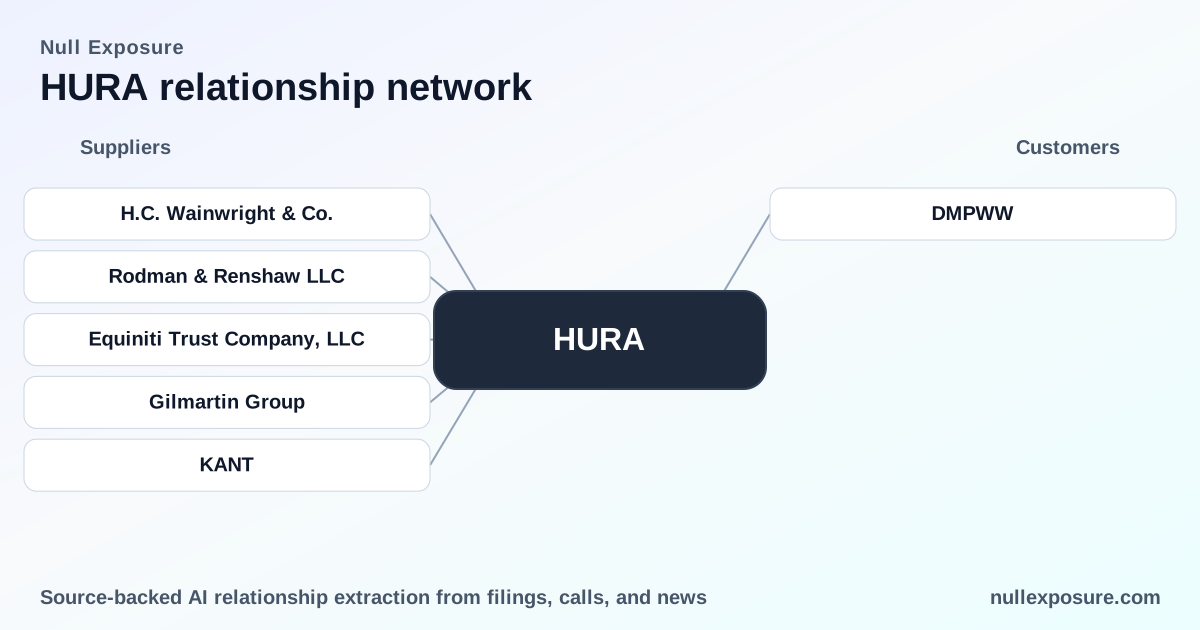
TuHURA Biosciences (HURA): customer relationships, cash mechanics and regulatory leverage
TuHURA Biosciences operates as a clinical‑stage immuno‑oncology company that monetizes progress primarily through financing events, equity issuances and licensing of its lead therapeutic programs prior to product revenue. Near‑term value inflection points for investors are driven by corporate transactions (warrant conversions, contingent share releases) and the company’s ability to secure regulatory approval and reimbursement rather than commercial sales today. For an investor or operator evaluating HURA customer/partner relationships, the mix is therefore financing and collaborator‑driven rather than end‑market commercial demand. Read more at https://nullexposure.com/.
Recent relationship activity: what investors should know first
TuHURA’s most visible relationship events in public media during FY2025–FY2026 relate to the treatment of legacy Kintara Therapeutics stockholders and the release of contingent equity tied to merger and contingent value milestones. These are corporate finance and shareholder‑related actions that affect share count, dilution and shareholder alignment rather than operating revenue.
DMPWW (inferred ticker for Kintara legacy listing)
A Futunn news item reported that the milestone triggering the release of 1,539,958 shares of TuHURA common stock to legacy Kintara Therapeutics stockholders has been achieved, which increases outstanding shares tied to the Kintara contingent value arrangement. According to the Futunn report dated March 10, 2026, the release follows the fulfillment of a pre‑specified contingency in the Kintara transaction. (Futunn news, March 10, 2026)
Kintara Therapeutics (legacy counterparty)
The same Futunn posting also named Kintara Therapeutics explicitly—confirming TuHURA’s post‑merger obligations to legacy Kintara stockholders and the conversion mechanics that transferred contingent value into TuHURA common stock. This transaction reflects TuHURA’s use of equity as a mechanism to satisfy legacy merger‑related commitments. (Futunn news, March 10, 2026)
How these relationships map into TuHURA’s operating and business model
The relationship events and the broader filings deliver consistent signals about TuHURA’s contracting posture, counterparty exposure, and commercial runway.
-
Contracting posture — short‑term liquidity and financing mechanics. Company disclosures list Warrant Exercise Notes due and payable on May 30, 2025, and describe secured promissory notes used to satisfy warrant exercise prices of roughly $3.0 million in aggregate, indicating reliance on short‑term financing instruments and equity‑based settlement mechanics rather than fully funded commercial revenue streams. (Company filing, 2025)
-
Counterparty concentration and criticality — government payors dominate the commercialization constraint. Filings repeatedly emphasize that coverage and reimbursement from government payors (Medicare/Medicaid) and managed care organizations are critical to commercial success. This positions TuHURA in a typical biotech risk profile where regulatory approval is necessary but not sufficient; obtaining acceptable government and private payor reimbursement is equally determinative of realized revenue. (Company filings; regulatory sections)
-
Counterparty types — individual clinicians and institutions matter. The company identifies physicians, hospitals and cancer centers as core adoption gatekeepers and flags transparency and payments rules that govern relationships with individual healthcare professionals—highlighting the operational focus on provider engagement once approvals are secured. (Regulatory and compliance excerpts)
-
Geographic footprint — multi‑jurisdictional commercial ambition. Filings stress regulatory, pricing and reimbursement complexity across North America, EMEA and global markets, signaling an explicit strategy to pursue multi‑region approvals and the attendant commercial/price‑control tradeoffs in Europe and other jurisdictions. (Regulatory sections; EMEA/NA/global excerpts)
-
Relationship roles — TuHURA acts as seller, buyer and manufacturer in different capacities. The disclosure set shows TuHURA issuing equity (seller of shares), using and receiving warrant exercise funds (buyer of capital), and preparing for the manufacturing, labeling and commercialization responsibilities that will follow potential FDA and foreign approvals. This tri‑role underlines the hybrid operational posture between corporate finance transactions and future commercial product operations. (Company filings)
-
Materiality and maturity — critical near‑term dependencies with early‑stage operations. The documents classify coverage and reimbursement as critical and the regulatory approval pathway as material, while simultaneously noting that the company currently has no product revenue and remains in early stages of clinical development—placing TuHURA squarely in a pre‑commercial, high‑leverage phase. (Company filings; financials)
-
Spend band and transaction scale. Public disclosures reference a specific secured promissory note aggregation of approximately $3.01 million tied to warrant exercises, which aligns with a $1M–$10M spend band for these corporate financing flows rather than recurring commercial AR or procurement spending. (Company filing, February 12, 2025)
Relationship table: every counterpart covered (concise takeaways)
-
DMPWW — The Futunn report identifies the release of 1,539,958 TuHURA shares under a contingent value arrangement associated with legacy Kintara obligations; this is a shareholder dilution and settlement event executed as equity rather than cash. (Futunn news, March 10, 2026)
-
Kintara Therapeutics — TuHURA completed the milestone that triggered the contingent share release to former Kintara stockholders, reflecting post‑merger settlement mechanics and continued legacy obligations from the Kintara transaction. (Futunn news, March 10, 2026)
Why this matters for investors and operators
-
Dilution and capital structure: Equity releases to satisfy legacy merger contingencies increase float and can pressure near‑term per‑share metrics; investors must model contingent shares when projecting future EPS and ownership concentration. The company’s insider ownership (around 25.6%) and relatively low institutional ownership (≈10.4%) amplify governance and control considerations. (Company profile)
-
Revenue runway and valuation sensitivity: TuHURA reports no product revenue (RevenueTTM = 0) and negative operating metrics (EPS -0.59), which makes valuation sensitive to clinical progress and external financing; absent regulatory approvals and reimbursement, financing events will continue to drive headline activity. (Company financials)
-
Regulatory and reimbursement risk is central: Filings make clear that coverage/reimbursement from government payors is a gating factor—investors must treat successful negotiation with CMS/Medicaid and equivalent European agencies as a key determinant of commercial value. (Regulatory excerpts)
-
Operational execution required beyond science: Beyond clinical milestones, TuHURA will need to scale manufacturing, pricing strategy, and payer engagement; the company’s filings treat these as material operational challenges that will determine if approval translates into revenue. (Company filings)
Bottom line and next steps for due diligence
TuHURA is a clinical‑stage biotech whose public relationship activity in FY2025–FY2026 is dominated by equity settlement of legacy merger obligations and short‑term financing mechanics rather than revenue contracts. Key investor focus areas are dilution exposure, regulatory timelines, and the company’s ability to secure government and private payer reimbursement upon approval. For a deeper look at comparable corporate financing events and how they affect shareholder value, visit our research hub at https://nullexposure.com/.
For investors performing operational due diligence: prioritize review of the company’s SEC filings on warrant notes, the detailed terms of the Kintara contingent value arrangement, and the timeline for regulatory milestones tied to product candidates.