Hancock Whitney (HWC): Customer Relationships and Commercial Dynamics
Hancock Whitney Corporation operates as a regional bank holding company that monetizes through net interest margin on loans, fee income from commercial and retail services, and trust & investment fees. The company’s model combines relationship banking across retail, small-business, and middle-market commercial segments with periodic loan sales and treasury products; core deposit stability and fee-rich services are the primary value drivers for investors. For a concise view of Hancock Whitney’s customer portfolio and relationship dynamics, visit https://nullexposure.com/.
A decisive acquisition in the Gulf South growth play
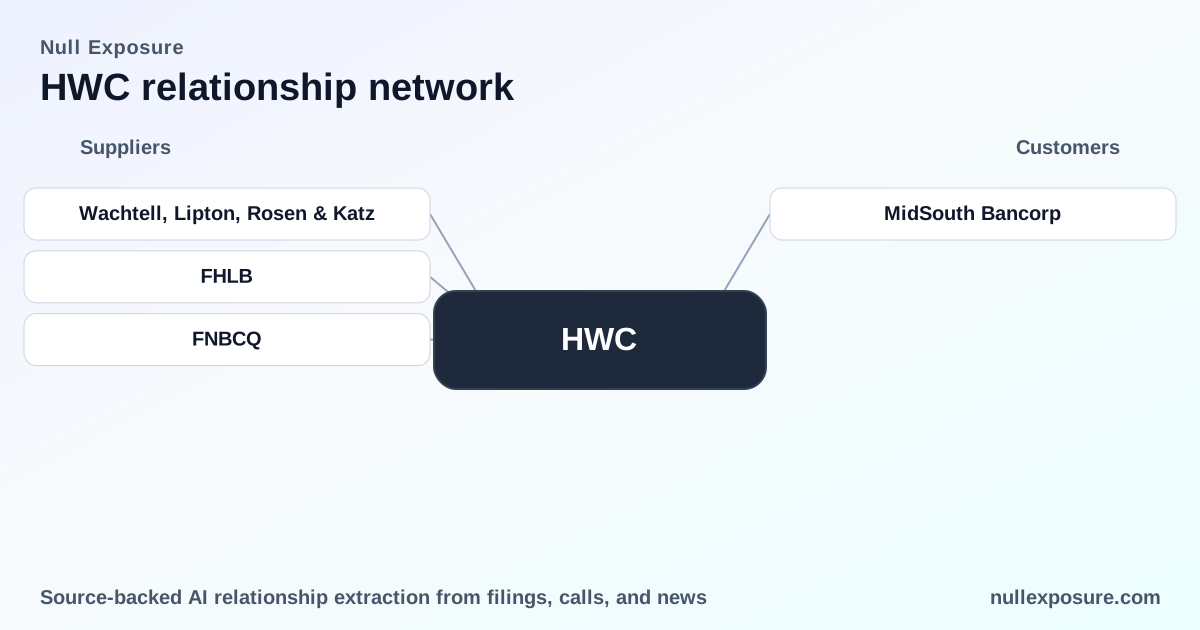
Hancock Whitney announced a strategic acquisition to enlarge its footprint and client base. WWLTV reported on March 10, 2026 that Hancock Whitney agreed to acquire MidSouth Bancorp of Lafayette for $213 million in stock, a transaction that extends the bank’s regional consolidation strategy and client relationships in Louisiana. (Source: WWLTV, March 10, 2026)
How customers contract and where revenue is generated
Hancock Whitney’s revenue mix reflects a mix of long-term, short-term, subscription-like and transaction-level contracts, each with distinct cash-flow characteristics:
- Long-term lending relationships dominate balance-sheet interest income: The company classifies loans it intends to hold as investment-grade on the balance sheet and discloses maturities for time deposits and multi-year mortgage exposures as of December 31, 2024. (Company filings, year-end 2024)
- Short-term liquidity and customer-funded vehicles: Treasury solutions such as customer repurchase agreements and short-term borrowings are routine and provide recurring funding. (10-K excerpts, 2024)
- Subscription-style portfolio management fees: Investment revenue includes monthly portfolio management fees recorded on an accrual basis, which act as steady recurring fee streams. (Company disclosure on investment revenue)
- Spot and usage fees: Mortgage sales generate point-in-time service-release premiums, ATM and card transactions produce transaction-level fees, and interchange is earned when cards are used. These items create immediate, high-frequency revenue. (Company disclosures, 2024)
Investor takeaway: the company benefits from a balanced contract posture — stable core deposit and loan income with an important overlay of transaction-driven fees that smooth profitability through rate cycles.
Who Hancock Whitney serves — composition and criticality
Hancock Whitney’s customer base is broad and structurally important to its funding and earnings profile:
- Individuals and retail clients represent a large share of deposits and consumer loans; retail deposits and consumer lending metrics are disclosed in the FY2024 filing. (FY2024 balance sheet and loan schedules)
- Public sector deposits are material: Interest-bearing public fund deposits totaled roughly $3.2 billion at December 31, 2024, making government entities an important, seasonally volatile funding source. (FY2024 disclosure on public funds)
- Small business and middle-market borrowers are core commercial customers, supported by treasury management, letters of credit and commercial lending products; equipment finance subsidiaries provide tailored middle-market solutions. (Company filings, 2024)
- Large enterprise and shared-credit facilities are used selectively; the bank participates in syndicated or shared-credit arrangements with known sponsors in its markets. (Risk management excerpts, 2024)
- Non-profit and trust relationships generate fee income through fiduciary services and asset management; trust fees increased notably year-over-year. (Trust fee disclosures, 2024)
Bold risk signal: deposits are the primary funding source and net interest income is the primary earnings engine; both are critical to enterprise profitability and stability. (Company risk disclosures, 2024)
Segments, spend bands and balance-sheet scale
Hancock Whitney operates at scale with significant off-balance-sheet commitments and concentrated exposures:
- Commitments to extend credit totaled approximately $9.25 billion, and letters of credit were ~$420 million at year-end 2024, placing many commercial relationships in the $100M+ spend band. (Off-balance sheet tables, Dec 31, 2024)
- The loan book is concentrated by product: C&I loans comprised ~55% of total loans, with notable allocations to commercial real estate and multifamily. (Loan portfolio breakdown, 2024)
- Industry exposures include manufacturing, retail, healthcare, and real estate, with manufacturing explicitly called out as one of the larger shared national credit concentrations. (Portfolio concentration disclosures, 2024)
Investor takeaway: the bank’s customer relationships are economically meaningful — high spend bands and portfolio concentrations require active credit and liquidity management.
Geographic footprint and market expansion
Hancock Whitney is a Gulf South regional franchise with branch density and growth plans:
- Operations span southern and central Mississippi, Alabama, Louisiana, parts of Florida and east Texas, with production offices in Nashville and Atlanta. (Branch footprint, corporate disclosure, 2024)
- Strategic in-market expansion is ongoing: the pending Sabal Trust acquisition and the MidSouth transaction shift wealth and deposit concentration within Florida and Louisiana respectively. (Acquisition disclosures and FY2024 comments)
Geographic implication: the company’s earnings and credit risk are strongly correlated with regional economic conditions in the Gulf South, though trading and regulatory exposure to global events is acknowledged as a secondary risk.
Operational posture, risks and regulatory constraints
Company-level constraints shape how partners and investors should assess Hancock Whitney:
- Regulation and compliance drive product design and cost: CFPB rules, deposit insurance regimes, and federal banking statutes directly affect product pricing, fee structures, and disclosure obligations. (Regulatory excerpts, 2024)
- Liquidity and deposit stability are priority constraints: the firm maintains sizable short-term liquidity buffers (approx. $19.5 billion available on/off balance sheet) to cover uninsured and non-collateralized deposits (~$11.0 billion). (Liquidity disclosures, Dec 31, 2024)
- Operational and reputational risk are critical: as a fiduciary and depositary institution, the bank is exposed to cyber, fraud and reputational events that can materially affect client confidence. (Operational risk disclosures, 2024)
- Contract variety increases operational complexity: long-term held loans, loan sales, matched derivative books for customer rate hedges, and point-in-time mortgage sales require sophisticated operational controls. (Accounting and derivatives disclosures, 2024)
These constraints are company-level signals derived from public disclosures; they are not assigned to any specific customer relationship unless explicitly stated.
Relationship lifecycle and product roles
Most customer relationships are active and mature, producing core deposit and fee revenue; a few product lines are in controlled run-off:
- Active, mature relationships: core deposit base and commercial lending relationships are described as seasoned and stable. (Deposit stability statements, 2024)
- Winding down: the company is exiting indirect automobile lending and the existing auto portfolio is in run-off. (Product exit disclosure, 2024)
- Roles: Hancock Whitney operates as both service provider (treasury, trust, card services) and seller/buyer (loan originations sold into secondary markets; loan sales to manage interest rate exposure). (Business model disclosures, 2024)
Investor implications and recommended focus
Hancock Whitney’s commercial profile is that of a regional relationship bank with material franchise economics: stable core deposits, diversified fee income, and significant credit commitments that require active portfolio management. Key items for investors and counterparties to monitor:
- Deposit composition and public fund flows, given their materiality to funding.
- Loan portfolio concentrations (C&I and CRE) and credit-loss metrics.
- Execution on integration and cross-sell following MidSouth and Sabal transactions, as these acquisitions materially affect wealth-fee generation and deposit geography.
For a data-driven deep dive into Hancock Whitney’s customer relationships and to track subsequent transaction developments, see https://nullexposure.com/.
If you want a tailored analysis or a comparator view versus regional peers, reach out via our site for an expanded research brief.