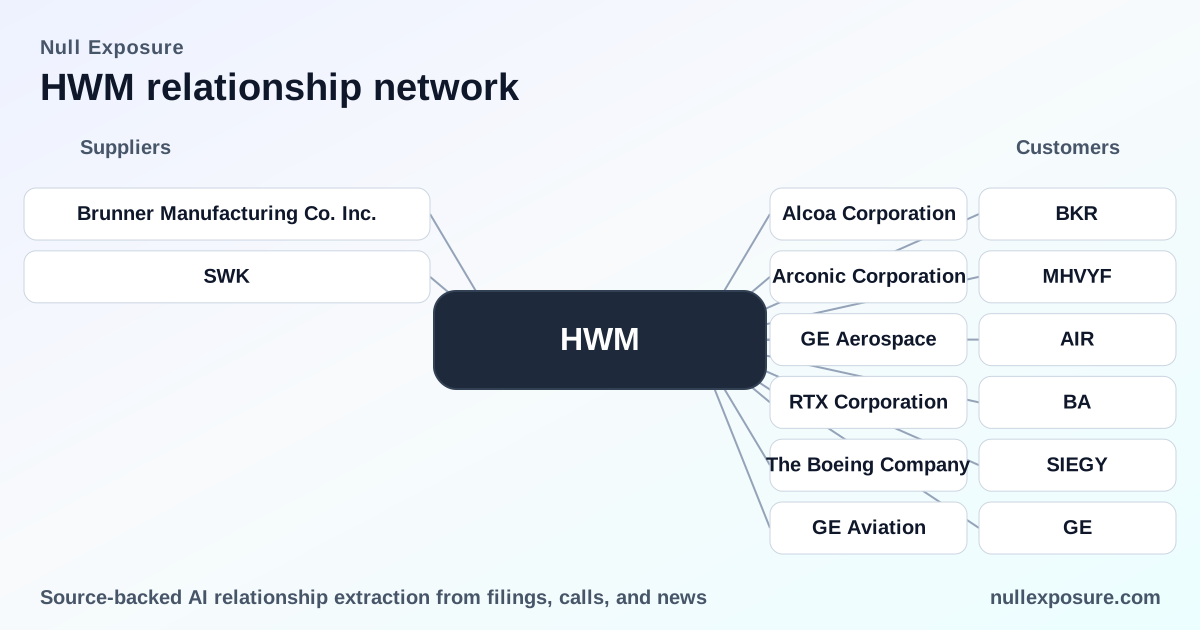
Howmet Aerospace (HWM): customer map, concentration risks, and what drives revenue
Howmet manufactures precision metal components—jet engine airfoils and disks, fastening systems, and forged aluminum wheels—and monetizes through direct OEM sales, negotiated multi‑year agreements and aftermarket spares. Revenue derives from high‑value OEM contracts and recurring aftermarket parts, with a significant portion recognized under acknowledged purchase orders or deferred‑revenue arrangements that schedule deliveries across one to five years. For investors assessing counterparty risk, the mix of large OEM customers and geographic concentration is the central story.
Learn more about customer signals and relationship analytics at https://nullexposure.com/.
Howmet’s operating model in plain terms
Howmet is a manufacturer‑seller of mission‑critical metal components for aerospace and commercial transportation. The company sells primarily to large OEMs and through distributors; contracts range from single acknowledged purchase orders to negotiated multi‑year agreements, and some revenue is recorded as deferred revenue reflecting delivery schedules. This structure creates stable near‑to‑medium‑term revenue visibility, but also concentrates exposure where a handful of OEMs drive a material share of sales.
- OEM dependence: large aerospace manufacturers determine sustained demand through build rates and engine programs.
- Aftermarket optionality: spares and gas‑turbine blades contribute higher margin recurring sales, supporting growth beyond OEM cycle swings.
- Geographic footprint: sales are concentrated in North America and Europe, with Asia and other regions supporting growth pockets.
Customer relationships — the complete list and what each connection means
Below are every customer relationship referenced in public filings, earnings calls, and recent press coverage relevant to Howmet’s customer base. Each entry is a concise business‑facing summary with the source cited.
GE Aerospace
GE Aerospace represented approximately 11% of Howmet’s third‑party sales in FY2025, making it one of Howmet’s largest single customers. According to Howmet’s FY2025 Form 10‑K, that level of concentration is material to the business.
Source: Howmet 2025 Form 10‑K (FY2025).
RTX Corporation
RTX Corporation also accounted for roughly 11% of third‑party sales in FY2025, placing it alongside GE Aerospace as a principal revenue driver whose loss would be material.
Source: Howmet 2025 Form 10‑K (FY2025).
The Boeing Company
Howmet discloses that Boeing production rates have a material impact on Howmet’s financial performance, underscoring Boeing’s role in shaping revenue through aircraft build cadence.
Source: Howmet 2025 Form 10‑K (FY2025).
Alcoa Corporation
Alcoa appears in the context of Howmet’s separation agreements; Alcoa agreed to indemnify Howmet for certain liabilities tied to the separation transactions, reflecting legacy corporate arrangements rather than a pure customer contract.
Source: Howmet 2025 Form 10‑K (FY2025).
GE Aviation
On the Q4 2025 earnings call, management cited parts for aero‑derivative engines made by GE Aviation among Howmet’s product relationships, reinforcing Howmet’s position in the engine supply chain.
Source: Howmet Q4 2025 earnings call (March 2026).
Arconic Corporation
Arconic is named alongside Alcoa in separation and distribution agreements that provide contractual indemnities related to the spin/separation process.
Source: Howmet 2025 Form 10‑K (FY2025).
GE Vernova
Management listed GE Vernova as one of the key industrial gas‑turbine customers served by Howmet’s gas‑turbine blade franchise on the Q4 2025 call, highlighting industrial‑turbine aftermarket exposure.
Source: Howmet Q4 2025 earnings call (March 2026).
Baker Hughes
Baker Hughes is identified by management as a customer for gas‑turbine blades and related products, positioning Howmet as a supplier into energy‑sector rotating equipment.
Source: Howmet Q4 2025 earnings call (March 2026).
Boeing (news coverage)
Independent market commentary links Boeing’s improving production — notably the 737 MAX recovery — to rising demand for Howmet’s products, reinforcing the operational link between airline/OEM production and Howmet revenue.
Source: TradingView / Zacks coverage (May 2026).
Airbus
Multiple market reports cite healthy Airbus build rates for the A320 and A350 as supporting higher spare‑engine demand for Howmet, indicating Airbus is an important demand anchor for both OEM and aftermarket sales.
Source: TradingView / The Globe and Mail / Trefis press coverage (March–May 2026).
AIR (ticker reference to Airbus in coverage)
Financial commentary referencing the AIR ticker reiterates similar points about Airbus build rates and aftermarket opportunity that benefit Howmet’s engine‑parts business.
Source: Trefis article and news aggregators (March 2026).
Mitsubishi Heavy
Mitsubishi Heavy is named by management as a customer for gas‑turbine blades, i.e., part of Howmet’s industrial gas‑turbine customer set.
Source: Howmet Q4 2025 earnings call (March 2026).
Siemens Power
Siemens Power appears on the earnings call list of gas‑turbine customers, again underscoring Howmet’s leadership position in turbine blade manufacturing for power generation.
Source: Howmet Q4 2025 earnings call (March 2026).
GE (ticker reference)
Press and earnings references to GE (ticker) consolidate Howmet’s multiple business ties across GE Aviation, GE Vernova and GE Aerospace, reflecting both aero and industrial engine exposure.
Source: Howmet Q4 2025 earnings call and FY2025 10‑K (2025–2026 commentary).
BA (ticker reference to Boeing in coverage)
Market coverage referring to BA echoes reporting on Boeing build‑rate recovery and its implications for Howmet’s spare‑engine and OEM demand.
Source: SimplyWallSt and TradingView press items (March–May 2026).
Operational constraints that shape customer risk and upside
-
Contracting posture and maturity: Howmet records deferred revenue for product deliveries over one to five years, signaling multi‑year delivery obligations and medium‑term revenue visibility. This is a company‑level signal about contract structure rather than tied to one customer.
-
Concentration and materiality: Two customers (RTX and GE Aerospace) each represented ~11% of third‑party sales in FY2025, a concentration that is explicitly material at the company level and elevates counterparty risk if build‑rates or program priorities shift.
-
Geography and market footprint: North America (72% of sales in 2025) and Europe (22%) dominate Howmet’s revenue mix, with APAC and other regions present but smaller; this concentration affects exposure to regional aerospace cycles and trade/regulatory regimes.
-
Relationship role: Howmet is the seller of manufactured components, with contracts delivered either via acknowledged purchase orders or negotiated multi‑year agreements, reinforcing its supplier posture and the importance of OEM procurement cycles.
-
Criticality to customers: Public commentary and filings identify participation in core engine and airframe programs where OEM production rates (Boeing, Airbus, GE) directly influence Howmet’s revenue trajectory.
Investment implications — what investors should watch
Howmet is well positioned in gas‑turbine blades and aftermarket spares, a high‑margin space that provides recurring revenue as OEM backlogs convert to spares demand. However, the company’s revenue mix is materially exposed to a handful of OEMs and to North American/European build rates. Investors should watch OEM production cadence (Boeing, Airbus), industrial turbine order flow, and deferred‑revenue delivery schedules for forward visibility.
If you want a deeper read on counterparty exposures and how they affect valuation scenarios, visit https://nullexposure.com/ for detailed customer analytics and signal maps.
Bottom line: Howmet combines structural aftermarket strengths with concentrated OEM risk—a profile that rewards detailed counterparty monitoring and scenario planning rather than macro guesses about aerospace demand.