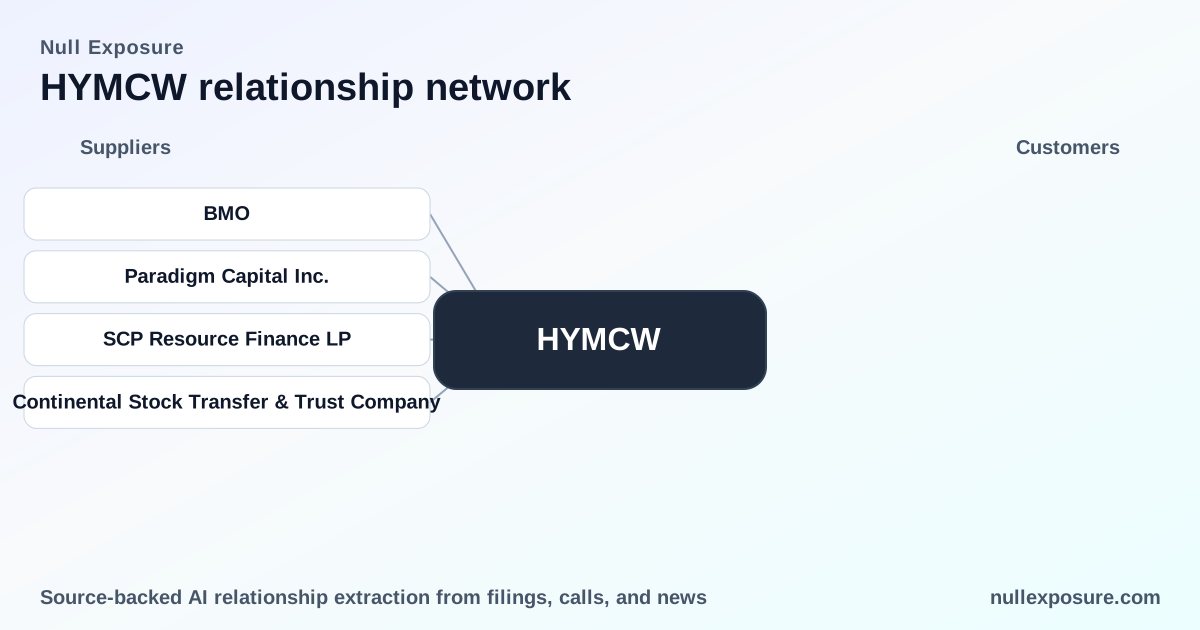
Hycroft Mining (HYMCW): Capital partners, asset sales and royalty buyers that define near-term optionality
Hycroft Mining operates as a U.S.-based gold and silver exploration and development company that monetizes through equity financings, equipment and asset sales, and royalty arrangements tied to production from the Hycroft Mine in Nevada. The company’s cash generation today is driven by non‑core disposals and financing programs rather than recurring metal sales, while long‑dated royalty and warrant arrangements underpin potential upstream liquidity events for investors and counterparties. For a concise view of partner signals and filings, see https://nullexposure.com/.
What investors need to know up front
Hycroft has converted operating exposure into financial relationships: equity subscriptions, perpetual royalties, and periodic asset/liquidation sales. Those relationships determine Hycroft’s balance‑sheet runway and the value capture profile for outside investors—they are the primary channels by which capital flows into and out of the business while active mining is suspended.
The counterparties that matter now
AMC Entertainment — an outsized retail-driven equity backer
AMC purchased 23,408,240 units in Hycroft under a subscription agreement dated March 14, 2022, paying roughly $27.9 million for equity plus warrants that expanded AMC’s exposure to Hycroft’s capital structure. According to the company subscription documentation and contemporaneous press, AMC’s investment was structured as units combining common stock and warrants at a fixed unit price in FY2022 (company subscription agreement; March 2022; CNBC coverage).
Sprott Mining — royalty and secondary equity buyer
Sprott (including entities such as SPRL II) is a strategic financial counterparty: the company received $30.0 million in cash from SPRL II in exchange for a perpetual 1.5% Net Smelter Return royalty on Hycroft production, payable monthly, established at the May 29, 2020 Recapitalization Transaction. The Sprott royalty transaction is documented in Hycroft’s corporate filings and forms a durable claim on future production (company filing, May 29, 2020).
In addition, secondary equity economics shifted in FY2025 when AMC transferred the majority of its equity position in Hycroft to Sprott Mining for net consideration of approximately $24.1 million, effectively consolidating Sprott’s equity exposure and returning most of AMC’s original capital. Market reporting on this transfer was captured in December 2025 coverage (StockTwits/market report, early December 2025).
Eric Sprott — metals investor participating in the equity tranche
Alongside AMC’s unit purchase, metals investor Eric Sprott acquired an identical number of Hycroft shares and warrants, giving him a direct equity stake tied to Hycroft’s restarted‑mining optionality. This allocation was reported at the time of the AMC subscription transaction and covered by general media reporting of the fundraising rounds in FY2022 (CNBC report, March 15, 2022).
How these relationships translate into business constraints and operating posture
Hycroft’s partner mix shows a combination of long-term encumbrances and active short‑term liquidity programs that shape strategy:
- Contracting posture: company filings document long‑term instruments (a perpetual Sprott royalty and multi‑year warrants issued at the 2020 recapitalization) alongside subscription equity that injected near‑term capital in 2022. The company has also used At‑The‑Market (ATM) programs and one‑off equipment sales to generate operating cash (company filings; FY2024 statements).
- Concentration and counterparty type: a small number of large counterparties (Sprott, AMC/Eric Sprott) dominate Hycroft’s externally visible capital flows—this increases single‑counterparty influence over valuation mechanics and liquidity realization.
- Criticality and maturity: the Sprott royalty is a perpetual revenue claim and therefore highly critical to Hycroft’s valuation on any future production restart, while equity subscriptions and ATM programs are liquidity mechanisms of tactical maturity (prospectus supplements and 2024 financial statements show active ATM availability).
- Commercial posture: Hycroft has transitioned from active miner to asset manager and seller in the near term—equipment disposals, IP and patent sales, and ATM financings supply cash while the company evaluates restart options (FY2023–FY2024 financials).
Company-level signals beyond named counterparties
Several corporate behaviors are material to underwriting risk and upside:
- Hycroft ceased active mining operations in November 2021 and processed residual leach pad inventory through 2022, which explains the absence of sustained metal sales revenue (company filings; FY2024).
- The company aggressively deployed ATM and New ATM programs, selling millions of shares in 2023–2024 to produce roughly $12.6 million of gross proceeds in 2024 and to maintain a sizable shelf (company filings; year ended December 31, 2024).
- Asset monetizations are significant: equipment and IP sales produced millions of dollars of proceeds in 2024, while several equipment purchase agreements and subsequent buyer terminations illustrate execution risk on large disposals (company filings; 2023–2024 disclosures).
- Regional footprint is North America — Hycroft is a U.S. Nevada asset, which simplifies jurisdictional risk relative to cross‑border mining exposure (company description).
Investment implications — what drives upside and where risk concentrates
Hycroft’s value hinges on a small set of binary and structural outcomes:
-
Upside drivers
- Restarting commercial mining and converting ore to payable metal would unlock both the royalty stream and residual equity value; the Sprott NSR is a high‑value, long‑dated claim on that upside.
- Continued disciplined asset sales and ATM program execution mitigate near‑term cash shortfalls and extend corporate runway.
-
Key risks
- Concentration of capital and counterparties: transfers between AMC and Sprott and the concentrated holder base create single‑party execution leverage over future financings and exits.
- Operational dormancy: absence of active mining through 2024 means the company relies on disposals and equity issuance for liquidity, increasing dilution risk.
- Execution risk on asset sales: the company has reported terminated purchase agreements and forfeited deposits, showing transactional fragility even for large equipment sales.
Bottom line and next steps for analysts
Hycroft’s commercial profile today is less that of a producing miner and more that of a capital‑structure play anchored by a perpetual Sprott royalty and episodic equity financing from retail and institutional backers. Investors should underwrite both the timing of any production restart and the counterparty dynamics that control liquidity events. For a broader comparative assessment of counterparties and additional Hycroft counterparty signals, visit https://nullexposure.com/.
For institutional diligence or to explore partner‑level exposure modeling, the Hycroft filings and contemporaneous press referenced above provide the primary readouts used in this commentary (company filings, prospectus supplements, CNBC coverage March 2022, and December 2025 market reporting).