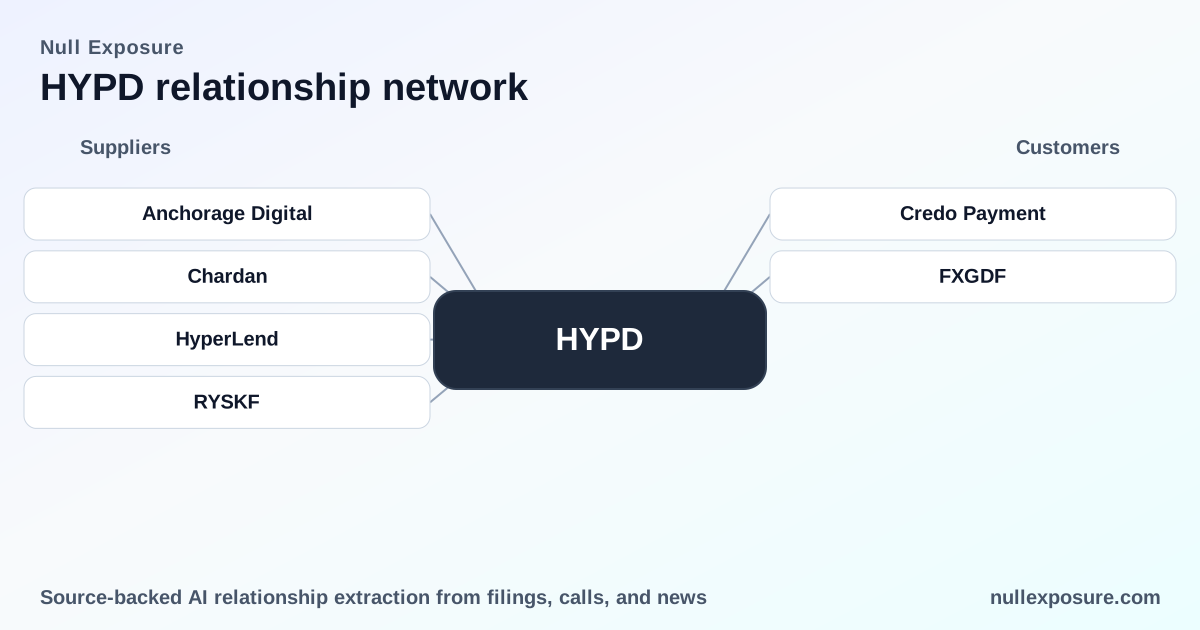
HYPD: Customer relationships that turn protocol utility into recurring fees
Hyperion DeFi operates a services stack that grants counterparties the right to use protocol assets and market infrastructure on the Hyperliquid chain, monetizing through fee splits on traded volume and ongoing staking rewards tied to asset-use agreements. The company supplements operating cash with capital markets activity—including multiple warrant and registered offerings—so investors should evaluate customer deals for their fee-generation profile and the balance between commercial receipts and financing-driven cash flows.
For direct access to original filings and consolidated signals, see https://nullexposure.com/.
What the recent customer deals tell investors about revenue mechanics
Hyperion’s 2025 Q3 disclosure identifies a specific commercial product: the HYPE Asset Use Service (HAUS). HAUS is a contractual mechanism that transfers the economic benefits of on-chain assets to commercial operators in exchange for a share of transaction fees and continued staking upside. That structure converts protocol liquidity into predictable, recurring revenue streams because Hyperion retains a portion of trading fees and continues to earn staking rewards while markets run on Hyperliquid.
- Fee-split monetization: Revenue is tied to traded volume on partner-operated markets; Hyperion collects a portion of market fees.
- Staking yield capture: Agreements preserve Hyperion’s claim on staking rewards, creating a parallel yield stream.
- Capital-market backstop: Recent warrant and registered offerings provide cash runway while customer revenue ramps.
According to the HYPD 2025 Q3 earnings call, the firm described the HAUS launch and follow-on deals as primary commercial milestones for Q3 and October 2025 (earnings call, filed March 2026).
Two named customers—what they mean for growth and concentration
Credo Payment — a proprietary trading firm as first mover
Hyperion announced the first HAUS agreement with Credo Payment during Q3 2025; the deal establishes Credo as the inaugural customer to use Hyperion’s HYPE Asset Use Service and run proprietary markets on Hyperliquid, with Hyperion receiving a portion of fees. This agreement validates the commercial model and creates an initial, measurable revenue stream from trading activity. (HYPD 2025 Q3 earnings call, mentioned March 2026.)
Felix / FXGDF — trading venue launch and recurring fees
The company’s second HAUS transaction was executed with Felix (reported also under the inferred symbol FXGDF) in October 2025, enabling Felix to launch new financial markets on Hyperliquid while Hyperion continues to receive a portion of market fees and staking rewards. This deal indicates HAUS can scale to marketplace operators, not just single trading firms, and shows early diversification of counterparty types. (HYPD 2025 Q3 earnings call, mentioned March 2026.)
Operational and contractual constraints that shape risk and upside
The record of extracted constraints from company filings yields a concise picture of Hyperion’s operating model and business risks. Present these as company-level signals that influence how customers convert into durable cash flows:
-
Contracting posture — long-term instruments dominate. Multiple filings and warrant amendments across 2023–2024 show long-dated exercise windows and extended warrant terms, signaling that management uses long-term financing instruments to bridge commercialization timelines rather than short spot sales alone. This creates a financing cushion but also dilutive outcomes tied to equity exercises. (Warrant amendment disclosures, 2023–2024 filings.)
-
Revenue mix — licensing and recurring fees are material. Constraint excerpts identified licensing as a prominent revenue component historically, with references to upfront payments, milestones and royalties. Treat HAUS fee-splits and staking revenue as analogous recurring income streams in the digital-asset context; the company’s public disclosures emphasize both licensing-style cash receipts and transaction-fee economics. (Company licensing excerpts, filings through 2024–2025.)
-
Counterparty breadth — government and individual exposure signaled. Extracted language flags engagement vectors that include government payors and individual end-users; while the granular excerpts reflect regulatory diligence typical in filings, for Hyperion this suggests heightened regulatory sensitivity and a need to manage public-sector interaction and retail user protections as the platform scales. (Regulatory and counterparty excerpts from company filings.)
-
Geographic footprint — North America plus APAC pathways. The constraints point to North America as a primary commercial region with meaningful APAC considerations; investors should expect regional regulatory variance to affect market launches and partner selection. (Geography excerpts, filing evidence.)
-
Materiality profile — customer relationships are treated as critical to viability. The firm’s disclosures categorize key commercial programs and contracts as material or critical to future profitability, underscoring that successful adoption of HAUS customers is central to avoiding further financing-driven dilution. (Materiality excerpts in filings.)
-
Business segments are diverse. Extracted signals identify multiple operating segments—core product, hardware, software and services—indicating the company structures monetization across both digital-asset services (HAUS/fee share, staking) and technology components. This multi-segment approach increases optionality but also operational complexity. (Segment excerpts in corporate filings.)
Risk profile for investors evaluating HYPD customer exposure
- Concentration risk: A small number of named customers (Credo Payment, Felix/FXGDF) drive early revenue and therefore produce high customer concentration until HAUS scales across more counterparties. (Earnings call, Q3 2025.)
- Contract maturity and predictability: The HAUS model is recurring by design, but financing disclosures show the company relies on long-term warrant and equity instruments to fund operations, which can dilute existing shareholders as commercial ramp remains underway. (Warrant/registered offering disclosures, 2023–2025.)
- Regulatory and geographic friction: Filing language emphasizes regulatory hurdles and government interactions; cross-border launches and APAC expansion will require active compliance and could slow monetization in high-opportunity markets. (Regulatory excerpts, filings.)
Investment takeaway and next steps
Hyperion DeFi’s early customer wins validate a revenue model that converts on-chain utility into recurring fee-split and staking income, and the October 2025 Felix deal demonstrates the HAUS product scales to market operators beyond single trading firms. Primary near-term investor focus should be customer diversification, fee capture metrics, and dilution risk from ongoing financing.
For a consolidated, source-linked view of HYPD customer signals and filings, visit https://nullexposure.com/. If you want a structured intelligence brief built from these relationship and constraint signals, explore the service at https://nullexposure.com/ for direct access to the underlying source documents and time-series extraction.