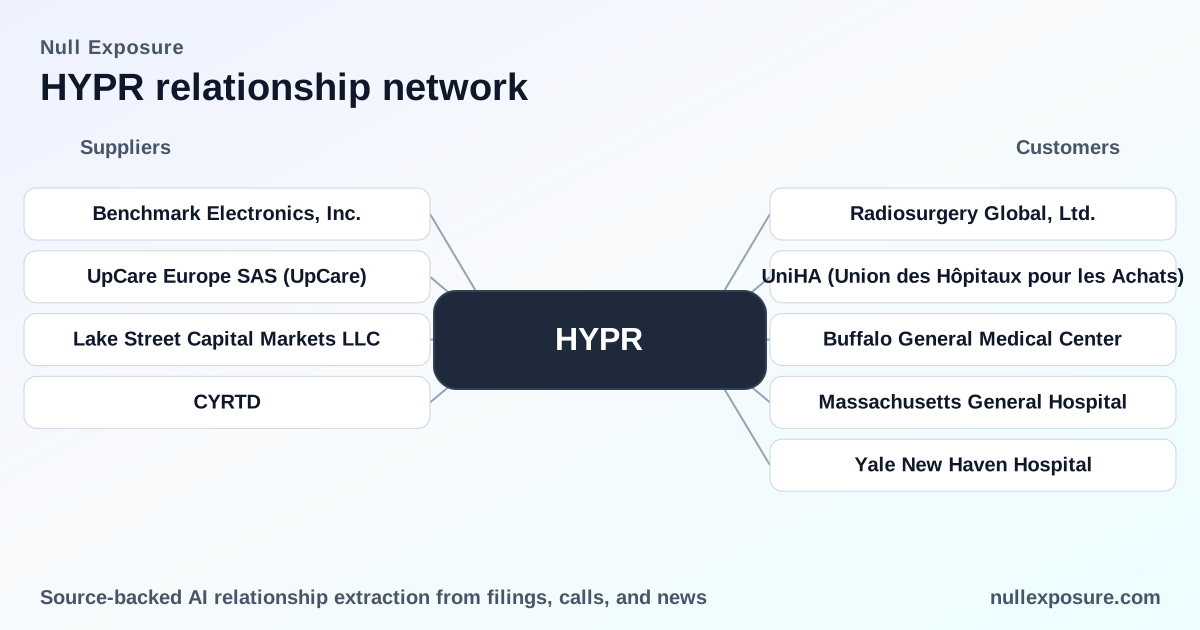
Hyperfine (HYPR) — Customer relationships that will shape commercial scale
Hyperfine monetizes by selling the Swoop® portable MRI as hardware accompanied by multi-year service and support agreements, supplemented by Device‑as‑a‑Service (DaaS) and cloud software subscriptions; device sales drive near-term cash, while service, SaaS and DaaS create the path to recurring revenue and margin expansion. For deeper commercial signals and relationship tracking, see https://nullexposure.com/ — this research note maps the customer partnerships disclosed in public reporting and press coverage and explains how they affect execution risk and growth potential.
How Hyperfine sells: one product, multiple contracting postures
Hyperfine’s commercial model is straightforward and consequential for investors. The company sells the Swoop® system as a physical device (Device revenue $10.45M in the most recent year) and recognizes a separate stream from services (Service revenue $2.44M), producing total reported sales of $12.89M. Contracts combine upfront hardware sales with 36– and 60‑month service/support terms, and the firm offers DaaS structures that are accounted for as lease revenue. This mixed model yields:
- Upfront capital inflows from device sales that support inventory and manufacturing scale.
- Deferred and long‑dated service revenue that converts to recurring cash over multi‑year periods.
- Subscription‑like economics via cloud PACS and software upgrades that increase lifetime value per unit.
Operational constraints are material: the company reports customer concentration (several customers each representing >10% of revenue in past years), regulatory and reimbursement dependence (Medicare/local coverage critical), and significant compliance obligations around HIPAA and international data transfer. Hyperfine is commercial (product launched 2020) but still maturing financially — revenue expansion is real, but EBITDA and EPS remain negative, underscoring execution risk even as product adoption accelerates.
If you want a consolidated monitoring feed for customer signals and contract patterns, visit https://nullexposure.com/ for subscription options and alerts.
Customer relationships disclosed in press and filings — what investors need to know
Below are the relationships surfaced in recent public reporting and news coverage. Each entry is concise and sourced to the underlying item.
Radiosurgery Global, Ltd.
Hyperfine will commercialize the Swoop® portable MRI in India through a distribution and commercialization partnership with Radiosurgery Global, Ltd., following regulatory authorization by India’s CDSCO that allows nationwide sales. This was reported in company coverage and filings in March–May 2026. Source: AIjourn article on the CDSCO approval (March 10, 2026) and related investing.com coverage of the company’s amended sales agreements (May 3, 2026): https://aijourn.com/hyperfine-announces-regulatory-approval-of-the-swoop-system-in-india/ and https://in.investing.com/news/sec-filings/hyperfine-amends-atthemarket-sales-agreement-to-add-btig-as-sales-agent-93CH-5167424.
UniHA (Union des Hôpitaux pour les Achats)
Hyperfine’s Swoop® system received a national referencing award from UniHA, France’s largest public hospital purchasing cooperative, positioning the device for prioritized procurement across French public hospitals. Source: MarketScreener coverage of the UniHA referencing (March 2026): https://www.marketscreener.com/news/hyperfine-swoop-system-referenced-in-francea-s-largest-public-hospital-procurement-body-to-facilitate-ce7d5ad8df8ff524.
Massachusetts General Hospital
Hyperfine provided portable MRI systems to Massachusetts General Hospital under sponsored research agreements; those devices contributed data to a multi‑center observational study (ACTION PMR) that was published in Stroke: Vascular and Interventional Neurology, evaluating performance on acute stroke detection. Source: company press and study announcement (publication noted in AIjourn, March 2026): https://aijourn.com/hyperfine-announces-publication-of-breakthrough-clinical-data-demonstrating-the-swoop-systems-enhanced-stroke-detection-capabilities/.
Yale New Haven Hospital
Yale New Haven Hospital participated in the multi‑center observational study combining data from ACTION PMR sites; Hyperfine supplied systems under sponsored research agreements used in that published stroke detection analysis. Source: study publication and company announcement referenced in AIjourn (March 2026): https://aijourn.com/hyperfine-announces-publication-of-breakthrough-clinical-data-demonstrating-the-swoop-systems-enhanced-stroke-detection-capabilities/.
Buffalo General Medical Center
Buffalo General Medical Center contributed ACTION PMR study data for the multi‑center stroke detection paper; Hyperfine provided systems to Buffalo General as part of sponsored research arrangements. Source: the same multi‑center study publication and company notice (AIjourn, March 2026): https://aijourn.com/hyperfine-announces-publication-of-breakthrough-clinical-data-demonstrating-the-swoop-systems-enhanced-stroke-detection-capabilities/.
What the relationships collectively signal for investors
- International go‑to‑market is accelerating. The India partnership and the UniHA referencing indicate a deliberate shift from a U.S.-centric commercial base to targeted international distribution and procurement channels; this supports the company’s stated ambition to generate more revenue outside the U.S.
- Clinical validation underpins enterprise adoption. Sponsored research agreements with major academic hospitals (Massachusetts General, Yale New Haven, Buffalo General) strengthen clinical credibility and will be persuasive when negotiating hospital and health‑system procurements.
- Distribution and tender channels matter. UniHA is a procurement gateway to French public hospitals; Radiosurgery Global provides a local commercialization partner in India — these relationship types reduce market entry friction but introduce execution risk tied to local regulatory and reimbursement regimes.
Company‑level constraints that matter for customer risk and contract economics
- Contracting posture is mixed: short payment terms exist (30 days to <1 year), yet the company routinely structures 36–60 month service/support agreements and DaaS leases that convert monthly payments into recognized lease revenue. That mix improves lifetime value but creates deferred revenue timing complexity.
- Counterparty profile is broad but concentrated: Hyperfine sells to government‑regulated payors and hospitals and also to individual physicians and clinics; historical reporting shows a small number of customers accounted for meaningful shares of revenue and accounts receivable, so customer concentration risk is real.
- Critical compliance and reimbursement dependencies: HIPAA, Medicare/local coverage decisions, and international data privacy rules are material constraints; favorable coverage decisions and secure data handling are critical to commercial momentum.
- Maturity is early commercial, scaling internationally: commercial launch in 2020, recurring revenue mechanics in place, but profitability remains negative and cash usage from operations is significant — growth requires both device placements and sustained service renewals.
Investment takeaway
Hyperfine’s customer activity shows a clear path from single‑product hardware sales toward recurring revenue through service, DaaS and software. The India partnership and UniHA referencing materially expand addressable markets; academic sponsored research supply clinical validation that accelerates enterprise sales. Key risks remain concentrated customer exposures, reimbursement/regulatory dependencies, and the need to convert clinical interest into contract renewals and scalable service margins.
For continuous monitoring of Hyperfine customer signals and contract dynamics, consider our coverage hub at https://nullexposure.com/ — you can track procurement wins, registry publications and distributor agreements that drive valuation inflection points.