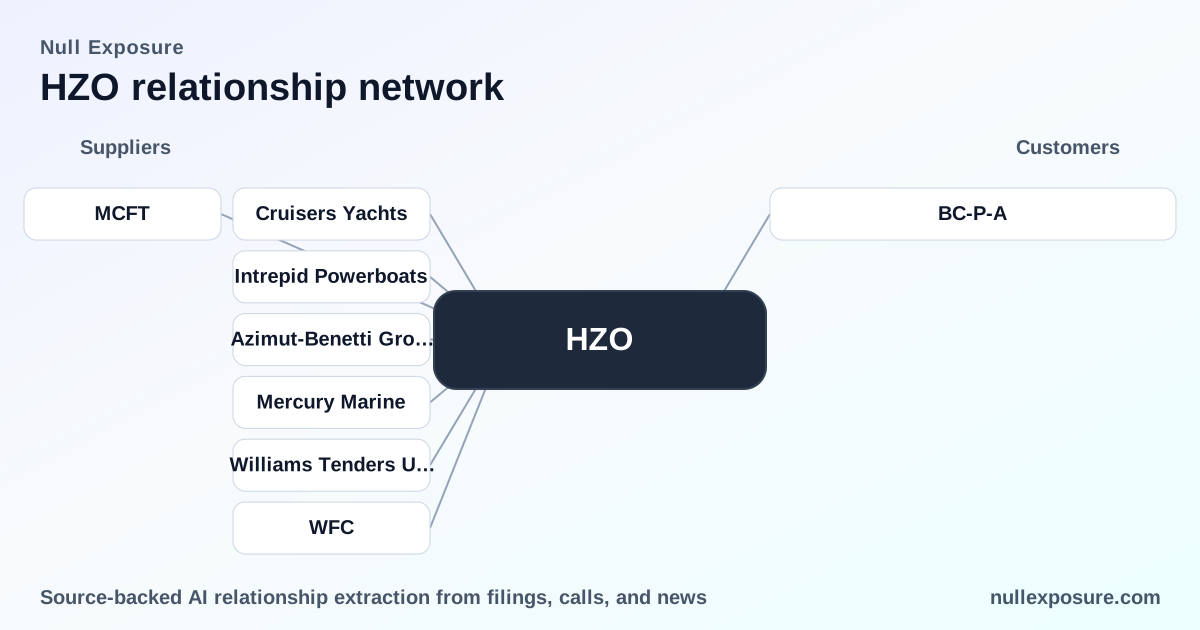
MarineMax (HZO) — customer relationships that drive a vertically integrated marine platform
MarineMax operates and monetizes through a vertically integrated retail and services platform: it sells new and used recreational boats (core product), manufactures select models through subsidiaries, and captures higher‑margin recurring revenue from financing, insurance, maintenance, storage, chartering and marina services. Revenues are concentrated in the U.S. retail footprint but amplified by global superyacht and marina operations, and by product manufacturing and distribution channels that create cross‑sell opportunities and aftermarket service flows. For investors, MarineMax’s model is scale + recurring services + selective manufacturing, with margin leverage dependent on retail cycles, interest availability and regional weather/seasonality. Learn more at the NullExposure homepage: https://nullexposure.com/.
Why the customer base matters: one platform, multiple revenue engines
MarineMax converts high‑ticket, episodic boat sales into durable customer relationships through F&I, service contracts, marinas and charter operations. New boat sales remain the dominant revenue engine, but finance & insurance (F&I), repair & storage, and brokerage/charter services meaningfully increase lifetime value and stabilize cash flow through seasonality. The company combines dealership retailing with ownership of manufacturers and marina networks to control distribution, service quality and post‑sale economics.
Company‑level operating signals and constraints that shape relationships
Investors should evaluate MarineMax under a set of firm‑level constraints that affect customer economics and counterparty dynamics:
- Contracting posture: The company's public disclosures show a mix of short‑term and longer‑term contracts — services and maintenance are short‑term or subscription‑like (often annual), leases and some real‑estate arrangements are multi‑year, and retail boat transactions are spot transfers of control recognized at delivery. This hybrid posture supports quick cash conversion on services while embedding longer commitments through storage, leaseholds and extended service agreements (Form 10‑K, FY2025).
- Counterparty composition: The customer base is predominantly individual retail buyers for core products and services, with meaningful interactions with large institutional counterparties for financing and manufacturer relationships. This duality concentrates consumer discretionary risk but also creates stable wholesale funding and product supply lines (FY2025 10‑K).
- Geography and concentration: Heavy U.S. concentration, with outsized exposure to Florida, while IGY and brokerage operations provide global reach. Regional weather, state tax and regulatory shifts therefore have disproportionate operational impact (FY2025 10‑K).
- Materiality and criticality: New boat sales are both material and critical to top‑line performance (over 60% of revenue in FY2025), while services and rentals are material levers for margin expansion (service/storage ≈10.6% of revenue in FY2025). Brokerage and F&I are notable revenue contributors but smaller by share.
- Maturity and lifecycle: The platform is mature and active across its retail, manufacturing and marina segments; many relationships are ongoing and transactional but supported by recurring service and charter offerings that extend customer lifetime value.
- Segment mix: The business spans core products (boats, engines), manufacturing (Cruisers, Intrepid), distribution/retail, services (maintenance, storage, F&I, brokerage, charters) and a growing software/digital layer (Boatyard/Boatzon) to improve customer engagement and operations.
- Spend profile: Transaction sizes are high relative to average retail, consistent with premium product pricing (average new boat sale ~$339k in FY2025), while higher‑volume service and parts receipts sit in the sub‑$1m bands.
Collectively, these signals describe a company that transacts large, lumpy purchases with individual consumers, then monetizes aftersales through recurring service, finance and marina networks, while retaining some pricing and distribution control through manufacturing ownership.
The relationships you need to know (each entry in the record)
Below are the specific counterparties and mentions identified in the provided results — one entry per provided result, with a concise, investor‑oriented summary and source note.
-
Blackstone Inc. (inferred ticker: BX) — Private equity interest in buyout discussions.
- Private equity groups including Blackstone, Centerbridge Partners and TPG publicly expressed interest in a potential buyout of MarineMax, signaling third‑party strategic interest that could affect valuation, governance and capital strategy. Source: BusinessObserverFL reporting (March 2026) citing Reuters coverage of FY2026 buyout interest.
-
BC‑P‑A (inferred link to Brunswick Corporation) — Manufacturer relationship for key brands.
- MarineMax discloses it is the largest retailer of Sea Ray and Boston Whaler recreational boats, both manufactured by Brunswick Corporation, establishing a critical distribution relationship for core product supply. Source: MarineMax Form 10‑K for the fiscal year ended September 30, 2025 (hzo‑2025‑09‑30).
-
Brunswick Corporation — Manufacturing partner for Sea Ray and Boston Whaler.
- The company explicitly names Brunswick Corporation as the manufacturer of Sea Ray and Boston Whaler, products that make up a significant portion of MarineMax’s new boat inventory and retail offering. Source: MarineMax Form 10‑K (FY2025).
Note: Two results reference Brunswick (once by ticker/identifier and once by name); both documents originate from MarineMax’s FY2025 10‑K and confirm the same distribution/manufacturer relationship.
What these relationships imply for investors
- Supply stability and product concentration: The Brunswick relationship supplies core premium brands; loss of favorable terms or supply disruptions would materially affect new boat sales and margins given the material concentration of new boat revenue in MarineMax’s mix (FY2025 10‑K).
- Strategic optionality from buyout interest: Publicized private equity interest (Blackstone, et al.) introduces near‑term strategic optionality for shareholders — it raises the prospect of a controlled recapitalization or sale, which could accelerate M&A or operational repricing for the platform (BusinessObserverFL / Reuters, March 2026).
- Revenue conversion and margin diversification: MarineMax’s aftersales and services (maintenance, storage, F&I, brokerage, charters, IGY marinas) act as margin diversifiers and reduce volatility from lumpy retail cycles; investors should monitor the growth of these higher‑margin streams as a hedge against retail softness (FY2025 10‑K).
Risk checklist that follows from the relationship map
- Consumer discretionary exposure — heavy dependence on retail demand, interest rates and credit availability for buyers.
- Geographic concentration — Florida and U.S. seasonal dynamics create regional vulnerability.
- Manufacturer dependence — key brand relationships (Brunswick/Sea Ray/Boston Whaler) are strategically critical to revenue.
- Cyclicality and inventory capitalization — high ticket inventories and working capital intensity press liquidity in down cycles.
Bottom line and next steps
MarineMax operates a vertically integrated premium marine platform where manufacturer partnerships (Brunswick), retail scale, and recurring services define profitability and risk. The company’s mix gives it both leverage to recover through services and exposure to consumer cycles; reported private equity interest elevates near‑term strategic variables for investors.
For further, structured intelligence on MarineMax’s customer and supplier network, and to track evolving relationship signals, visit NullExposure: https://nullexposure.com/.