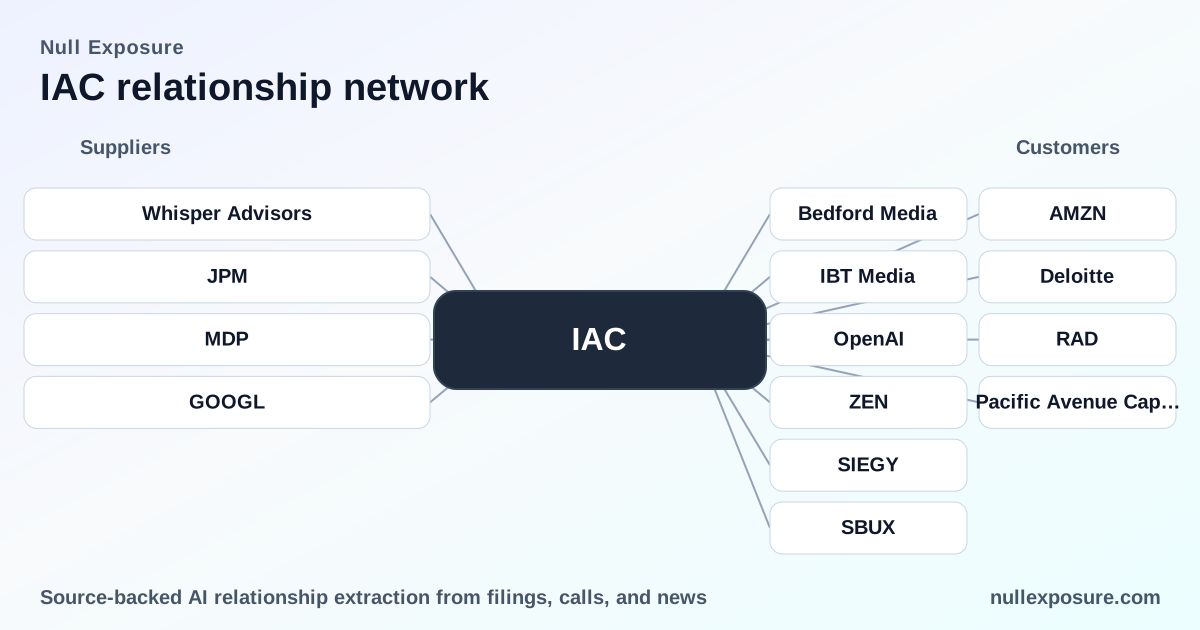
IAC’s customer map: who pays, partners and what it means for investors
Thesis — IAC operates as a diversified digital media and services holding company that monetizes through three principal vectors: advertising and performance marketing from Dotdash Meredith; subscription and enterprise fees from platforms such as Care.com and Angi; and licensing/transaction fees across niche businesses. Revenue is a mix of recurring subscriptions, usage-based charges and spot advertising sales; the company leverages long-standing services agreements and brand licensing to stabilize cash flows while actively pruning and selling non-core assets to optimize capital allocation. For model-ready intelligence and relationship tracing, see NullExposure’s research hub: https://nullexposure.com/.
A concise roster — every reported customer and partner relationship
Below I list every relationship in the data payload, with a plain-English summary and the source context for each mention.
-
Bedford Media — bought the publishing rights to Life from IAC’s Dotdash Meredith. The New York Post reported that Bedford Media (Kushner/Kloss) acquired the Life publishing rights from Dotdash Meredith (IAC subsidiary) in a transaction disclosed in 2026 coverage of FY2024 activity. (New York Post, March 2026)
-
Bending Spoons SpA — acquired Mosaic Group assets and IP from IAC. Bloomberg reported that IAC sold the Mosaic suite of mobile apps and related IP to Italian firm Bending Spoons, in a deal described as valued at over $100 million. (Bloomberg, January 2024 / reported in FY2024 coverage)
-
Pacific Avenue Capital Partners — buyer committed to acquire Care.com from IAC. Multiple press accounts document a March 2, 2026 definitive agreement for IAC to sell Care.com to an affiliate of Pacific Avenue Capital Partners for approximately $320 million in cash. (The Globe and Mail; Investing.com; PR Newswire, March 2026)
-
IBT Media — historical buyer of Newsweek from IAC-controlled holdings. Variety recounts that IAC once took Newsweek through a set of ownership changes and ultimately sold the title to IBT Media in 2013. (Variety, historical recap cited in FY2024 coverage)
-
Rite Aid — named enterprise customer of Vimeo. A PR Newswire release on Vimeo’s equity financing lists Rite Aid among enterprise customers using Vimeo’s platform for internal and marketing video needs. (PR Newswire, Vimeo financing announcement, FY2020)
-
Siemens — named enterprise customer of Vimeo. The same Vimeo announcement lists Siemens as an enterprise customer. (PR Newswire, FY2020)
-
Starbucks — named enterprise customer of Vimeo. Starbucks appears on Vimeo’s enterprise-customer list in PR Newswire coverage of Vimeo’s financing. (PR Newswire, FY2020)
-
Zendesk — named enterprise customer of Vimeo. Vimeo’s announced customer roster includes Zendesk, per the PR Newswire release. (PR Newswire, FY2020)
-
OpenAI — content licensing / commercial deal with IAC’s publishing business. The Hollywood Reporter noted that IAC struck a deal with OpenAI, and AdExchanger later reported a content licensing partnership between People (IAC’s rebranded publishing operations) and OpenAI that began contributing material revenue. (The Hollywood Reporter; AdExchanger, FY2024–FY2025)
-
Microsoft — signed an AI licensing deal referenced by IAC leadership. IAC commentary in investor-facing coverage referenced a new Microsoft AI licensing agreement as a contributor to digital growth at the People/People Inc. segment. (Investing.com / IAC earnings commentary, FY2025)
-
Amazon (AMZN) — commercial distribution and Vimeo enterprise customer references. IAC disclosures and press accounts show Amazon both as a distribution/commerce partner for Dotdash Meredith’s performance marketing and as a Vimeo enterprise customer. (InPublishing; PR Newswire, FY2020–FY2022)
-
Deloitte — cited among Vimeo’s enterprise clients. PR Newswire’s Vimeo release lists Deloitte as a customer of Vimeo’s enterprise platform. (PR Newswire, FY2020)
-
Pacific Avenue Capital Partners — multiple references documenting the Care.com sale. In addition to Investing.com and The Globe and Mail, IAC press notices and PR Newswire materials reference Pacific Avenue in connection with the sale of Care.com. (PR Newswire; The Globe and Mail; Investing.com, March 2026)
-
Amazon (inpublishing entry) — Dotdash Meredith uses Amazon as a commerce partner. InPublishing covered Dotdash Meredith’s performance marketing model and its commerce partnerships (including selling proprietary products via Amazon). (InPublishing, FY2022)
-
Duplicate AMZN entries — same commercial and customer role reiterated. Multiple results list Amazon/AMZN across different source documents, reflecting both distribution partnerships and enterprise customer mentions. (PR Newswire; InPublishing)
Note: the results include multiple duplicates for the same counterparty across different sources and periods; each listing above maps to the corresponding source mention in the provided results.
Contracting posture and revenue mechanics investors should care about
-
Mixed contract types drive both predictability and variability. Public disclosures emphasize a heavy subscription base (magazine subscriptions, professional memberships, Care.com and Angi enterprise subscriptions) combined with usage-based and spot pricing—for example, professional leads and ad placements are often usage- or performance-priced while many enterprise products run on annual contracts.
-
Long-term and short-term contracts coexist. IAC balances multi-year enterprise contracts and brand licensing agreements with short-term advertising and one-off newsstand/spot sales; the company explicitly uses ASC 606 practical expedients for contracts under one year which reduces disclosure friction for short-term revenue.
-
Licensing and trademark royalties are a stable mid-tail. Dotdash Meredith’s brand licensing and functional content licenses (including deals that feed AI models) give IAC recurring, contractually licensed revenue streams beyond ad cycles.
-
Services and intercompany agreements are material and governed by framework arrangements. IAC and Angi operate under a suite of governance documents (services agreement, contribution and tax-sharing agreements) that formalize ongoing operating support and cost allocation—these are not simple ad-hoc relationships.
Concentration, criticality and maturity — what the constraints signal
-
Concentration: material platform dependence exists. Disclosures show Google-related revenue in the high hundreds of millions (>$500M in recent years) and advertising as a significant portion of consolidated revenue, indicating meaningful exposure to a small set of major advertising platforms.
-
Criticality: user engagement is core to value. The company states that its ability to engage directly with users and subscribers is critical to success—this makes platform distribution, email/text deliverability and search-market positioning strategic risk points.
-
Maturity: mix of mature media and evolving digital lines. Dotdash Meredith’s print/subscription backbone is mature and cash-generative, while Angi and newer digital licensing / AI partnerships are in growth or transition phases; IAC actively sells or monetizes non-core digital software (e.g., Mosaic) to reallocate capital.
-
Spend bands indicate enterprise-scale relationships. Several revenue lines and counterparty mentions point to $100M+ spend bands, reinforcing that IAC transacts with large enterprise customers and platforms at scale.
Risk vectors and investor takeaways
-
Ad platform concentration and regulatory shifts are tangible risks. Changes in paid-search pricing, programmatic dynamics or privacy regulation (CCPA/GDPR-style laws) will materially affect advertising and performance marketing revenue.
-
Subscription churn and renewal rules matter. New negative-option rules and subscription regulation can compress renewal economics at Dotdash Meredith, Care.com and Angi; the company calls out these regulatory vectors explicitly.
-
Asset recycling supports capital discipline. IAC demonstrates active portfolio management—selling Mosaic, Care.com (closing with Pacific Avenue) and other assets—converting non-core units into cash for buybacks or reinvestment.
How to act on this read
-
For a consolidated view of IAC’s counterparty exposure and primary contractual patterns, use NullExposure’s relationship intelligence at https://nullexposure.com/ — it aggregates filings and media-sourced relationship evidence into investor-ready signals.
-
If you are modeling IAC, stress test ad revenue sensitivity to Google/paid-search pricing and model subscription churn under tighter “negative option” rules, while reflecting one-off sale proceeds from recent disposals into your cash-flow profile.
Bold final takeaway: IAC’s revenue mix is deliberately hybrid—subscription and licensing for stability, advertising and usage-based fees for upside—and management is harvesting non-core assets to sharpen that blend.