IAMGOLD (IAG): How counterparties and royalties shape cash flow and operational risk
IAMGOLD operates and monetizes primarily as a gold producer and developer across North and South America and West Africa, generating cash from mine production while sharing future metal revenue with third-party royalty and streaming counterparties. The company’s operating model blends direct mining cash flow with monetization via NSR royalties, so investor returns and downside protection are influenced by both operational execution and the commercial terms held by royalty owners. For a detailed counterparty view, visit https://nullexposure.com/.
The business model in one line
IAMGOLD extracts value by running and developing mines (notably the Côté and Gosselin assets) while external royalty/streaming firms hold minority carriage on future metal receipts; cashflow volatility therefore combines mine performance, capex to stabilize operations, and third‑party royalty claims on production.
How to read the relationship map — what it implies for investors
The relationship data for IAG provides clear signals about IAMGOLD’s contracting posture, revenue concentration, criticality of the underlying assets, and the maturity of monetization arrangements:
- Contracting posture: IAMGOLD operates as the principal asset operator while granting or retaining NSR (net smelter return) interests with royalty firms, indicating a hybrid monetization strategy that reduces upfront capital needs but commits future production streams to third parties.
- Concentration: Multiple royalty holders on the same asset (Côté/Gosselin) imply shared claims on a small set of high-value mines, concentrating counterparty exposure around those assets rather than being widely dispersed.
- Criticality: Royalties sit on core assets rather than peripheral projects, making these counterparties material to long-term revenue allocation.
- Maturity: The relationships include both historical acquisitions (royalty stakes purchased years ago) and more recent adjustments, showing a mature, actively traded royalty market rather than nascent or one-off agreements.
These are company-level signals derived from the relationship set rather than contract-level extracts. For a fuller counterparty map and source-level detail, see https://nullexposure.com/.
Relationship breakdown — who holds claims on IAMGOLD assets
Metalla Royalty & Streaming Ltd. (MTA)
Metalla holds a meaningful NSR royalty position on IAMGOLD’s Côté and Gosselin projects, having expanded its stake over time; Metalla increased its Côté‑Gosselin NSR to 1.50% following a C$3.4 million purchase on October 31, 2025, reflecting active secondary-market consolidation of royalty exposure to IAMGOLD assets. This builds on earlier purchases that established a 1.35% position in 2021 and confirms Metalla’s long-term orientation toward Côté/Gosselin. (Sources: Metalla press release, October 31, 2025; Streetwise Reports, July 8, 2024; Kitco commentary, September 25, 2024.)
Gold Royalty Corp. (GROY)
Gold Royalty holds a 0.75% NSR (partial coverage) on the Côté Gold project, a directly monetizable interest in IAMGOLD production streams; Gold Royalty’s public updates reference IAMGOLD’s February 17, 2026 announcement to prioritize mine stability and efficiency at Côté, and subsequent project-level equipment installs (an additional secondary crusher and a planned Vertimill) that Gold Royalty links to improved long-term royalty revenue potential. These operational upgrades increase the predictability and scale of payable metal to royalty holders. (Sources: Gold Royalty press commentary, March 2026; investingnews update citing IAMGOLD’s Feb 17, 2026 announcement; Intellectia/press summaries March 2026.)
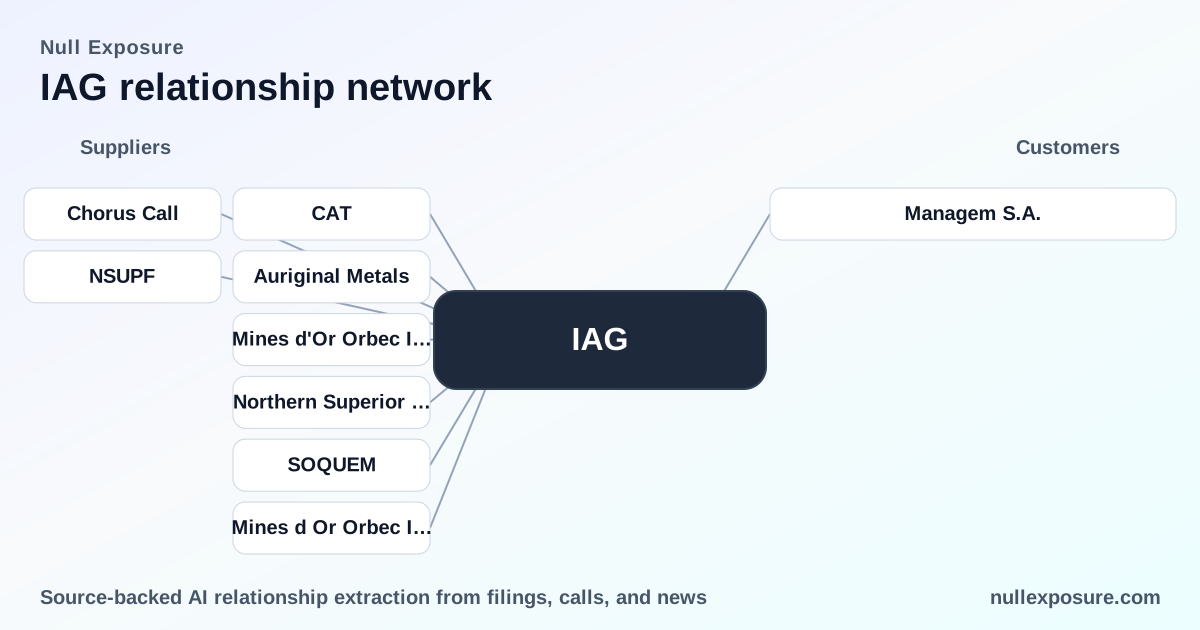
Managem S.A.
IAMGOLD’s attempted sale of the Diakha‑Siribaya Gold Project to Managem S.A. did not complete: the definitive agreement expired on December 31, 2024 and was not extended, leaving Diakha‑Siribaya under IAMGOLD’s control and signaling a reversal or delay of external divestiture plans for that asset. This failed transfer affects disposability of certain assets and the company’s potential to monetize non-core projects via third‑party buyers. (Source: Reuters coverage via TradingView, February 17, 2026.)
What these relationships mean for valuation and risk
- Cashflow allocation: Royalties held by Metalla and Gold Royalty siphon a fixed percentage of revenue from Côté/Gosselin production, reducing free cash available to IAMGOLD but also reflecting non‑dilutive funding decisions that likely supported project development earlier.
- Operational sensitivity: Short-term share-price and cashflow sensitivity will track IAMGOLD’s operational execution at Côté — upgrades such as crushers and Vertimills materially improve royalty payability and therefore bolster the value of external claimants.
- Liquidity and secondary market activity: Active purchases by Metalla and public commentary from Gold Royalty show these royalty positions are tradable and market‑priced, which gives investors external markers for valuing IAMGOLD’s asset base beyond company disclosures.
- Strategic optionality: The lapse of the Managem sale indicates reduced near-term disposability for certain projects, tightening IAMGOLD’s balance‑sheet optionality unless new buyers emerge.
Investment implications — concise takeaways for investors
- Positive: Operational upgrades at Côté increase production stability and long‑run royalty streams, which supports both IAMGOLD’s corporate valuation and the market value of royalty holders.
- Negative: Persistent royalty obligations create a structural drag on IAMGOLD’s retained free cash, and concentration of royalty claims on a handful of assets heightens counterparty-revenue coupling.
- Net: IAMGOLD trades as an operationally leveraged gold producer with third‑party monetization embedded in its cashflow profile; investors should value production upside against permanently committed royalty percentages.
For researchers and managers mapping counterparty exposure, the combination of royalty consolidation (Metalla), income-linked counterparties (Gold Royalty), and failed asset sale attempts (Managem) defines a strategic set of constraints and opportunities for IAG. For an interactive counterparty map and source-level documents, visit https://nullexposure.com/.
Final note
This relationship snapshot is focused on customer/royalty counterparties explicitly found in recent reporting and press; the critical investor lens is operational execution at core mines and the fixed percentage nature of royalty claims, which together determine how much upside IAMGOLD captures from higher gold prices and improved throughput.