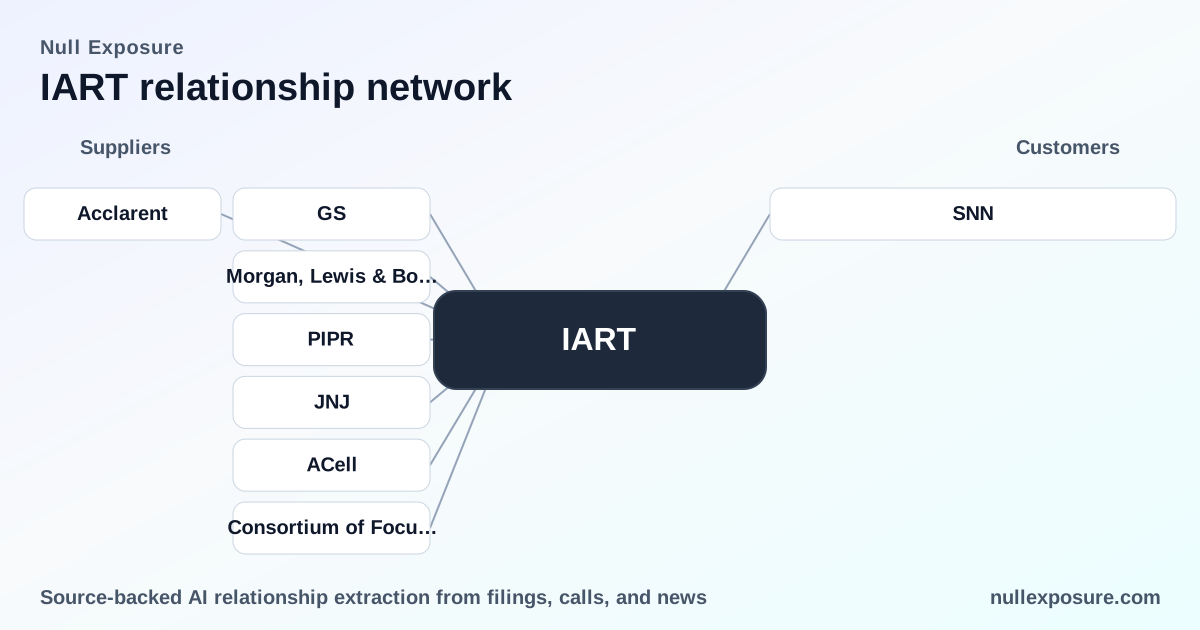
Integra LifeSciences (IART): Customer Relationships and Commercial Signals that Drive Valuation
Integra LifeSciences sells and manufactures surgical implants, biologic matrices and specialty instruments to hospitals, clinicians and channel partners worldwide, monetizing through product sales, multi‑period service agreements, private‑label manufacturing and royalty/licensing arrangements. Revenue is driven by a two‑segment mix — Codman Specialty Surgical (high‑margin instruments and devices) and Tissue Technologies (biologic matrices and private‑label manufacturing) — sold through a blended direct and distributor model across North America, EMEA and APAC. For deeper customer and counterparty intelligence visit https://nullexposure.com/.
How investors should think about Integra’s commercial model
Integra operates as a manufacturer‑seller with an integrated distribution footprint and a clinical sales motion: direct clinical specialists and hospital reps sell capital hardware and implantable devices, while biologics and private‑label products are distributed through specialty distributors and wholesalers. The company combines short‑term transactional sales (typical 30‑day terms) with longer‑duration service contracts and royalty/licensing income, producing a diversified cash flow profile but placing a premium on manufacturing quality and regulatory compliance.
Key relationship snapshots — who matters today
Below are concise, investor‑oriented summaries of each identified customer relationship in the record.
-
Smith+Nephew / SNN
Integra agreed to divest its Extremity Orthopedics business to Smith+Nephew for $240 million in cash, a strategic sale that transferred a product line and customer relationships to SNN in FY2020. According to a GlobeNewswire press release announcing the definitive agreement (FY2020), the transaction was positioned as a portfolio rationalization. https://www.globenewswire.com/news-release/2020/09/29/2100557/0/en/Integra-LifeSciences-Announces-Definitive-Agreement-to-Divest-its-Extremity-Orthopedics-Business-to-Smith-Nephew-for-240-Million.html -
MedStar Georgetown University Hospital
MedStar Georgetown’s wound‑care clinicians publicly cite PriMatrix as incorporated into their clinical workflow for complex limb salvage and reconstruction, indicating continued clinical adoption and real‑world utilization of Integra’s Tissue Technologies products in FY2026. The commentary appeared in Integra’s real‑world evidence release distributed via GlobeNewswire in April 2026 and was also syndicated by Finviz. https://www.globenewswire.com/news-release/2026/04/07/3269118/0/en/Integra-LifeSciences-Unveils-New-Real-World-Evidence-Highlighting-PriMatrix-Utilization.html and https://finviz.com/news/342808/integra-lifesciences-unveils-new-real-world-evidence-highlighting-primatrix-utilization -
DAIO (Data I/O Corporation) / DAIO
Integra’s references include a collaboration context where IAR’s (third‑party vendor language in the press release) solution integrates with Data I/O’s PSV programming systems to streamline secure device provisioning; Data I/O’s management described the agreement with IAR positively during FY2026 earnings commentary. The announcement appeared on GlobeNewswire in February 2026, and Data I/O leadership reiterated the strategic value on a Q4 2025 earnings call transcript posted on InsiderMonkey. https://www.globenewswire.com/fr/news-release/2026/02/25/3244594/0/en/Data-I-O-and-IAR-Announce-Collaboration-to-Simplify-and-Unify-Security-Provisioning-from-Embedded-Design-to-Manufacturing.html and https://www.insidermonkey.com/blog/data-i-o-corporation-nasdaqdaio-q4-2025-earnings-call-transcript-1706171/
What the signaling around contracts and counterparties tells investors
Integra’s public disclosures and footnote language convey a commercial posture that mixes short transactional cycles with pockets of longer commitments and royalties:
- Contracting posture: The company invoices most product sales at transfer of control with standard net‑30 payment terms and recognizes private‑label manufacturing revenue over the 1–3 month production period; non‑refundable, multi‑period service fees are amortized as performance obligations are satisfied. These patterns produce a cash‑conversion profile weighted toward short receivable durations with some deferred revenue from service agreements.
- Licensing and usage‑based economics: Integra records royalty and license revenue tied to partner sales in the same period those partner sales occur; this creates a small but recurring usage‑based stream that supplements product sales.
- Counterparty mix and criticality: The customer base includes government payors and health systems, individual prescribers and a wide distributor network; public payors and hospital procurement cycles materially influence demand and reimbursement dynamics.
- Global footprint and concentration: Revenue is truly global — North America dominates (~$1.19bn of 2024 revenue) with meaningful EMEA and APAC contributions and substantial exposure to multiple currencies. This footprint supports growth but raises regulatory, trade and reimbursement risk.
- Materiality and operational sensitivity: Tissue‑derived products represent a significant portion of revenue (25.7% from bovine‑derived products in 2024), and the TT segment generates roughly one‑third of company sales, making manufacturing quality and supply continuity material to enterprise value.
- Commercial roles: Integra functions principally as seller, manufacturer and distributor, while also operating as a licensor and service provider in limited contexts; the business runs a hybrid direct sales force alongside specialty distributors and private‑label arrangements.
- Relationship maturity: The company reports many active customer relationships with some pipeline prospects and ongoing ramping of new international launches and acquired product lines (for example, the Acclarent integration in 2024).
Investment implications: growth drivers and risk vectors
- Growth drivers: clinical adoption of proprietary biologics (PriMatrix, MicroMatrix), re‑launches of key devices (CereLink) and the Acclarent ENT portfolio provide visible near‑term revenue uplift and cross‑sell opportunities into existing surgical channels.
- Operational risk: manufacturing quality and regulatory compliance are high‑impact risks; the Boston facility recall and subsequent redistribution of production illustrate execution sensitivity that can affect revenue and intangible asset valuations.
- Reimbursement and payor pressure: Government and private payor coverage decisions materially affect elective procedure volumes and the commercial attractiveness of higher‑cost biologic solutions.
- Balance‑sheet and scale signals: The company’s mid‑cap capitalization and near‑term forward P/E indicate leverage to recovery in procedure volumes and operational improvements; royalty/license income and private‑label manufacturing provide upside optionality without proportional SG&A spend.
Quick takeaways for allocators
- Integra is a manufacturing‑led medical device franchisor with diversified channels and meaningful international revenues.
- Factory quality and regulatory approvals are value‑determinative.
- Clinical endorsements (for example, MedStar Georgetown’s use of PriMatrix) support adoption narratives, while divestitures (Smith+Nephew) show portfolio optimization in practice.
For a deeper read on customer signals and counterparty concentration across med‑tech portfolios, consult our research hub at https://nullexposure.com/.