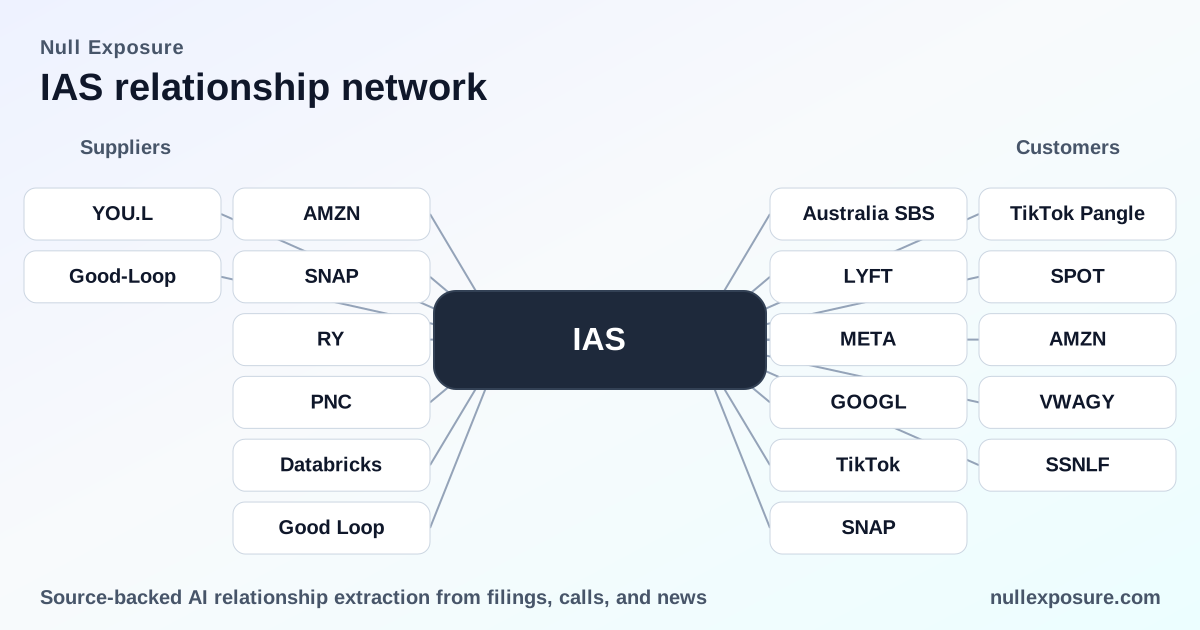
Integral Ad Science (IAS): Customer Relationships Drive Recurring Measurement Revenue
IAS sells independent media quality measurement—viewability, invalid-traffic (IVT) detection, brand safety and contextual/suitability scoring—to advertisers and major platforms, monetizing through recurring contracts, platform integrations and bespoke measurement services. The company’s revenue model is platform-centric and partnership-driven: IAS embeds measurement into large ad ecosystems and licenses analytics to advertisers, creating high-margin, recurring streams dependent on a small set of marquee platform and publisher relationships. For a quick gateway to the platform-level analysis, visit https://nullexposure.com/.
Investor thesis in one paragraph
IAS has built a defensible position as the independent arbiter of "media quality" across digital and CTV channels, converting platform integrations and advertiser demand for verification into recurring license and measurement fees. The business scales as platforms and ad formats proliferate, but it also concentrates commercial risk: deep integrations with a handful of platforms lift revenue predictability while exposing IAS to platform consolidation, renegotiation of terms, or insourcing by large partners.
How to read the customer roster
Below I walk through every customer relationship surfaced in IAS filings and press coverage. Each entry gives the practical commercial implication and a concise source reference. After the roster, I summarize company-level operational constraints and risk characteristics investors should weigh.
Customer-by-customer read: who matters and why
Australia SBS
IAS signed Australia SBS, the public broadcaster, for a strategic deal to monetize live sports inventory tied to the 2026 FIFA World Cup, indicating expansion into premium live-event publishing and regional broadcast partnerships. Source: IAS 2025Q2 earnings call (first seen Mar 8, 2026).
Lyft (LYFT)
IAS announced a partnership enabling advertisers to validate Lyft media buys across viewability, IVT and brand safety, showing expansion into ride-share owned inventory and closed-loop ad channels. Source: IAS 2025Q2 earnings call (June announcement; first seen Mar 8, 2026).
Meta / Meta Platforms (META)
IAS launched AI-driven contextual category reporting across Facebook and Instagram feeds and Reels, and extended Total Media Quality measurement to Threads and additional Meta inventory, reinforcing deep integration with Meta’s social ad stack. Source: IAS 2025Q2 earnings call and SimplyWallSt coverage (FY2024–FY2025 releases, June 18 and community narrative summary).
Google / Alphabet (GOOGL)
IAS introduced pre-screen brand safety and suitability offerings for the Google Search Partner network and integrations with Google Ad Manager, reflecting strategic product placement inside Google’s ad ecosystem and potential recurring revenue from search- and display-related measurement. Source: SimplyWallSt news aggregation (May 08 / Nov 05, FY2025).
TikTok
IAS expanded brand safety and suitability coverage for TikTok brand and performance solutions, including category exclusions and vertical sensitivity segments—an important foothold given TikTok’s scale in social video. Source: MarketWatch/MarketBeat and SimplyWallSt reporting (April 20 and Apr 11, FY2025–FY2026).
TikTok Pangle
IAS deepened collaboration with TikTok Pangle to provide brand safety, viewability and IVT measurement across Pangle’s app network, demonstrating reach into TikTok’s extended mobile ad distribution. Source: SimplyWallSt community narrative (FY2024 report).
Snap / Snapchat (SNAP)
IAS expanded measurement for Snap with comprehensive third‑party viewability, IVT, brand safety and suitability across Sponsored Snaps and additional Snapchat ad formats, and launched AI-powered social attention measurement for Snap—evidence of multi-year platform productization. Source: SimplyWallSt and PR Newswire summaries (FY2024–FY2025 releases; Nov 04 and Jul 01).
Spotify (SPOT)
IAS announced AI-driven brand safety and suitability solutions for podcast advertising on the Spotify Audience Network, signaling product diversification into audio/podcast inventory and advertiser demand for suitability in non-video formats. Source: SimplyWallSt reporting (May 06, FY2025).
Volkswagen of America (VWAGY)
Volkswagen of America adopted IAS’s Total Media Quality across major social platforms in the U.S., indicating direct advertiser renewals and enterprise adoption of IAS measurement at the brand level. Source: IAS 2025Q2 earnings call (first seen Mar 8, 2026).
Samsung / SSNLF
IAS reached a two-year expansion and renewal with Samsung, described as the company’s largest OEM partner in CTV, underlining IAS’s CTV distribution footprint through embedded OEM relationships. Source: IAS 2025Q2 earnings call (second-quarter disclosure, first seen Mar 8, 2026).
Amazon (AMZN)
Analyst commentary highlights deepening and expanding platform partnerships with Amazon, positioning IAS as integrated within Amazon’s advertising ecosystem and thus capturing recurring measurement opportunities across programmatic and seller-sourced inventory. Source: SimplyWallSt community narrative (FY2024 analyst summary).
What the roster collectively implies about IAS’s business model
- Contracting posture: IAS operates on multi-year renewals and platform integrations, evidenced by the Samsung two-year renewal and recurring product rollouts with Meta and Snap—this is a licensing and partnership-led contracting model that favors predictable, recurring revenue.
- Concentration: The customer list demonstrates concentration risk around a small number of large platforms (Meta, Google, TikTok, Snap, Amazon, Samsung). That concentration increases leverage and recurring revenue when relationships are stable, but raises exposure to platform renegotiation or insourcing.
- Criticality: For advertisers and third‑party publishers, IAS often acts as an independent arbiter of measurement—a critical control point for brand safety and IVT verification—making the company strategically valuable to both platforms and brands.
- Maturity: Relationships with large platforms and global advertisers reflect commercial maturity: productized integrations (contextual category reporting, Total Media Quality) and renewals show that IAS is beyond proof-of-concept and into scale deployments.
Key investment takeaways
- Revenue durability is strong when platform integrations remain in place, since platform-embedded measurement converts to recurring fees and expanded product footprints.
- Concentration risk is the primary downside: a small number of platform customers dominate strategic value; any unfavorable renegotiation or insourcing by those platforms directly pressures top-line growth and margins.
- Product diversification across channels (social, CTV, audio, in-app) reduces single-format vulnerability, but the company’s success remains tied to its ability to sustain independent, trusted measurement versus platform native signals.
For deeper coverage and ongoing relationship tracking, visit https://nullexposure.com/ to see how platform partnerships evolve and how IAS derivatives between product launches and contract renewals translate to revenue.
Bold final point: IAS’s commercial strength is its independence and embeddedness inside major ad platforms—but that exact positioning creates both the most compelling growth vector and the single largest concentration risk investors must monitor.