i-80 Gold (IAUX): Who the Company Sells To and Who’s Financing Its Turnaround
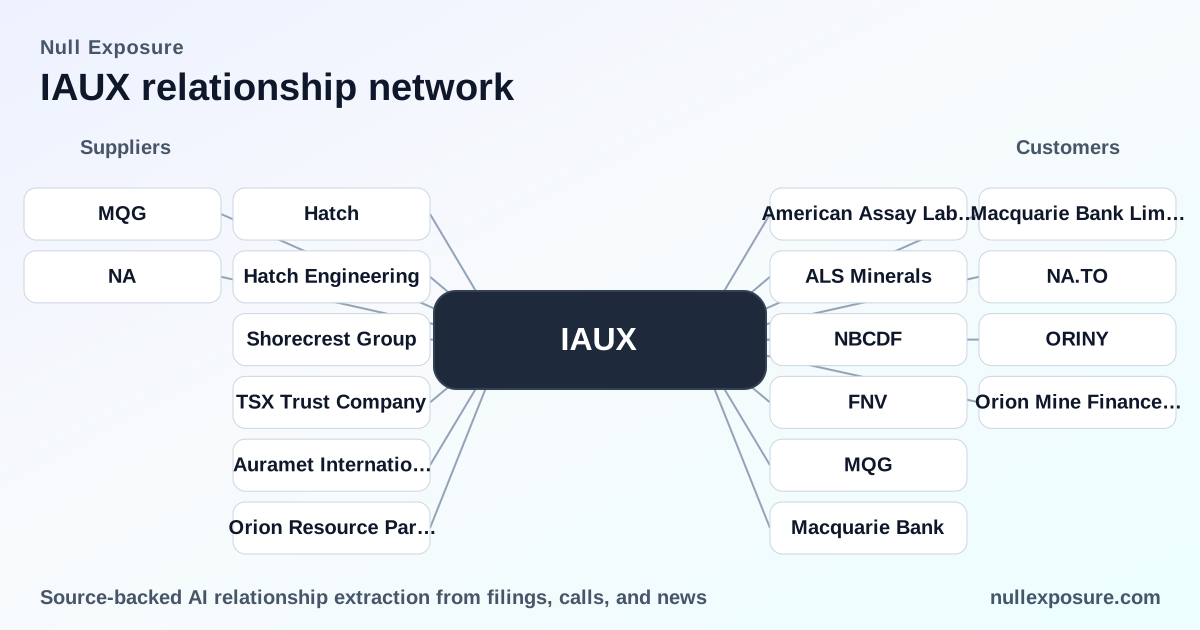
I-80 Gold is a Nevada-focused gold and silver producer that monetizes through three principal channels: direct metal sales into the London/spot market, prepay/stream and offtake contracts with large financial counterparties, and non‑dilutive royalty financing. Revenue and working capital management are tightly coupled to metal deliveries under contractual prepayment and purchase agreements, while recent financing activity has reshaped counterparty exposure and the company’s liquidity runway.
For a concise map of counterparties and financing partners, see more at https://nullexposure.com/.
The commercial and financing counterparties that matter today
Below is a plain-English run through of every counterparty listed in i-80’s compiled relationship set, with sources for each item.
ALS Minerals
ALS Minerals is i-80’s ISO/IEC 17025:2017 accredited laboratory used for exploration sample preparation and analysis in Sparks, Nevada, supporting the company’s assay workflows that underpin reserve and production reporting. This relationship is disclosed in the company’s FY2024 Form 10‑K.
Source: i-80 Gold FY2024 Form 10‑K (exploration/sample analysis).
American Assay Laboratory
American Assay Laboratory in Sparks serves as i-80’s umpire lab for check‑sample analysis, providing independent assay verification to validate primary laboratory results. This relationship is described in the FY2024 10‑K.
Source: i-80 Gold FY2024 Form 10‑K (umpire check sample analysis).
National Bank of Canada (NBCDF / National Bank)
National Bank of Canada is a lead gold prepayment counterparty in the financing package that provides an initial $150 million advance to i-80, with contractual obligations tied to gold deliveries (the financing package also contemplates a larger accordion). Insidermonkey’s Q4 2025 earnings coverage and contemporaneous press reporting detail the advance and delivery scheduling (approximately 40,000 ounces over a 30‑month period beginning January 2028). Multiple news outlets reported the bank’s role in the March 2026 financing announcements.
Source: Earnings call transcript coverage (Insidermonkey, March 2026); Finviz / E&MJ coverage of financing package (March 2026).
Macquarie Bank / Macquarie Bank Limited
Macquarie Bank participated alongside National Bank in the gold prepay facility, providing part of the initial $150 million tranche and the facility structure that includes an uncommitted accordion for additional capacity. TradingView and Finviz summarised Macquarie’s role in the announced financing package.
Source: TradingView and Finviz reporting on the financing package (March–May 2026).
Franco‑Nevada Corporation (FNV)
Franco‑Nevada executed a $250 million life‑of‑mine royalty purchase, a non‑dilutive financing that closed in early May 2026 and is explicitly intended to support debt retirement and development spending. PR Newswire reported the closing of the royalty financing and related press releases confirm the amount and the counterparty.
Source: PR Newswire release (May 2, 2026); Finviz/E&MJ reporting (March 2026).
Orion / Orion‑affiliated funds (ORINY / Orion Mine Finance Fund III (HG) Ltd. / OMF Fund III)
Orion and its affiliates are long‑running prepay and silver purchase counterparties with multiple amended agreements, embedded delivery schedules, convertible debt instruments, and off‑take commitments; Orion has been both a purchaser of metal under prepaid arrangements and a lender via convertible facilities. SEC filing references and trading coverage note ongoing amendments, deferred deliveries, and the retirement of legacy Orion obligations as part of the financing package.
Source: i-80 Gold FY2024 Form 10‑K disclosures; TradingView and Finviz coverage of the 10‑K and financing package (March 2026).
What the contract and counterparty signals tell investors
-
Contracting posture mixes short‑term obligations with multi‑year offtakes. i-80 operates both short-term prepay/silver deliveries (explicit short‑term delivery schedules through 2025) and multi‑year offtake constructs (Orion/offtake terms that extend into the 2028–2034 window). This mix creates a rolling cadence of operational delivery risk and liquidity events. (Company signal: contract_type excerpts in FY2024 disclosures.)
-
Counterparty types skew toward large financial institutions. The company sells significant metal volume to large, credit‑worthy financial counterparties (banks and specialty finance groups) and uses royalty buyers for balance‑sheet financing. This is a strategic choice to prioritize liquidity and credit quality over diversified industrial offtakes.
-
Geography is primarily North America with global market access. Operations and most counterparties are North America‑centric (Nevada operations, U.S./Canadian counterparties), but sales and pricing are exposed to global gold markets; the company sells into the London spot market for price realization when appropriate.
-
Concentration is a structural risk. Disclosures indicate very high receivable concentration (one unnamed customer represented a very large share of trade receivables at year‑end), which is a critical counterparty concentration signal for creditors and suppliers (company‑level materiality signal).
-
Relationship maturity varies—active deliveries, renewals and prospective offtakes. Many agreements are active and being amended to manage short‑term liquidity; others are prospective long‑dated offtake frameworks that only commence after current contracts expire.
-
Spend bands and materiality indicate meaningful cash flows. Prepay and royalty transactions are material—tens to hundreds of millions—so counterparties and lenders have structural influence on execution timelines.
Why these relationships matter for valuation and operational risk
-
Financing reshapes cashflow risk. The combined royalty sale to Franco‑Nevada and the prepay facility with National Bank and Macquarie materially improved liquidity and enabled retirement of legacy obligations, reducing near‑term refinancing risk. PR Newswire and market reports confirm the $250M royalty close and the $150M initial prepay advance.
-
Delivery schedules create operational execution gates. The company’s ability to meet scheduled gold and silver deliveries under prepay and silver purchase arrangements (some of which were deferred and amended) is a direct determinant of covenant compliance, cash flows, and future access to accordion funding.
-
Single‑counterparty concentration elevates counterparty exposure. High receivable concentration amplifies downside if the dominant purchaser or a key finance partner changes terms or reduces offtake — a material credit and revenue risk the company acknowledges in its 10‑K.
-
Laboratory and assay providers are operational enablers. Accredited labs (ALS, American Assay Laboratory) underpin reserve validation and saleable product verification; disruptions there would be operationally awkward but not balance‑sheet altering.
For investors seeking a one‑page orientation on counterparties and financing dynamics, visit https://nullexposure.com/ for additional company maps and relationship analytics.
Bottom line for investors
- Positive: The Franco‑Nevada royalty and the National Bank/Macquarie prepay together materially strengthen the balance sheet and reduce immediate refinancing pressure. PR Newswire and March 2026 coverage document the transactions and closing activity.
- Watchlist: Execution on delivery schedules, the company’s ability to diversify receivables, and operational ramp at core projects are the critical near‑term value drivers. Contractual concentration and the timing of deliveries under prepaid structures are principal risk vectors.
If you’re evaluating i-80 for underwriting, lending, or portfolio exposure, focus on contractual delivery performance, counterparty amendment histories, and the timetable for the company’s project ramp‑up — these factors determine whether current financing converts into sustainable cash generation.