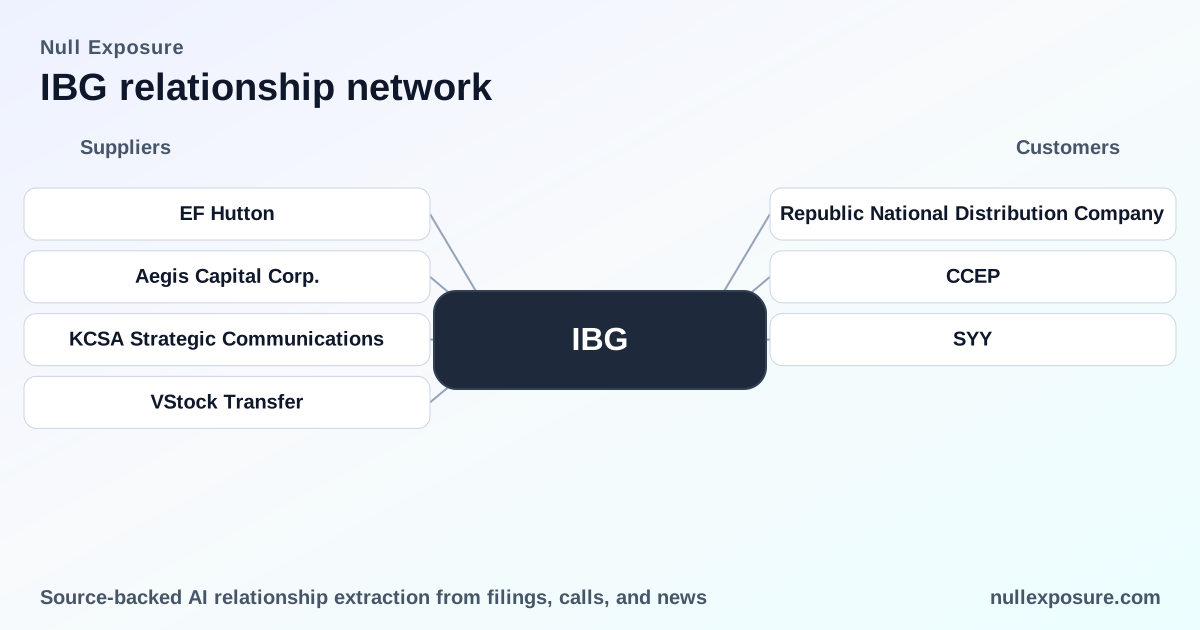
IBG Customer Relationships: Distribution Muscle Driving Revenue Growth
Innovation Beverage Group Limited (IBG) develops and sells a portfolio of sustainable beverage brands—most notably Australian Bitters—monetizing through wholesale and retail distribution deals, direct online retail, and strategic partnerships that extend shelf presence and brand visibility. Revenue is earned by product sales through third‑party distributors and retailers; distribution partnerships are the primary commercial lever for scaling market penetration in the U.S. and Australia. For a concise company profile and data-driven monitoring, see https://nullexposure.com/.
Why the partner list matters to investors
IBG’s partner set is not an academic exercise—these relationships define go‑to‑market economics, inventory velocity, and margin realization. A network anchored by national beverage distributors and foodservice leaders signals a distribution-first contracting posture, low upfront capex to scale, and dependence on channel partners to convert brand awareness into sales. Key business-model implications:
- Concentration and criticality: A handful of large distributors can accelerate scale but create concentration risk if a partner’s commitment shifts.
- Maturity signal: Partnerships with legacy players and national wholesalers indicate the company has moved beyond direct-to-consumer proof‑of‑concept and is executing traditional wholesale routes.
- Commercial leverage: National distribution and a branded e‑commerce presence provide multiple revenue channels that help stabilize seasonality and improve customer reach.
If you want structured monitoring of IBG’s partner activity and filings, visit https://nullexposure.com/ for ongoing coverage.
Relationship-by-relationship read: who does what and why it matters
RNDC brings Australian Bitters to six U.S. states
IBG’s Australian Bitters Company and BITTERTALES brands are slated for distribution by Republic National Distribution Company in California, Oregon, Washington, Hawaii, Arizona, and Michigan, expanding stateside shelf coverage and on‑premise availability. According to ACN Newswire (Mar 10, 2026), RNDC is a major alcohol distributor that materially extends IBG’s reach into west coast and select mid‑west markets (https://www.acnnewswire.com/press-release/english/98574/innovation-beverage-group-expands-u.s.-distribution-of-its-award-winning-bitters-through-one-of-the-nation's-largest-beverage-alcohol-distributors).
Bevmart serves as IBG’s online retail storefront
Bevmart is the company’s designated online retailer for spirits, liqueurs, and ready‑to‑drink categories, providing a direct digital channel for consumer sales and demand capture. A market writeup on Intellectia.ai highlighted Bevmart’s role in IBG’s retail distribution strategy (May 3, 2026) (https://intellectia.ai/news/stock/innovation-beverage-group-draws-retail-interest-ahead-of-blockfuel-merger).
CCEP noted as an amplifier of distribution and visibility (QuiverQuant)
A QuiverQuant release noted a partnership with Coca‑Cola Europacific Partners that enhances IBG’s distribution capabilities and brand visibility in critical markets, implying co‑brand routing into major retail and on‑premise channels. The QuiverQuant item (Mar 10, 2026) frames CCEP as a strategic distribution amplifier for IBG (https://www.quiverquant.com/news/Innovation+Beverage+Group+Ltd+Announces+Five-for-One+Reverse+Stock+Split+Effective+January+30%2C+2026).
Coca‑Cola Europacific Partners described as a market partner (QuiverQuant)
QuiverQuant repeats that Coca‑Cola Europacific Partners partnership strengthens IBG’s distribution footprint and supports market entry efforts—an operational signpost that IBG has negotiated channel access beyond boutique distribution. See QuiverQuant (Mar 10, 2026) for the announcement context (https://www.quiverquant.com/news/Innovation+Beverage+Group+Ltd+Announces+Five-for-One+Reverse+Stock+Split+Effective+January+30%2C+2026).
Sysco puts Australian Bitters into U.S. foodservice channels
IBG’s Australian Bitters are announced as available nationwide in the U.S. through Sysco, the global leader in foodservice distribution, which opens restaurant and hospitality channels for the brand. ACN Newswire reported this Sysco arrangement on Mar 10, 2026, explicitly linking IBG to national foodservice distribution (https://www.acnnewswire.com/press-release/english/98574/innovation-beverage-group-expands-u.s.-distribution-of-its-award-winning-bitters-through-one-of-the-nation's-largest-beverage-alcohol-distributors).
SYY (Sysco) referenced as the Nasdaq symbol for the same arrangement
The data also lists SYY (Sysco’s ticker) in connection with IBG’s U.S. foodservice availability, reinforcing that the Sysco relationship is a material channel for on‑premise demand generation (ACN Newswire, Mar 10, 2026) (https://www.acnnewswire.com/press-release/english/98574/innovation-beverage-group-expands-u.s.-distribution-of-its-award-winning-bitters-through-one-of-the-nation's-largest-beverage-alcohol-distributors).
CCEP framed as partner behind IBG’s market-dominating bitters position (ManilaTimes / GlobeNewswire)
Multiple fundraising and market update releases describe IBG’s Australian Bitters as having disrupted an incumbent and achieving a market‑dominating position in several territories “including a partnership in Australia with Coca‑Cola Europacific Partners,” linking CCEP to IBG’s domestic strength. ManilaTimes/GlobeNewswire coverage (Mar 13, 2026) associates the partnership with IBG’s market momentum (https://www.manilatimes.net/2026/03/13/tmt-newswire/globenewswire/innovation-beverage-group-limited-announces-pricing-of-6-million-public-offering/2299632).
CCEP cited again in public‑offering closing (QuiverQuant)
In the context of a $6 million public offering, QuiverQuant reiterated that IBG’s market‑leading bitters brand benefits from an Australian partnership with Coca‑Cola Europacific Partners—linking capital raises to distribution scale and investor messaging (QuiverQuant, May 3, 2026) (https://www.quiverquant.com/news/Innovation+Beverage+Group+Limited+Closes+%246+Million+Public+Offering+to+Fuel+Growth+and+Development).
Additional CCEP mention in closing notice (ManilaTimes)
A separate ManilaTimes release covering the closing of the $6 million public offering again references the CCEP partnership as a contributor to IBG’s territorial strength, reinforcing the consistency of IBG’s disclosure around that relationship (ManilaTimes, Mar 17, 2026) (https://www.manilatimes.net/2026/03/17/tmt-newswire/globenewswire/innovation-beverage-group-limited-announces-closing-of-6-million-public-offering/2301049).
Company-level signals on contracting and risk
There are no explicit contractual terms or constraints disclosed in the relationship data provided, so the following are company-level signals derived from partner types and reporting:
- Contracting posture: Channel partnerships are typical commercial distribution agreements rather than equity JV structures; IBG’s model emphasizes non‑capital, revenue‑sharing expansion.
- Concentration: The recurrence of large distributors (RNDC, Sysco, CCEP) suggests mid‑to‑high concentration of downstream customers—useful for scale but a potential single‑point risk if terms change.
- Criticality and maturity: Partnerships with national distributors and major bottlers indicate IBG has transitioned from experimental launches to commercially viable distribution, increasing predictability of revenue flows.
- Operational implication: Reliance on third‑party logistics and route‑to‑market partners reduces direct investment needs but places execution risk in channel partners’ hands.
Investment implications and next steps
Positive: National distribution through RNDC and Sysco, plus market access via Coca‑Cola Europacific Partners and an owned online retail channel (Bevmart), materially de‑risks IBG’s go‑to‑market for its flagship bitters and RDT categories. Risk: Channel concentration means partner contract renewals, listing terms, and promotional support will materially affect topline cadence. For investors tracking customer‑relationship developments and their impact on revenue trajectories, the partner announcements over March–May 2026 constitute meaningful operational progress.
For continuous alerts on partner activity and filings that affect IBG’s commercial outlook, visit https://nullexposure.com/.