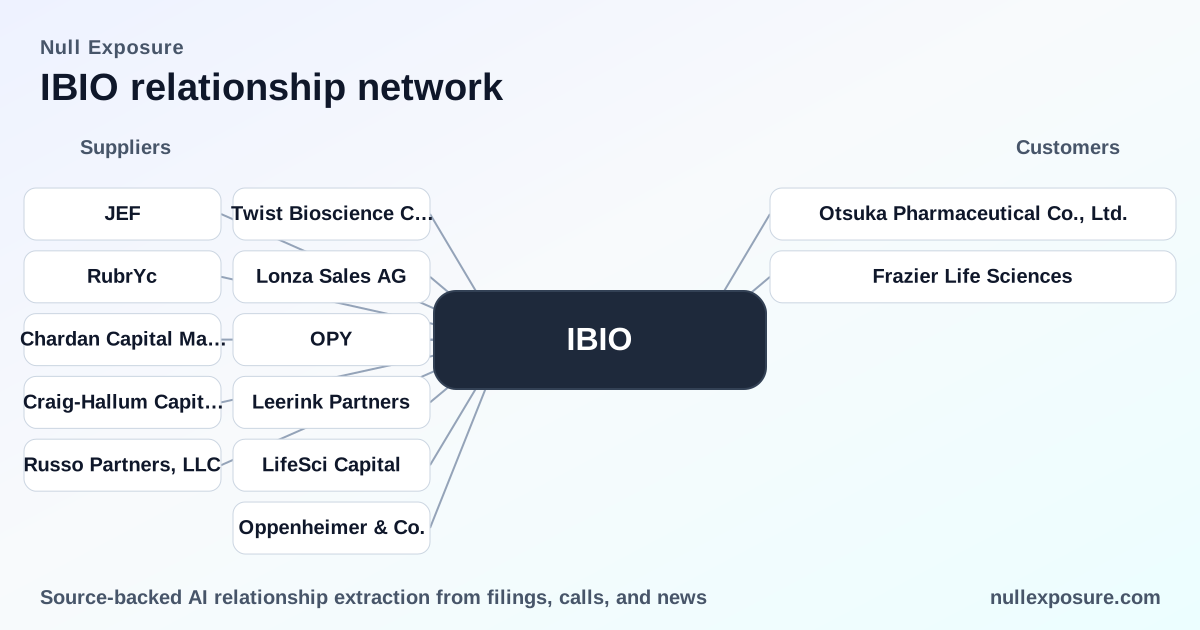
iBio (IBIO): Customer and Counterparty Map for Investors
iBio operates as a hybrid biotech services and product developer: it provides contract development and manufacturing (CDMO) services, sells intellectual property and licensing rights, and finances operations through equity placements and warrant financings. The company monetizes through fixed‑fee CDMO work and license fees for technology/IP, supplemented by asset sales and a variety of financing arrangements to fund development and operations. For a concise view of iBio’s relationship footprint and its implications for investors, see https://nullexposure.com/.
High‑level takeaways investors need first
- Revenue is small and concentrated: reported continuing operations revenue was $400k in FY2025 and $225k in FY2024, indicating that commercial service revenue is currently immaterial to overall financing needs.
- The business is financed actively through equity instruments and private placements, including multiple warrant inducements, ATM programs and private placements in the $0.7–26M range.
- Contracts are mixed: iBio uses licensing and short‑term fixed‑fee contracts for research and CDMO work, while also executing spot asset sales and structured equity purchase frameworks.
- Geography and counterparty mix is North America‑centric with global regulatory exposure, and the company has executed at least one material real‑asset sale to a public university system.
The counterparties that define recent activity
Below are the relationships surfaced in public filings and news; each entry includes a plain‑English summary and a concise source reference.
Otsuka Pharmaceutical Co., Ltd.
iBio sold and assigned intellectual property rights related to its PD‑1 assets to Otsuka under an Asset Purchase Agreement dated February 25, 2024. This transaction transferred IP ownership and constituted a discrete asset sale rather than an ongoing CDMO engagement. (Source: iBio FY2025 Form 10‑K, asset purchase agreement disclosure.)
- Constraint linkage: the filing explicitly documents a spot asset sale to Otsuka, which registers as a one‑off monetization of IP in the company’s FY2025 disclosures.
Frazier Life Sciences
Frazier Life Sciences led a private placement financing for iBio, participating in a $26 million financing round announced January 9, 2026; the financing drew participation from existing investors. This relationship is capital‑provider rather than customer‑of‑services and underscores iBio’s reliance on institutional life‑science investors to fund operations. (Source: GlobeNewswire press release, Jan 9, 2026.)
Texas A&M University System Board of Regents
The Texas A&M Board of Regents acquired iBio’s Bryan, Texas manufacturing facility for $8.5 million; iBio’s disclosures document a purchase and sale agreement dated May 17, 2024 that terminated the prior ground lease and transferred buildings, equipment and related rights. This represents a material real‑asset disposition to a government entity and a strategic contraction of owned manufacturing capacity. (Source: iBio FY2025 Form 10‑K; media reporting aggregated by SimplyWall, June 2026.)
What the relationship map implies about iBio’s operating model
-
Contracting posture: iBio executes a mix of short‑term R&D/fixed‑fee engagements and spot asset sales, alongside longer‑dated equity frameworks (warrants, ATM and purchase agreements). That combination signals a company balancing cash generation from discrete transactions against ongoing financing programs. Evidence in filings includes licensing revenue and small research collaborator revenues, ATM sales activity, and multiple warrant inducement agreements.
-
Concentration and materiality: iBio’s disclosed revenues are concentrated in a handful of collaborators (the company reported revenue from one research collaborator in FY2025 and two in FY2024). Customer revenue is immaterial relative to financing activity, so investor focus should be on counterparty credit and financing sources rather than recurring service cash flow.
-
Criticality and maturity: Revenue lines tied to licensing and research are early‑stage and low in absolute size (hundreds of thousands annually), while the company has executed material one‑off monetizations (real‑estate sale to Texas A&M, IP sale to Otsuka). Commercial maturity is low; product candidates remain in development and the firm relies on non‑operating cash infusions.
-
Financing posture: iBio maintains an active capital markets strategy — ATM programs, private placements, warrant inducements, and at‑the‑market subscription constructs — indicating the company treats equity liquidity and contingent financings as primary funding levers. Reported spend bands in filings and financing notices place transactions across the $100k–$100M spectrum, with multiple financings and an $8.5M property sale.
Operational and investor risks highlighted by relationships
- Revenue volatility and reliance on disposals/financing: With core service revenue in the low six figures and material proceeds coming from asset sales and financings, cash flow is event‑driven, not recurring. Investors should treat operating cash generation as experimental until CDMO or product revenues scale materially.
- Counterparty profile matters: Transactions run the gamut — strategic pharma (Otsuka), institutional investor syndicates (Frazier and other life‑science investors), and a public university system (Texas A&M). Government counterparty transactions and IP transfers change operational footprint and can reduce balance‑sheet asset intensity.
- Regulatory and reimbursement exposure: Filings repeatedly flag dependence on government payors and regulatory approvals; this is a company‑level risk that affects the future commercial value of licensed IP and product candidates.
How to use this map in investment analysis
- Prioritize cash runway analysis that incorporates likely proceeds from known asset dispositions and committed financing tranches rather than projecting recurring revenue growth.
- Evaluate counterparties for strategic value (Otsuka’s acquisition of PD‑1 IP signals external validation of that program) and for capital reliability (institutional investors such as Frazier signal market willingness to fund).
- Monitor disposal activity (facility sales, IP transfers) as a balance‑sheet reshaping strategy that reduces fixed costs but also shrinks future CDMO capacity.
For a structured look at counterparties and contracts across small‑cap biotech issuers, visit https://nullexposure.com/ for comparative analysis and data‑driven summaries.
Bottom line
iBio’s customer and counterparty footprint shows a company in transition: operationally light, financing‑heavy, and executing discrete monetizations of IP and real assets while maintaining small‑scale CDMO and licensing revenue. Investors should treat the current revenue base as nonrecurring, focus on financing durability, and value counterparties both for immediate cash impact and for strategic validation of retained assets.