ETF holders and clients that matter for Interactive Brokers (IBKR): what investors need to know
Interactive Brokers is a global, automated electronic broker that earns transaction and servicing revenue by executing, clearing and custodying trades, lending securities, and providing market data and financing to a mix of retail and institutional clients. Its monetization is a blend of usage-based fees (commissions, payments-for-order-flow, clearing fees, securities lending) and recurring/subscription revenue (market data, sweep and custody programs), with net interest and margin lending a material second pillar of earnings. For investors and operators, the ownership by major ETFs and the presence of clearing clients confirm both IBKR’s liquidity profile and its central role as a service provider to other financial intermediaries. Read more analysis and data at NullExposure.
What the public relationships say: a concise roll call
Below are every relationship flagged in the source results. Each entry states the observable relationship and points to the original source.
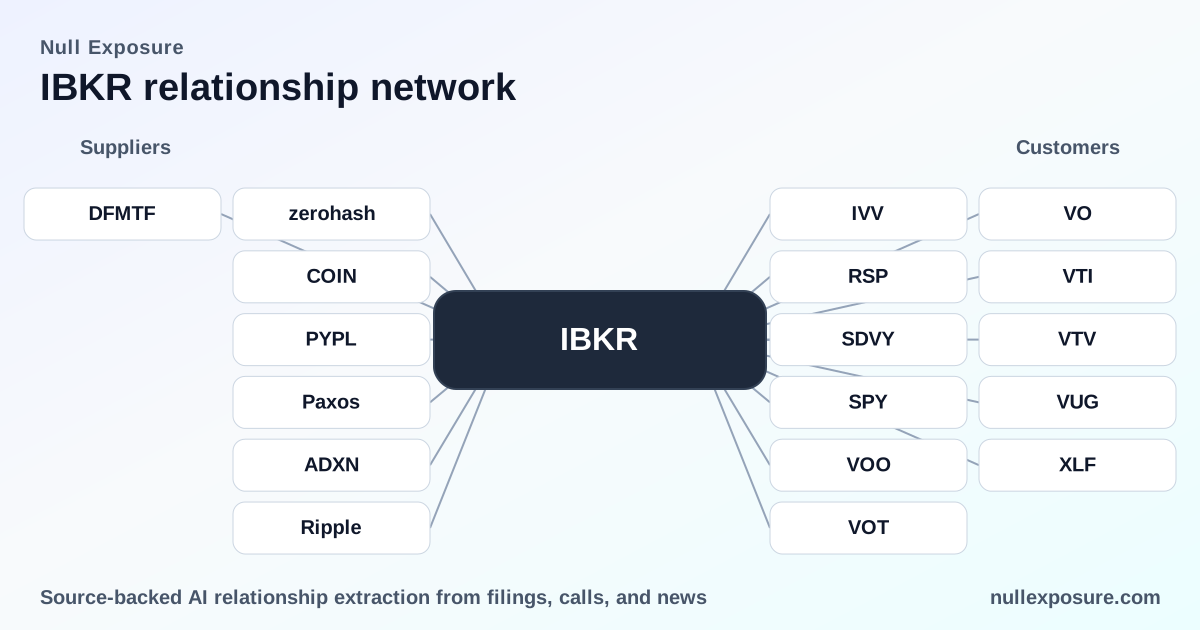
XLF — large financial-sector ETF holds IBKR
State Street’s XLF shows a 0.41% weight in IBKR with a reported market value of $197.60 million; this indicates institutional passive demand from financial-sector index exposure. According to TradingView’s NASDAQ-IBKR holdings page (first seen March 10, 2026), XLF lists that holding.
IVV — S&P 500 core ETF ownership
iShares Core S&P 500 ETF (IVV) records a 0.05% stake in IBKR, market value $375.92 million, reflecting broad-market passive exposure to the company as an S&P 500 constituent. TradingView’s NASDAQ-IBKR holdings snapshot documents this position (March 10, 2026).
RSP — equal-weight S&P exposure includes IBKR
Invesco’s RSP shows a 0.19% weight in IBKR with market value $170.71 million, which signals that equal-weight strategies place a larger relative bet on IBKR than cap-weighted funds. This position is reported on TradingView’s NASDAQ-IBKR holdings page (March 10, 2026).
SDVY — small/mid dividend-focused ETF lists IBKR
First Trust’s SDVY reports a 0.92% weight in IBKR, market value $94.30 million, underscoring that certain dividend or SMID strategies include IBKR exposure. TradingView’s NASDAQ-IBKR page contains this holding (March 10, 2026).
SPY — the flagship S&P ETF includes IBKR
SPDR S&P 500 ETF Trust (SPY) shows a 0.05% weight, market value $345.07 million in IBKR—another confirmation of broad passive S&P allocation to the stock. This is recorded on TradingView’s NASDAQ-IBKR holdings page (March 10, 2026).
VO — Vanguard mid-cap ETF holding
Vanguard Mid‑Cap ETF (VO) reports a 0.34% weight with $686.19 million market value in IBKR, indicating meaningful mid-cap indexing exposure. TradingView’s NASDAQ-IBKR holdings snapshot captures this (March 10, 2026).
VOO — Vanguard S&P 500 ETF exposure
VOO shows a 0.06% weight in IBKR with market value $849.53 million, consistent with S&P tracking funds owning the company across multiple products. TradingView’s NASDAQ-IBKR page includes this entry (March 10, 2026).
VOT — Vanguard mid-cap growth ETF holds IBKR
Vanguard Mid‑Cap Growth ETF (VOT) lists a 0.84% weight in IBKR with a market value of $265.50 million, highlighting growth-oriented mid-cap allocations to the share. TradingView’s NASDAQ-IBKR holdings record this (March 10, 2026).
VTI — Vanguard Total Stock Market ETF position
Vanguard Total Stock Market ETF (VTI) carries a 0.05% weight in IBKR with market value $999.99 million, reflecting broad inclusion across total-market exposures. TradingView’s NASDAQ-IBKR page reports this (March 10, 2026).
VTV — Vanguard Value ETF allocation
Vanguard Value ETF (VTV) shows a 0.06% weight with $145.83 million market value in IBKR, indicating value-focused products hold the name too. TradingView’s NASDAQ-IBKR holdings detail this (March 10, 2026).
VUG — Vanguard Growth ETF ownership
Vanguard Growth ETF (VUG) lists a 0.07% weight in IBKR, market value $247.02 million, demonstrating growth-style ETFs’ exposure. TradingView’s NASDAQ-IBKR holdings page shows this (March 10, 2026).
MDBH — a direct client using Interactive Brokers for clearing and custody
MDBH’s 2024 filing notes that clearing, custody and trade administration fees were incurred from Interactive Brokers, the company's clearing firm, indicating MDBH uses IBKR as a service provider for trade settlement. This relationship is documented in MDBH’s Form 10-K (MD B Holdings filing for year ended December 31, 2024).
How these relationships map to IBKR’s operating model
-
Passive ETF ownership is broad and diversified. Multiple major S&P, total‑market, mid‑cap, growth and value ETFs report IBKR positions—this confirms institutional index-driven demand for the share and supports liquidity in the free float. (Source: TradingView holdings, March 10, 2026.)
-
IBKR operates as both seller and service provider. The firm collects commissions, clearing and custody fees and provides margin and securities‑lending services; it also acts as a clearing counterparty for other financial firms such as MDBH, as shown by MDBH’s 2024 filing.
-
Revenue mix is layered: usage-heavy plus subscriptions. Company disclosures show usage-based fees (commissions, payments-for-order-flow, risk exposure fees) are recognized at execution or daily, while market data and sweep programs are recognized monthly—a deliberate hybrid monetization posture that balances volatility in trading income with recurring streams (Interactive Brokers 2024 Form 10‑K language).
-
Counterparty concentration and materiality profile. The company reports no single customer represented more than 2% of commissions in 2024, indicating low customer concentration on the revenue side, while customer balances and margin lending are large (tens of billions) and therefore operationally critical to IBKR’s net interest income (2024 Form 10‑K).
-
Global reach with North America central. IBKR is a global execution and clearing platform across 160+ exchanges in 36 countries, with substantial international revenue but strong U.S. footprints—a mature, geographically diversified infrastructure (2024 Form 10‑K).
If you want a structured view of holdings and client links for portfolio or counterparty analysis, visit NullExposure for integrated reports and signals.
Investment implications — what investors and operators should track
-
Liquidity and index inclusion reduce downside selling friction. Broad inclusion across large passive products provides a stable base of holders that supports liquidity.
-
Earnings sensitivity to volumes and interest rates remains high. Trading volumes drive commissions and fee income, while margin lending and sweep programs couple earnings to benchmark rates; monitor DARTs, customer margin loans and net interest margins in quarterly filings.
-
Operational and counterparty risk is material. IBKR’s role as custodian and clearing agent is critical; systems outages, regulatory shifts, or customer defaults can have material consequences for finance and operations.
-
Watch payments-for-order-flow and regulatory fees. These are notable components of non‑interest revenue and are sensitive to market structure changes or exchange fee adjustments.
Conclusion: ETF ownership paints IBKR as a broadly held, liquid, index‑eligible company while direct customer relationships (like MDBH) underscore its critical role as a clearing and custody provider. For allocators and operators, the combination of diversified passive holders and high‑volume, usage-driven revenue makes IBKR a unique franchise with both scalable upside and operational exposure.
For deeper counterparty mapping and continuous monitoring tools, explore actionable signals at NullExposure.