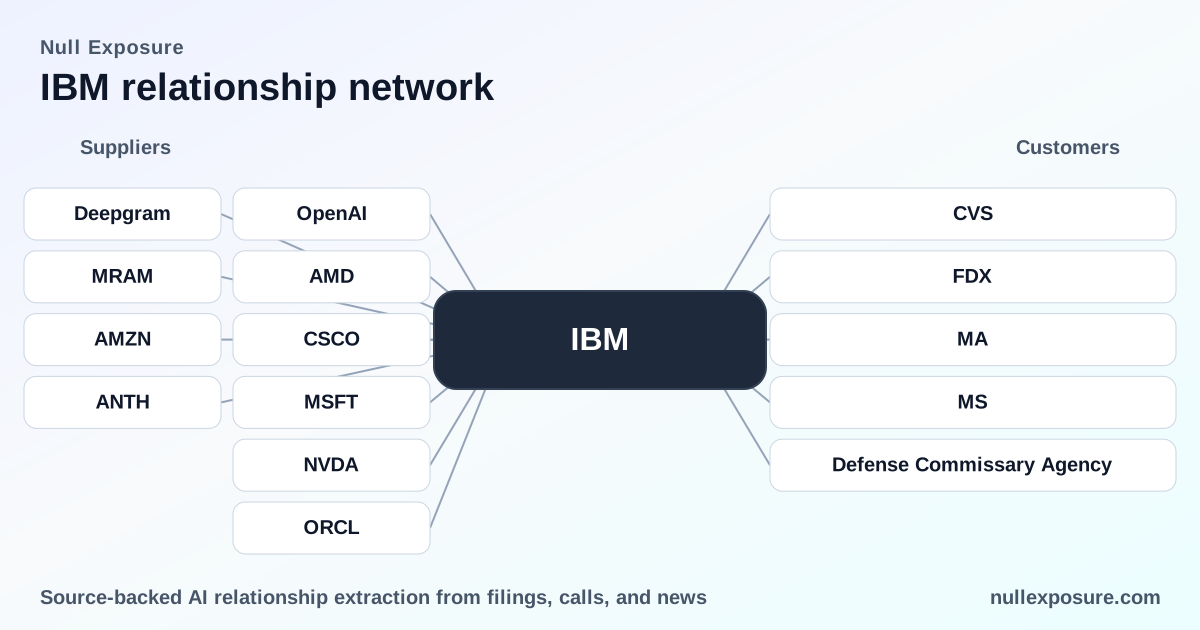
IBM’s customer map: revenue engine, risk posture, and named clients investors should know
Thesis: IBM monetizes a hybrid mix of software licenses, infrastructure sales, and high‑margin consulting services, increasingly anchored to its watsonx AI platform and hybrid‑cloud stack; recurring revenue from software and services plus large, multi‑year client engagements drive cash flow and create stickiness. For investors, the relevant lens is incumbency in mission‑critical systems, expanded AI monetization, and the exposure that comes from deep relationships with governments and very large enterprises. Learn more at https://nullexposure.com/.
How IBM sells — simple commercial logic, complex delivery model
IBM sells across three monetizable pillars: software (AI and middleware), infrastructure (mainframes and hybrid cloud), and consulting/services (strategy, implementation, and managed services). According to company filings, IBM’s trailing twelve‑month revenue is roughly $68.9 billion, with material contributions from software and consulting that convert higher gross margins and recurring cash flow. The company also offers client financing to lower procurement friction on hardware and large transformation deals.
This operating model produces a contracting posture dominated by long term, enterprise and government engagements — contracts that are transactional for hardware but outcome‑oriented for consulting and AI rollouts. That mix drives both predictable services revenue and episodic capital sales tied to infrastructure refresh cycles.
Constraints and structural signals that shape customer relationships
- Global footprint and client diversification. IBM operates in 175+ countries and earns the majority of revenue outside the U.S.; this global reach reduces concentration risk but raises regulatory and compliance complexity, especially for data and AI governance.
- Broad customer base across segments. The client set spans small businesses to very large enterprises and governments, meaning IBM must manage tailored delivery models from packaged SaaS to bespoke consulting and on‑premises systems.
- High materiality and criticality. IBM’s offerings are used in regulated and mission‑critical environments — financial services, healthcare, defense and public sector — which translates into longer sales cycles, contractual SLAs, and heightened compliance obligations.
- Service provider and seller roles. IBM acts both as vendor (selling software, hardware) and as service provider (consulting, managed services), increasing cross‑sell potential but also operational complexity in delivery and risk exposure.
- Segment concentration on services and software. Constraints indicate strong emphasis on services, software and infrastructure — the very areas where IBM is shifting toward AI‑driven recurring revenue.
Key takeaway: IBM’s business model creates durable revenue but requires disciplined execution on large, regulated contracts and continued investment in security and compliance to preserve enterprise incumbency.
If you want a structured view of customer mentions across IBM’s public disclosures and press, see our platform at https://nullexposure.com/.
What the public record says about named IBM customers and partners
Below is a concise, itemized review of every relationship referenced in the public results set. Each entry is a plain‑English takeaway with a source reference.
-
DVLT (Datavault AI / DVLT) — Datavault highlights a deepened alliance with IBM including platinum partner status and integration of IBM watsonx.ai to deliver enterprise AI at the edge and cybersecure compute in metro deployments; Datavault discussed this on its 2025 Q3 earnings call and press releases in early 2026. (Datavault earnings call, 2025Q3; Datavault press releases, Mar 2026).
-
Mastercard (MA) — IBM’s 2025 Q4 earnings commentary lists Mastercard as a customer leveraging IBM’s data management platforms, software and GenAI products in core workflows. (IBM 2025 Q4 earnings call, Mar 2026).
-
Morgan Stanley (MS) — IBM stated on its 2025 Q4 earnings call that Morgan Stanley is infusing IBM GenAI technologies into core workflows, reflecting adoption in financial services. (IBM 2025 Q4 earnings call, Mar 2026).
-
CVS Health (CVS) — IBM highlights CVS as an infrastructure client using z/OS Z17 AI capabilities to manage mainframe application workloads and enhance resiliency. (IBM 2025 Q4 earnings call, Mar 2026).
-
FedEx (FDX) — IBM’s 2025 Q4 remarks include FedEx as a customer integrating GenAI and IBM technology into operations. (IBM 2025 Q4 earnings call, Mar 2026).
-
Pearson (PSO) — IBM will help Pearson develop a custom AI learning platform to combine human expertise with AI assistants, similar to IBM Consulting Advantage (news coverage, Dec 2025). (Sahm Capital report, Dec 11, 2025).
-
20/20 BioLabs (AIDX) — 20/20 BioLabs launched a OneTest solution built with IBM watsonx.ai, and public filings and press releases specify IBM acted as an information‑technology provider in FY2026. (GlobeNewswire press releases and company filings, Feb–Mar 2026).
-
TD SYNNEX (SNX) — Channel coverage describes TD SYNNEX gold partners leveraging IBM watsonx and lists TD SYNNEX among distributors that benefit from IBM hybrid‑cloud and AI spending. (IndustryAnalysts and Finviz coverage, FY2025–FY2026).
-
2U (TWOU) — 2U launched IBM‑developed microcredentials for AI and data workforce training using IBM curriculum and materials. (2U newsroom, FY2025).
-
SEI Investments (SEIC) — Multiple reports describe SEI engaging IBM to accelerate infrastructure modernization and agentic AI deployment across operations. (Finviz and Investing.com coverage, FY2026).
-
Defense Commissary Agency (government) — News reporting records an IBM contract (reported ~$112M) for electronic‑shelf‑label modernization and other AI contracts in early 2026. (Finviz and press coverage, Feb–Mar 2026).
-
Kyndryl (KD) — Kyndryl introduced agentic AI‑powered mainframe services built on IBM z/OS and Watsonx Assistant for Z, reflecting continued product and service integration between IBM and its former managed‑services spinout. (Simply Wall St and TIKR commentary, FY2026).
-
TruGolf (TRUG) — TruGolf announced AI enhancements powered by IBM watsonx.ai that the company expects to be a differentiator in its software ecosystem. (GlobeNewswire, Q3 2025 results).
-
Arrow Electronics (ARW) — Channel commentary notes Arrow is selling AI offers across vendors including IBM, indicating distribution channel activity around IBM’s AI portfolio. (CRN article, FY2026).
-
Ferrari (RACE) — Press releases report IBM debuting AI‑powered features in Scuderia Ferrari’s app, reflecting branded consumer/experience work. (MarketScreener and Intellectia coverage, FY2026).
-
V2X (VVX) — Company commentary on partnerships lists IBM alongside AWS and Google as technology partners for V2X’s platform implementations. (Earnings call transcript coverage, FY2026).
-
Coursera (COUR) — Coursera cited that it has aligned certificates to India’s NSQF including programs from IBM, indicating IBM’s role in workforce credentialing programs. (Coursera earnings call transcript, Mar 2026).
-
Entrust — Analyst coverage references a collaboration between Entrust and IBM Consulting on quantum‑safe cryptography, positioning the partnership as revenue‑adjacent. (MarketBeat analyst note, Apr 2026).
-
Dallara — Market commentary notes a collaboration with IBM for physics‑based AI and quantum vehicle design, cited as part of IBM’s partnership announcements. (MarketBeat coverage, Apr 2026).
-
Cementos Pacasmayo (CPAC) — IBM Services case study documents SAP S/4HANA migration and cloud transformation work for Cementos Pacasmayo, an example of IBM’s regional consulting wins. (IBM case study, FY2023).
Investment implications and risks to flag
- Upside: IBM’s named relationships demonstrate enterprise and public‑sector traction for watsonx and hybrid cloud, supporting recurring consulting and software revenue. Cross‑sell between consulting and software is a structural advantage.
- Downside risks: Concentration in regulated industries and government contracts increases compliance, cybersecurity and contract performance risk; IBM’s global footprint also amplifies geostrategic and regulatory exposure. Execution on multi‑year professional services engagements and on‑premises infrastructure deliveries is critical.
For a deeper, search‑able index of IBM’s client mentions and contract signals, explore the research tools at https://nullexposure.com/.
Bold conclusions: IBM’s revenue engine is increasingly AI and services‑led, backed by long‑dated enterprise and government relationships — an attractive profile if IBM sustains execution and compliance controls, but one that requires careful monitoring of large contract delivery and regulatory exposure.