ICICI Bank (IBN): Customer Relationships and What They Signal to Investors
ICICI Bank Limited operates as a diversified universal bank headquartered in Mumbai, monetizing through net interest income, fee-based services, and treasury operations across retail and corporate channels. With a market capitalization of roughly $93.7 billion, a trailing P/E of 16.76, and reported TTM revenue listed at 2,174,509,515,000, ICICI’s balance of scale and earnings quality anchors its strategic position in India’s financial system. For investors focused on counterparty exposure and client composition, recent public records show both traditional banking relationships and media/communications engagements reflected in the company’s customer footprint. For a systematic view of corporate customer relationships and signals, see NullExposure: https://nullexposure.com/.
Why customer relationships matter for a bank like ICICI
Customer relationships drive three core risk/reward vectors for banks: revenue concentration, credit risk, and strategic positioning in growth verticals. ICICI’s public metrics — Return on Equity 16.4%, Profit Margin 24.9%, and improving quarterly revenue growth — indicate a healthy earnings engine, but granular customer signals reveal where those earnings originate and how durable they are. The relationships captured in recent public reporting fall into two distinct buckets: corporate communications engagements that reflect branding and capital markets activity, and classic banking clients that reflect lending and balance-sheet risk.
For deeper, searchable customer-level intelligence, visit NullExposure: https://nullexposure.com/.
What the recent relationship disclosures show
The available reporting includes three discrete customer relationships. Two items are press-distribution engagements described as IBN providing corporate communications services, and one is a conventional corporate banking facility renewal. Each relationship is short, but together they offer a mixed picture of market visibility and commercial lending activity.
Versus Systems Inc. (VS)
A GlobeNewswire release syndicated by The Manila Times on April 7, 2026 states that Versus Systems Inc. engaged IBN to assist with its corporate communications strategy, positioning IBN as a provider of financial news and publishing services to public and private companies. This indicates IBN’s role in delivering investor-facing communications for small-cap or micro-cap issuers and contributes to fee income outside traditional banking products.
Source: GlobeNewswire/ManilaTimes, April 7, 2026.
Cardio Diagnostics Holdings Inc. (CDIO)
A GlobeNewswire item carried by The Manila Times on April 8, 2026 reports Cardio Diagnostics Holdings Inc. retained IBN for corporate communications support, describing the firm as leveraging epigenetics and AI in cardiovascular medicine. This engagement reinforces the pattern of IBN serving as a communications vendor for capital markets clients in life sciences and tech-adjacent sectors.
Source: GlobeNewswire/ManilaTimes, April 8, 2026.
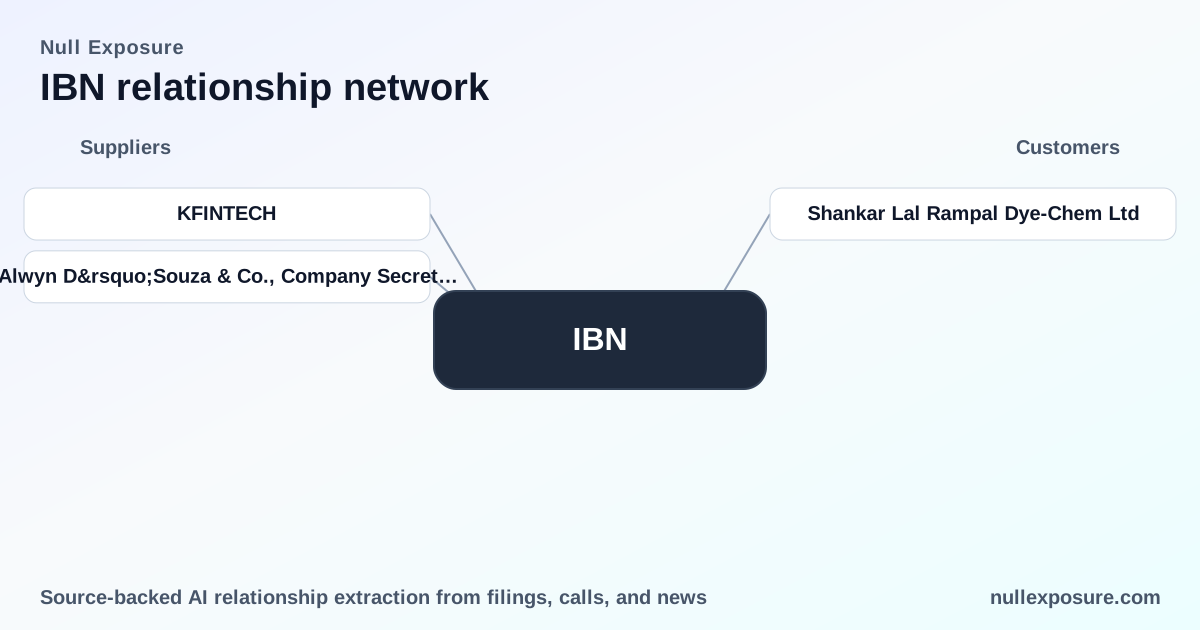
Shankar Lal Rampal Dye-Chem Ltd
A March 10, 2026 market news post on ScanX.Trade reported that Shankar Lal Rampal Dye-Chem Ltd renewed a ₹315 million banking facility with ICICI Bank. This is a traditional commercial banking relationship that directly ties to ICICI’s asset book and underwriting activity, representing credit exposure to a mid-market manufacturing borrower.
Source: ScanX.Trade, March 10, 2026.
How to interpret these relationships as an investor
- Revenue mix signal: The two communications engagements point to ancillary fee-generating activities associated with capital markets and corporate communications. These are not core banking revenues but are incremental fee lines that improve margin resilience where executed at scale and recurring cadence.
- Credit book signal: The dye-chem facility renewal is a direct read on underwriting and client retention in the commercial lending portfolio. A ₹315 million renewal suggests ICICI continues to service mid-market industrial borrowers, supporting both interest income and potential cross-sell avenues (working capital, trade finance).
- Concentration and diversity: The small sample set shows diverse client types — capital markets/communications clients on one hand and conventional borrowers on the other — which is consistent with a universal bank model that mixes fee businesses with lending.
- Visibility vs. economic weight: Publicized communications engagements are high-visibility but lower economic weight compared with credit relationships; the single lending renewal is the more material signal for balance-sheet risk.
Constraints and company-level operational signals
No relationship-level constraints were flagged in the available results. Company-level signals from the relationship set include:
- Contracting posture: ICICI demonstrates a conventional commercial posture — servicing one-off PR/communications clients and renewing commercial lending facilities — consistent with a broad-service bank that engages across transaction types.
- Concentration: There is no evidence of customer concentration from these disclosures; the captured relationships span distinct industries and purposes, indicating low concentration risk within this small sample.
- Criticality: Lending relationships like the ₹315 million facility are material to balance-sheet risk and earnings, while communications engagements are strategic for market visibility but lower in credit or liquidity impact.
- Maturity: Renewal of an existing banking facility signals an established, ongoing lending relationship; the communications engagements reflect transactional vendor relationships rather than long-term credit commitments.
These are company-level readings drawn from the public relationship signals rather than contractual excerpts; they indicate a bank operating across multiple client archetypes without concentrated, disclosed counterparty risk in the sample.
Investment implications and risks for operators
- Positive: ICICI’s mixed client set supports diversified revenue, combining lending scale with fee-based services that improve earnings stability. Strong ROE and a reasonable P/E support a constructive baseline view.
- Watchlist: Monitor the credit pipeline — renewals like Shankar Lal Rampal are reassuring short-term, but the overall credit mix, provisioning trends, and sector exposure should be tracked for cyclical risk.
- Reputational and market visibility: Engagements where IBN provides corporate communications to listed issuers increase the bank’s visibility in capital markets; these are strategically useful but do not substitute for rigorous credit underwriting.
Bottom line for investors
The public relationship record for IBN in this sample reflects a dual-role profile: provider of corporate communications to capital-markets clients and active commercial lender renewing mid-market facilities. The communications work signals market-facing revenue streams, while the ₹315 million loan renewal is a concrete lending exposure that directly feeds ICICI’s interest-earning asset base. Investors should treat these signals as complementary: one set enhances market positioning and fee income, the other anchors balance-sheet risk and recurring revenue.
For analysts and portfolio managers needing granular customer-level reads, NullExposure maintains structured intelligence on these customer relationships and how they evolve: https://nullexposure.com/.