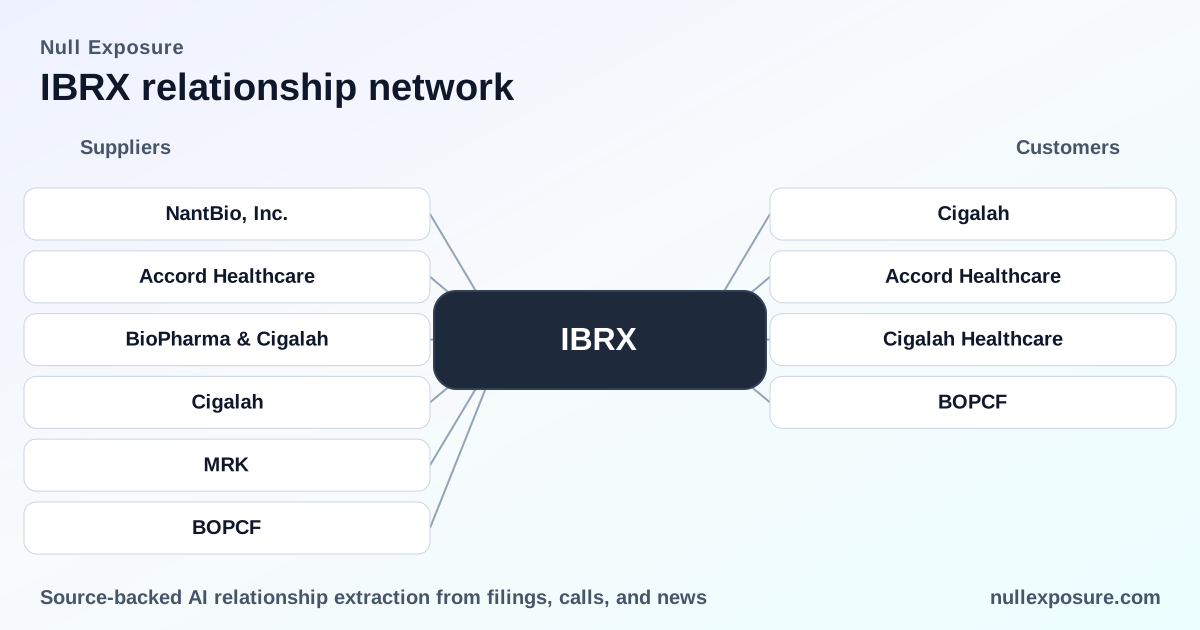
ImmunityBio (IBRX) — who’s buying ANKTIVA and what it tells investors
ImmunityBio monetizes through the commercialization of a single approved biologic, ANKTIVA (nogapendekin alfa inbakicept-pmln), combined with licensing, bioreactor hardware sales, and royalty-style revenue interest arrangements; commercial revenue flows primarily through specialty distributors and regional licensing/partnership deals. Investors should treat ImmunityBio as a concentrated, commercialization-stage biotech with active global roll‑out partners and material contractual obligations that convert future revenue into near-term liquidity. For an institutional view of customer exposure and partner coverage, visit https://nullexposure.com/.
Quick investment thesis — one product, fast global ramp
ImmunityBio is a vertically integrated biotech that converted regulatory approval (FDA approval April 22, 2024) into initial commercial sales beginning May 2024 and is now scaling through specialty distributors and targeted regional partnerships. Revenue generation combines direct finished‑goods sales to specialty pharmacies/distributors, licensing and usage‑based royalty mechanics, and monetization of expected future sales through revenue‑interest financings — a hybrid model that accelerates cash today while retaining upside exposure to global ANKTIVA adoption.
What investors need to know about the operating model
- Contracting posture: Licensing and long‑term commercial contracts are core — ImmunityBio historically sold non‑exclusive licenses and now structures agreements that include upfronts, milestones and sales‑based royalties.
- Concentration: Revenue is highly concentrated; top three customers accounted for ~92% of gross revenue in 2024, which makes distributor and payer relationships strategically material.
- Criticality: Coverage and reimbursement from government payors and large specialty distributors are essential to product uptake; regulatory and pricing controls are central risk vectors.
- Maturity: The company has moved from R&D to active commercialization in the last 12–18 months (FDA approval April 2024; J‑code January 2025; shipments began May 2024), so customer relationships are ramping to active but remain early in commercial life.
Customer relationships — the roll call (every result in the source set)
Below I list each relationship entry found in the dataset with a concise plain‑English takeaway and the original source.
-
Accord Healthcare — ImmunityBio partnered to expand ANKTIVA access across 30 countries, positioning Accord as a distribution/market access partner for broad international reach; reported March 10, 2026 by StockTwits: https://stocktwits.com/news-articles/markets/equity/ibrx-stock-declines-immunitybio-resubmits-anktiva-application-to-fda/cZdVj9URIIL
-
Cigalah — ImmunityBio established a Saudi unit and named Cigalah among regional distributors to expand ANKTIVA across the Middle East and North Africa (MENA), reflecting a direct go‑to‑market strategy for MENA; reported March 10, 2026 by StockTwits: https://stocktwits.com/news-articles/markets/equity/ibrx-stock-tumbles-after-hours-bcg-shortage-saudi-anktiva-launch-middle-east-tensions/cZd9PqbRI5R
-
Cigalah Healthcare — Company press release confirms ANKTIVA distribution in Saudi Arabia via ImmunityBio’s partnerships with Biopharma and Cigalah Healthcare and support from the company’s wholly owned Saudi subsidiary; ImmunityBio press release, May 3, 2026: https://immunitybio.com/immunitybio-announces-anktiva-is-now-available-in-saudi-arabia-for-bladder-and-lung-cancer-patients-market-entry-achieved-within-two-months-of-mena-partnership/
-
Cigalah Healthcare — Financial news coverage notes the collaboration with Biopharma and Cigalah to commercialize ANKTIVA in Saudi Arabia and MENA after SFDA clearance, underscoring regulatory market entry as a revenue catalyst; FinViz, March 10, 2026: https://finviz.com/news/329062/immunitybio-inc-ibrx-price-target-raised-after-strong-anktiva-launch
-
Cigalah Healthcare — Trade press highlights the MENA distribution partnership with Biopharma and Cigalah as a driver of ANKTIVA sales growth in the region; IBTimes Australia, March 10, 2026: https://www.ibtimes.com.au/immunitybio-ibrx-stock-explodes-500-2026-anktivas-700-revenue-surge-1862023
-
Cigalah Healthcare — Additional news aggregation references the same MENA launch and Cigalah’s distributor role for ANKTIVA; StockTwits, March 10, 2026: https://stocktwits.com/news-articles/markets/equity/ibrx-stock-immunitybio-q4-revenue-anktiva-growth/cZRtp77R4yO
-
BOPCF — The March 10, 2026 StockTwits item also references regional distributors (listed as Biopharma and Cigalah) in connection with a new Saudi unit; the entry maps to BOPCF in the dataset and reflects the same regional distribution narrative: https://stocktwits.com/news-articles/markets/equity/ibrx-stock-tumbles-after-hours-bcg-shortage-saudi-anktiva-launch-middle-east-tensions/cZd9PqbRI5R
-
Biopharma — Trade coverage identifies Biopharma as a lead distribution partner supporting ANKTIVA rollout across MENA alongside Cigalah, reinforcing an MENA distribution pair strategy; IBTimes Australia, March 10, 2026: https://www.ibtimes.com.au/immunitybio-ibrx-stock-explodes-500-2026-anktivas-700-revenue-surge-1862023
-
BOPCF — The IBTimes item is also recorded under BOPCF in the dataset, reiterating the Biopharma/Cigalah distribution relationship in MENA: https://www.ibtimes.com.au/immunitybio-ibrx-stock-explodes-500-2026-anktivas-700-revenue-surge-1862023
-
BOPCF — A StockTwits summary of ImmunityBio Q4 commentary duplicates the distributor launch language and is attributed to BOPCF in the dataset: https://stocktwits.com/news-articles/markets/equity/ibrx-stock-immunitybio-q4-revenue-anktiva-growth/cZRtp77R4yO
-
BOPCF — FinViz coverage also records the Biopharma/Cigalah commercialization note and is included as a BOPCF‑tagged result in the dataset: https://finviz.com/news/329062/immunitybio-inc-ibrx-price-target-raised-after-strong-anktiva-launch
-
Biopharma — ImmunityBio’s May 3, 2026 press release explicitly states ANKTIVA distribution will be conducted through partnerships with Biopharma and Cigalah Healthcare, confirming the company’s chosen regional distributors: https://immunitybio.com/immunitybio-announces-anktiva-is-now-available-in-saudi-arabia-for-bladder-and-lung-cancer-patients-market-entry-achieved-within-two-months-of-mena-partnership/
-
Biopharma — StockTwits aggregation covering Q4 revenue and ANKTIVA growth again names Biopharma as a MENA commercial partner, consistent with ImmunityBio’s market‑entry narrative: https://stocktwits.com/news-articles/markets/equity/ibrx-stock-immunitybio-q4-revenue-anktiva-growth/cZRtp77R4yO
-
Biopharma — FinViz reporting reiterates the tie‑up with Biopharma and Cigalah to commercialize ANKTIVA in Saudi Arabia and MENA following SFDA approval; FinViz, March 10, 2026: https://finviz.com/news/329062/immunitybio-inc-ibrx-price-target-raised-after-strong-anktiva-launch
-
Biopharma — The March 10 StockTwits article describing the Saudi unit and distributor partnerships is cataloged a second time under Biopharma in the dataset: https://stocktwits.com/news-articles/markets/equity/ibrx-stock-tumbles-after-hours-bcg-shortage-saudi-anktiva-launch-middle-east-tensions/cZd9PqbRI5R
Constraints and structural signals investors should price in
- Licensing is baked into revenue mechanics. ImmunityBio’s historical revenue mix and contractual language confirm that licensing (non‑exclusive and exclusive in prior deals) is a core source of non‑product income and a common contractual form going forward.
- Usage‑based economics exist alongside upfronts. The company recognizes sales‑based royalties and has structured revenue‑interest deals that convert future net sales into immediate cash flows — a hybrid monetization strategy that amplifies near‑term liquidity at the cost of future gross margin.
- High customer concentration is a structural risk. With 92% of 2024 gross revenue coming from the top three customers, loss or contract stress with a single distributor or major payer would materially affect throughput.
- Government payors and regulatory controls are critical. NA and EMEA payor regimes and U.S. Medicare/Medicaid coverage decisions are explicit determinants of commercial scale.
- Geographic expansion is active and prioritized. The company is pursuing EMEA and MENA market entry in parallel with U.S. commercialization, which creates execution and regulatory complexity but also expands addressable market.
Risks, upside and what to watch next
- Key risks: payor reimbursement trends (especially U.S. Medicare negotiation dynamics), dependence on a small set of distributors/partners, and potential supply or combination‑product constraints (BCG supply historically relevant).
- Upside catalysts: rapid uptake in MENA/EMEA via Biopharma and Cigalah partnerships, broader formulary coverage in the U.S., and successful expansion of ANKTIVA indications.
- Near‑term signals to monitor: distributor shipment cadence and channel sell‑through, payer coverage decisions in Europe and the U.S., and any material amendments to revenue‑interest financing terms.
Bottom line and follow up
ImmunityBio is executing a capital‑efficient, partner‑led global roll‑out for ANKTIVA while leveraging licensing and revenue‑interest financing to fund commercialization. The company’s model delivers cash up front but concentrates execution risk in a handful of distributors and payer outcomes — a dual‑edged profile for investors who prioritize either near‑term cash visibility or long‑term margin capture.
For a more detailed counterparty map and to monitor updates to partner exposure, see the full coverage at https://nullexposure.com/.