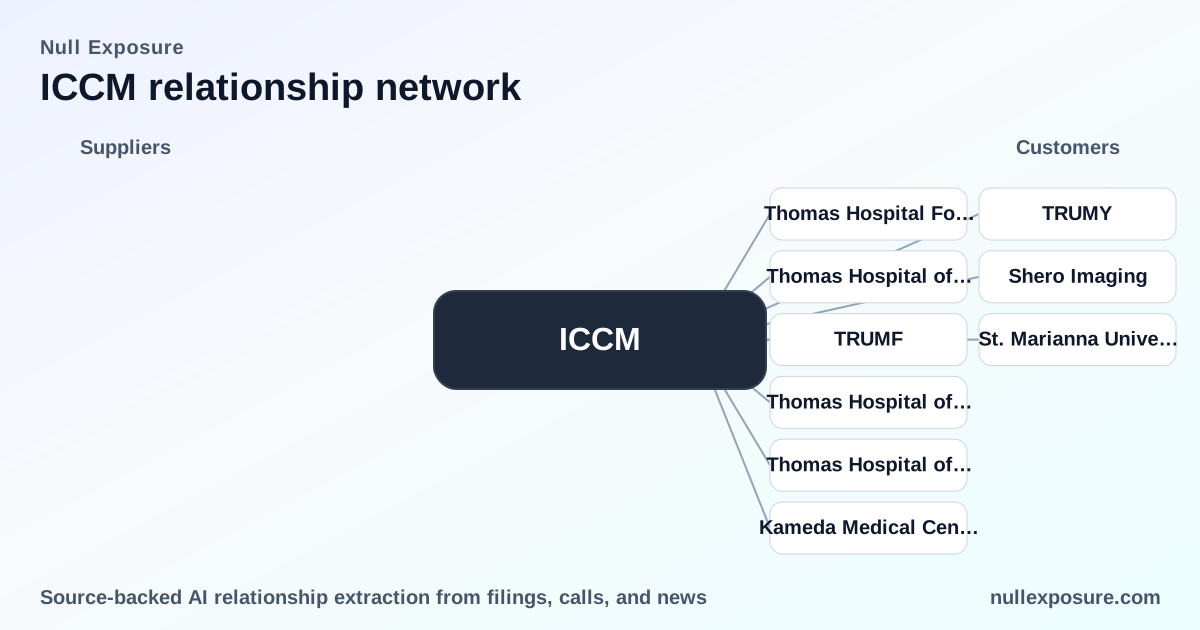
IceCure Medical (ICCM): Customer Relationships and What They Signal to Investors
IceCure Medical develops and sells the ProSense® cryoablation system for minimally invasive tumor treatment, monetizing through device sales, distributor arrangements, and ancillary service revenue tied to installations and clinical adoption. Revenue today is concentrated and early-stage: direct hospital and clinic sales are complemented by exclusive distribution agreements (notably in Japan), and clinical endorsements drive the sales funnel. For more on data-driven relationship intelligence, visit https://nullexposure.com/.
Why customer wins matter now
IceCure’s commercial story is not theoretical — it is being written in operating rooms and community clinics. Direct purchases by hospitals and clinics validate ProSense as a sellable capital medical device, while the Terumo distributor relationship in Japan offers a scalable, regulatory-driven pathway to larger, higher-margin markets. At current scale, IceCure’s revenue base remains small (Revenue TTM ~$3.4M) against a market cap near $23.9M, so every commercial reference significantly affects growth prospects and investor valuation.
- Concentration and criticality: a single distributor relationship in Japan and a handful of early institutional adopters indicate a concentrated go-to-market posture that can amplify upside if regulatory approvals and broader adoption follow.
- Maturity signal: installations in hospitals and clinics signal commercial product-market fit in selected use cases, but the company remains in the commercialization ramp rather than broad penetration.
Relationship log — every mention from recent coverage
Below are plain-English summaries for each relationship listed in the available results, stated exactly as reported in company releases, earnings calls, and news coverage.
Thomas Hospital
IceCure highlighted a recent ProSense installation at Thomas Hospital in Alabama and noted the system generated a local media segment that boosted awareness. Source: InsiderMonkey Q4 2025 earnings call transcript (published May 3, 2026) — https://www.insidermonkey.com/blog/icecure-medical-ltd-nasdaqiccm-q4-2025-earnings-call-transcript-1720427/.
TRUMF (Terumo symbol variant)
Terumo (listed in sources as TRUMF) is expected to submit a PMDA application for breast cancer indication for ProSense by end-2025, positioning the distributor to drive regulatory-led commercialization in Japan. Source: PR Newswire release covering ProSense at Japanese Breast Cancer Society conference (Mar 10, 2026) — https://www.prnewswire.com/news-releases/icecures-prosense-featured-at-japanese-breast-cancer-society-conference-updated-positive-clinical-data-shows-99-recurrence-free-rate-with-cryoablation-302513539.html.
Terumo Corporation
IceCure’s appointed Japanese distributor, Terumo Corporation, is slated to file for regulatory clearance in Japan for breast cancer treatment, a next-step that could materially expand Japanese revenues. Source: PR Newswire (Mar 10, 2026) and IceCure FY2025 commentary.
Thomas Hospital of Fairhope, Alabama
Thomas Hospital of Fairhope (part of Infirmary Health) purchased and installed a ProSense system, becoming the first center in Alabama to offer ProSense breast cancer cryoablation — a direct device sale and marketing milestone. Source: PR Newswire company announcement (Feb–Mar 2026) — https://www.prnewswire.com/news-releases/icecure-announces-thomas-hospital-of-infirmary-health-installs-prosense-becomes-first-hospital-in-alabama-to-offer-breast-cancer-cryoablation-302692519.html.
Thomas Hospital Foundation
The Thomas Hospital Foundation facilitated the purchase of the ProSense system as part of its mission to fund advanced medical technology, indicating philanthropic capital can be an enabler of device adoption in community hospitals. Source: PR Newswire (Mar 10, 2026) — https://www.prnewswire.com/news-releases/icecure-announces-thomas-hospital-of-infirmary-health-installs-prosense-becomes-first-hospital-in-alabama-to-offer-breast-cancer-cryoablation-302692519.html.
Fuel Imaging
IceCure named Fuel Imaging among the announced installations, citing it alongside Thomas Hospital as visible adopters while noting other prominent but unnamed installations exist in major cities. Source: InsiderMonkey Q4 2025 earnings call transcript (May 3, 2026) — https://www.insidermonkey.com/blog/icecure-medical-ltd-nasdaqiccm-q4-2025-earnings-call-transcript-1720427/.
Fuel Imaging (duplicate mention)
During the Q4 2025 company commentary, Fuel Imaging was reiterated as an announced ProSense customer and example of commercial traction in imaging/clinic partners. Source: The Globe and Mail coverage of IceCure Q4 2025 earnings transcript (May 3, 2026) — https://www.theglobeandmail.com/investing/markets/markets-news/motley/799936/icecure-medical-iccm-q4-2025-earnings-transcript/.
Terumo Corporation (earnings-call reference)
In the company’s Q3 2025 earnings call, management reiterated expectations that Terumo would submit regulatory applications for ProSense in Japan in H1 2026 — a repeat confirmation of the distributor pathway. Source: ICCM Q3 2025 earnings call transcript (Mar 7, 2026).
Thomas Hospital of Infirmary Health
In FY2026 reporting, IceCure described Thomas Hospital of Infirmary Health as the largest not-for-profit healthcare system in Alabama to purchase and install ProSense, underscoring institutional endorsement within a regional health system. Source: PR Newswire and FY2025/FY2026 results release (Mar–May 2026).
Shero Imaging
Shero Imaging, a privately operated clinic in St. Louis, purchased ProSense and became the first clinic in Missouri to offer breast cancer cryoablation, showing penetration into specialty clinics beyond hospitals. Source: FY2025–FY2026 PR Newswire / Finviz coverage (Mar 2026).
Thomas Hospital of Fairhope (alternate mention)
Multiple outlets repeated that Thomas Hospital of Fairhope installed ProSense and became Alabama’s first center offering ProSense-guided cryoablation, reinforcing media pickup from that installation. Source: SahmCapital and Finviz summaries of company press releases (Feb–Mar 2026).
Kameda Medical Center
Kameda Medical Center’s Professor Eisuke Fukuma presented independent breast cryoablation data from a study of over 600 women (2006–2023), providing clinical credibility for ProSense outcomes in Japan. Source: PR Newswire (Mar 10, 2026) — https://www.prnewswire.com/news-releases/icecures-prosense-featured-at-japanese-breast-cancer-society-conference-updated-positive-clinical-data-shows-99-recurrence-free-rate-with-cryoablation-302513539.html.
Shero Imaging (duplicate)
Company releases reiterated Shero Imaging’s status as Missouri’s first clinic offering ProSense procedures, signaling local market first-mover branding. Source: Finviz press summaries (Mar 2026).
St. Marianna University School of Medicine
A study led by St. Marianna University reported zero breast cancer local recurrence at five years following ProSense treatment in the reported cohort, an important clinical data point for adoption and payer conversations. Source: PR Newswire (Mar 10, 2026).
Terumo / TRUMF (multiple company communications)
Across CEO letters and FY2025–FY2026 communications, IceCure reiterated that Terumo remains the exclusive Japanese distributor and is expected to request breast cancer clearance from Japan’s PMDA in the first half of 2026, which is the pivotal regulatory inflection for the region. Source: CEO letter to shareholders and PR Newswire releases (Jan–Mar 2026).
Mid-deck strategic note
For an investor-grade view built from these relationship signals, see https://nullexposure.com/ — the roster of direct installs and the Terumo distribution pathway collectively point to a commercial ramp driven by regulatory milestones and select institutional adopters.
What this customer map implies for investors
- Commercial validation: Direct installations at hospitals (Thomas Hospital / Infirmary Health) and specialty clinics (Shero Imaging, Fuel Imaging) show IceCure is converting clinical interest into paid equipment sales. Those are critical early revenue events given the company’s modest top line.
- Regulatory leverage: The Terumo relationship is strategic — Terumo’s PMDA filing is a primary catalyst for scaling in Japan and unlocking recurring consumable service revenue tied to procedures.
- Concentration risk: Current customer mentions are few and geographically focused; this implies high operating leverage to each new hospital or distributor milestone.
- Clinical backbone: Peer-reviewed and independent study references (Kameda Medical Center; St. Marianna University) provide clinical evidence investors demand before larger hospital systems and payers commit.
Investment checklist — three risk-and-opportunity items
- Opportunity: PMDA clearance in Japan through Terumo would materially expand addressable market and validate the distribution model.
- Risk: Revenue remains small vs. valuation; IceCure reports negative EBITDA and high insider ownership, which concentrates governance and exposes minority investors to execution risk.
- Execution: Scaling beyond a handful of high-profile installs requires commercial infrastructure and reimbursement progress; monitor quarterly device sales, distributor milestones, and installation announcements.
Bottom line
IceCure’s customer mentions reflect a company transitioning from clinical validation to early commercial deployments, with Terumo's regulatory pathway in Japan as the single most consequential commercial relationship. Institutional and clinic installations in the U.S. demonstrate sell-through potential but also highlight concentration and execution risk. For a structured market view of relationship-driven catalysts and risk monitoring, visit https://nullexposure.com/.
Key takeaway: watch Terumo’s PMDA filing and the cadence of hospital/clinic installs — those two signals will define whether early market validation converts into sustained revenue growth.