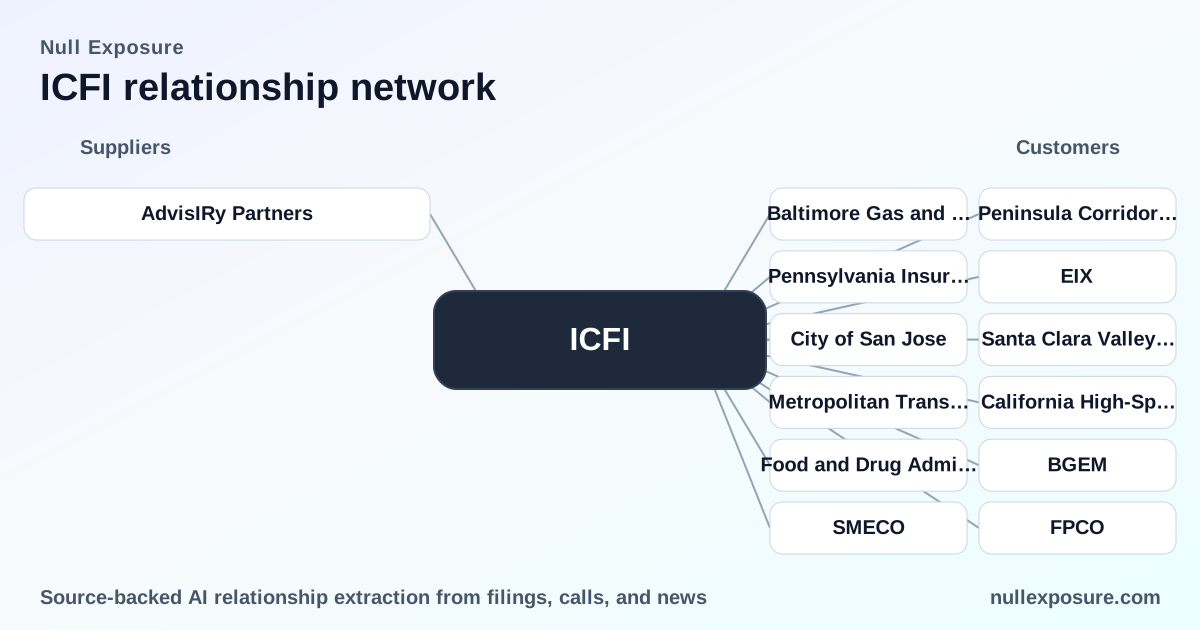
ICF International: customer relationships that drive repeatable, government‑anchored consulting revenue
ICF monetizes by selling professional services and technology-enabled implementations to government and commercial clients, combining multi-year contracts, IDIQ/MSA frameworks and time-and-materials work to produce a predictable mix of billed receivables and backlog. The company is a prime contractor on large public-sector programs, with government clients accounting for roughly three quarters of revenue and $1.3 billion of remaining unfulfilled performance obligations as of year‑end 2024 — a profile that supports stable cash generation but concentrates political, audit and appropriation risk.
If you evaluate customer exposure and contract durability, start at ICF’s government footprint and the recent wins described below. For more on how we track client relationships and contract signals, visit https://nullexposure.com/ for a concise overview.
What investors need to know up front
- Revenue mix is government‑heavy and contract‑driven. Government clients generated approximately 75% of revenue in 2024; federal clients alone were ~54%.
- Backlog is sizeable and front‑loaded. ICF reported $1.3 billion of remaining unfulfilled performance obligations with most recognition within two years.
- Contracting posture is mixed: IDIQ/MSA frameworks give optionality and repeat work, while many engagements are multi‑year and fixed‑price or time‑and‑materials. These characteristics drive recurring cash but require ongoing capture and renewal discipline.
Recent and material customer wins (one paragraph per relationship)
This list covers every customer relationship reported in the public signals ICF submitted and in press coverage through early 2026.
-
Defense Counterintelligence and Security Agency — ICF secured a position on a new multiple‑award blanket purchase agreement to modernize NBIS (National Background Investigation Services) systems under a five‑year BPA, strengthening its defense IT modernization pipeline. According to Finviz and Simply Wall Street coverage in May 2026, the award places ICF on an $800 million digital modernization vehicle for the agency. (Finviz / Simply Wall Street, FY2026)
-
Baltimore Gas and Electric (BGE) — BGE awarded ICF over $65 million in re‑compete and new energy efficiency and demand‑response contracts to implement EmPOWER Maryland, expanding ICF’s utility program management and delivery footprint. This was announced via PR Newswire in March 2026. (PR Newswire, FY2026)
-
Pennsylvania Insurance Department — ICF won a $64 million contract to modernize and operate Pennsylvania’s environmental claims management system for underground storage tanks, a deal described as up to a 10‑year term in subsequent coverage. This contract was reported in March 2026 and analyzed in investor commentary in January 2026. (Finviz / Sahm Capital, FY2026 / FY2026)
-
Santa Clara Valley Transportation Authority (lead for multi‑agency Diridon project) — ICF was awarded a $21 million engagement to lead environmental reviews for the Diridon Station Redevelopment Project in San Jose, a collaborative program advanced by five regional agencies. Coverage in March 2026 frames this as an infrastructure‑environment delivery role. (Finviz, FY2026)
-
Southern California Edison (EIX) — ICF received an amendment to an energy efficiency contract with SCE, reflecting ongoing utility program work and recurring amendments with major regulated utilities; this relationship is referenced across investor presentations and Finviz reporting in 2025–2026. (Finviz / investor materials, FY2025–FY2026)
-
Food and Drug Administration (FDA) — ICF worked with FDA on modernizing historical documents as part of openFDA efforts, illustrating ICF’s digital archives and public‑health technology work for civilian federal agencies. See the ICF client case study on their corporate site describing the engagement. (ICF client case study, FY2026)
-
SMECO — ICF designed and managed SMECO’s suite of residential load management programs across about 10,000 homes, boosting participation and energy savings metrics documented on ICF’s utilities practice pages. (ICF utilities casework, FY2025)
-
California High‑Speed Rail Authority — As part of the Diridon Station Redevelopment Project partnership, ICF leads environmental reviews for the high‑speed rail authority, reinforcing its role on complex, multi‑agency infrastructure NEPA/CEQA work. (Finviz, FY2026)
-
City of San Jose — The city is a named partner in the multi‑agency Diridon Station Redevelopment Project where ICF will conduct environmental and community impact work for the City of San Jose. (Finviz, FY2026)
-
Metropolitan Transportation Commission — The regional commission is one of the five Diridon partners for whom ICF will perform environmental review leadership, expanding ICF’s Bay Area infrastructure client set. (Finviz, FY2026)
-
Peninsula Corridor Joint Powers Board (Caltrain) — Caltrain is a co‑sponsor of Diridon; ICF’s award includes work for the Peninsula Corridor Joint Powers Board as part of the project consortium. (Finviz, FY2026)
-
BGEM (market/inferred symbol for BGE) — ICF’s utility program case study cites a 300% increase in participation for BGE’s energy efficiency savings program, supporting the PR Newswire report of material utility revenue from EmPOWER Maryland. (ICF site / PR Newswire, FY2025–FY2026)
-
FPCO / Florida — Reporting flagged a Florida comprehensive management services contract in 2026 commentary; investor write‑ups referenced state‑level program management work tied to ICF’s public‑sector services. (Finviz commentary, FY2026)
-
Florida (state) — Coverage grouped a Florida award for comprehensive management services as part of the firm’s expanding state and local government business in 2026 investor pieces. (Finviz, FY2026)
(Each item above is drawn from the cited press and client‑case coverage; see the referenced company press pages and investor news for primary detail.)
What the contract and relationship signals say about ICF’s operating model
-
Contract mix and cadence. ICF operates across a spectrum: framework/IDIQ vehicles and MSAs for access and repeated task orders; long‑term contracts that create backlog; and short‑term/time‑and‑materials work where delivery is rapid. This mix produces predictable near‑term revenue while leaving upside to capture multi‑year task orders.
-
Concentration and criticality. Government clients are the core revenue engine (≈75% of revenue). That client mix is material to financials and makes ICF sensitive to appropriations, audit risk and administrative reprioritization — structural risks for investors.
-
Contract maturity and stage. Many relationships are mature and multi‑year, with ICF holding prime positions on long‑running federal engagements; new wins (e.g., DCSA BPA, Pennsylvania, BGE) show active renewal and expansion. The company reports recurring contract amendments and re‑competitions rather than one‑off projects.
-
Spend scale and visibility. The company has large spend bands in play (>$100m UPO) while maintaining a portfolio of mid‑sized public and commercial engagements; this creates a balance of predictability and exposure to big‑ticket political risk.
-
Role profile. ICF is primarily a service provider and prime seller, delivering advisory, digital, environmental and program implementation work; it also uses framework vehicles to bid as prime and capture downstream task orders.
Investment implications and risk profile
- Upside: repeatable, high‑margin advisory plus technology services to government clients give ICF a competitive moat in mission‑critical modernization, energy programs and environmental reviews. Recent awards demonstrate continued pipeline conversion into funded work.
- Risks: high government concentration, appropriation and audit risk, and competitive re‑procurement dynamics; termination‑for‑convenience notices in recent filings underscore the political sensitivity of certain contracts.
For a quick corporate snapshot and ongoing tracking of client wins, visit https://nullexposure.com/ and view our client‑exposure dashboards. If you want a deeper brief focused on contract duration, billing terms, or UPO recognition timing for ICF, reach out and we’ll assemble a focused investor memo.