Intchains Group (ICG): What the customer ledger reveals about a corporate divestiture and connected-party flow
Intchains Group Limited builds and sells ASIC chips and supporting hardware/software for blockchain applications out of Pudong, China, monetizing through chip product sales, ancillary services and disposals of non-core technology assets. Recent transactional activity centers on a disposition of early-stage chip R&D assets to an entity controlled by senior management, a move that shifts development obligations off the corporate balance sheet and produces limited near-term cash consideration. For investors assessing customer and counterparty exposures, the deal illuminates governance, concentration of business lines, and how non-core units are being rationalized under current operating pressures. Learn more company-level signals at https://nullexposure.com/.
A short read for investors: what changed and why it matters
Intchains recorded revenue of roughly RMB-equivalent $221 million (TTM) but continues to operate with negative margins and net losses. The transfer of non-core chip R&D assets removes an early-stage, capital-intensive unit from the parent and generates up to RMB18 million of consideration, principally structured as RMB3 million fixed IP payment and up to RMB15 million in contingent inventory purchases over 12 months. That structure delivers modest cash today while also preserving optional commercial uptake of legacy inventory for the buyer. For shareholders, the transaction trims R&D commitment and transfers execution risk to the purchaser, but it also concentrates the company on its remaining product lines and revenue-generating customers.
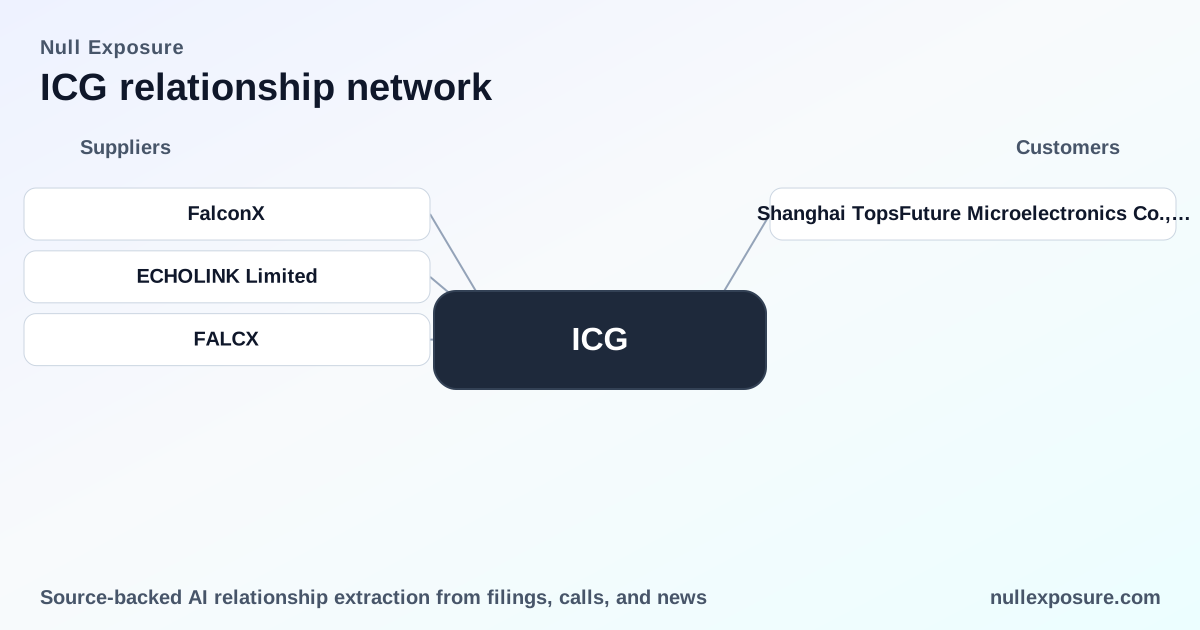
The relationship: Shanghai TopsFuture Microelectronics Co., Ltd.
Shanghai TopsFuture Microelectronics is the counterparty acquiring non-core chip research and development assets from Intchains’ subsidiary, Shanghai Intchains Technology Co., Ltd.
- Intchains entered into a business transfer agreement to sell the non-core chip R&D assets to Shanghai TopsFuture Microelectronics; coverage noted the deal as a divestiture of an early-stage chip design and related assets completed in FY2026. According to an Investing.com report dated May 3, 2026, the transfer covered certain non-core R&D assets and associated property rights. (Investing.com, May 3, 2026)
- The buyer is controlled by Intchains’ chairman and CEO, and the financial terms specify RMB3 million fixed consideration for intellectual property plus up to RMB15 million in optional inventory purchases over 12 months, for aggregate consideration up to RMB18 million; this detail is documented in a company press release reported by The Globe and Mail on March 10, 2026 (transaction date referenced as January 5, 2026 in corporate disclosure). (The Globe and Mail / company press release, FY2026)
Both items refer to the same counterparty and the same corporate transfer; together they confirm that management-directed asset reallocation converted a non-core R&D burden into a predictable small cash inflow and contingent purchase rights.
What this transaction signals about Intchains’ operating model
This divestiture is a clear corporate signal on several operating-model dimensions:
- Contracting posture: The company structured the transfer as a fixed-IP payment plus optional inventory purchases, indicating a preference for limited, staged monetization rather than an upfront full-value exit. That posture reduces upfront cash dependence but retains potential follow-on receipts tied to inventory off-take.
- Concentration: The sale removes a non-core R&D unit from the parent, concentrating resources on core ASIC and hardware lines. This reduces internal diversity of technical bets but focuses capital and management attention.
- Criticality: Because the assets were characterized as non-core and early-stage, they were not critical to Intchains’ primary customer-facing product set; the transfer therefore does not interrupt core revenue flows, but it reduces optional internal development capacity.
- Maturity: Transferring early-stage R&D assets to a related-party buyer indicates a maturity mismatch between corporate priorities and speculative internal projects—management preferred to spin the unit out rather than continue to fund long-horizon development internally.
These are company-level signals; no constraint excerpt in the record ties these operational traits to a single customer relationship.
Governance and related-party considerations
The buyer’s control by Intchains’ chairman and CEO raises governance and related-party transaction considerations. The disclosed structure—modest fixed IP payment plus optional inventory purchases—creates a potential conflict of interest because the purchaser is controlled by insiders and because follow-on payments are contingent on inventory buybacks under management influence. The disclosure in the March 2026 press release identifies that linkage explicitly and quantifies the payments. Investors should treat such related-party transfers as execution-aligned but also subject to heightened scrutiny of valuation fairness and board oversight.
Risk and investment implications
- Near-term cash and earnings: The transaction produces limited cash (RMB3 million fixed plus contingent purchases) and reduces ongoing development expense, which marginally improves near-term free cash flow but does not materially change the company’s loss profile given current negative operating margins.
- Operational focus: With non-core R&D moved out, management can concentrate on commercialization and customer-facing production, which benefits operating efficiency if core markets sustain demand.
- Governance risk premium: Related-party nature of the counterparty warrants a persistent governance risk premium and elevated monitoring for transfer pricing and subsequent transactions between the parties.
- Upside optionality: The contingent inventory purchases provide upside if the purchaser elects to absorb inventories, but these are optional and time-limited (12 months), so dependency on contingent receipts is limited.
Practical investor checklist
- Confirm actual cash receipts and timing against the press release provisions; fixed RMB3 million is immediately realizable, contingent RMB15 million depends on inventory purchases within 12 months.
- Monitor any subsequent dealings between Intchains and Shanghai TopsFuture for transfer pricing or preferential supplier arrangements.
- Evaluate whether freed capital is redeployed to core ASIC production that can scale revenue and lift margins.
Full relationship coverage — concise entries
Shanghai TopsFuture Microelectronics Co., Ltd.
- Intchains sold non-core chip R&D assets to Shanghai TopsFuture Microelectronics under a business transfer agreement reported in FY2026; the press coverage emphasized that early-stage R&D and related assets were transferred out of the group. (Investing.com, May 3, 2026)
- The acquiring company is controlled by Intchains’ chairman and CEO; the transaction consideration is up to RMB18 million, consisting of RMB3 million fixed for intellectual property and up to RMB15 million in optional inventory purchases over 12 months, as disclosed in a January 5, 2026 transfer announcement and reported in March 2026. (The Globe and Mail / press release, FY2026)
Conclusion: what investors should take away
This is a focused, limited-value divestiture designed to reduce non-core development drag and transfer early-stage execution risk to an insider-controlled buyer. The move clarifies management priorities—concentrate on revenue-generating ASIC products—while introducing governance questions that investors must monitor. For a structured view of Intchains’ customer and counterparty footprint, including ongoing related-party flows and disclosures, visit https://nullexposure.com/ for deeper intelligence and source-aligned reporting.