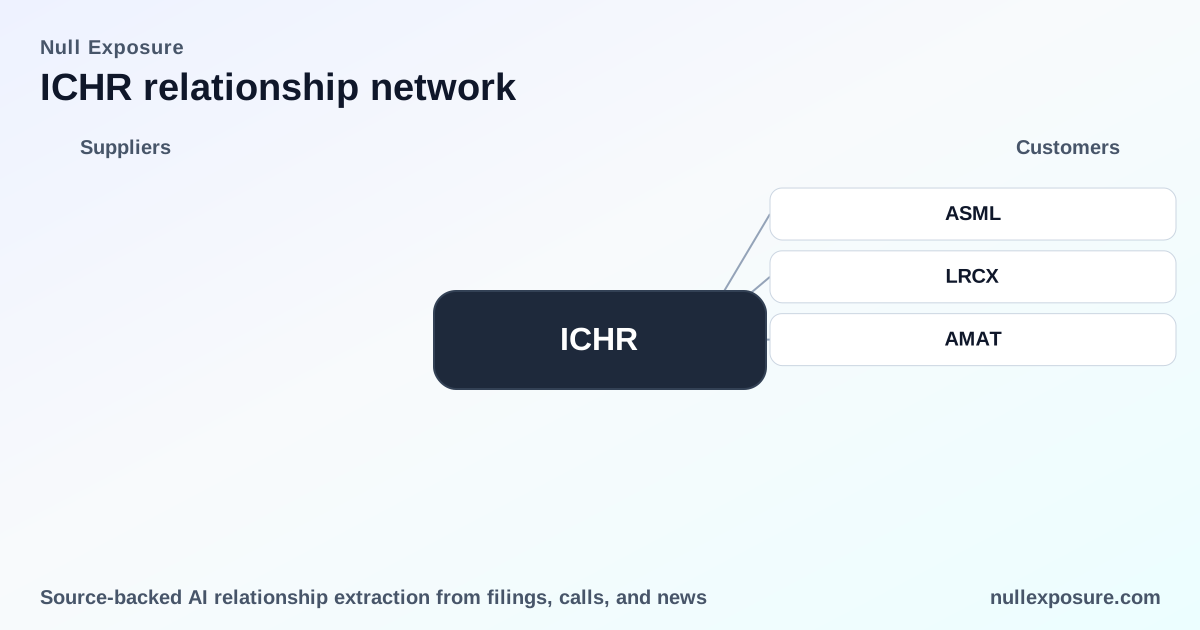
Ichor Holdings (ICHR): Customer Map, Commercial Dynamics, and Investor Implications
Thesis — Ichor designs, engineers and manufactures fluid delivery subsystems and components for semiconductor capital equipment and monetizes by selling these hardware systems, precision components and associated engineering services directly to a small set of OEMs; revenue is concentrated and largely transacted on short-term purchase orders, so quarter-to-quarter cash flow and margins track OEM capex cycles and order timing.
If you want a compact dossier on Ichor’s customer relationships and what they mean for revenue stability and operational leverage, this briefing lays out the commercial facts, the major counterparties, and the company-level constraints that matter to investors. For a quick reference hub on similar analyses, visit https://nullexposure.com/.
How Ichor’s commercial model actually works
Ichor operates as a specialized subcontractor to semiconductor equipment OEMs. The company captures value by:
- Designing and manufacturing gas and chemical delivery subsystems, weldments and precision components that OEMs integrate into process tools.
- Embedding engineering teams with customers early in product cycles to secure design wins and follow-on production orders.
- Selling principally on a purchase-order, short-term basis—revenue is recognized at shipment and most contracts complete within 12 months, with payment terms typically 15–60 days.
The net result: high operational leverage to OEM capex and concentration risk from a small number of very large customers. Ichor’s footprint is global, with facilities placed near major customers to support just‑in‑time delivery and close engineering collaboration.
Detailed customer relationships (each cited)
Below I list every relationship referenced in the source material with a concise, plain-English summary and the citation for that mention.
-
ASML — 10‑K (FY2024): ASML was disclosed as a major customer, with Ichor listing $85,589 in sales tied to ASML in the FY2024 major-customer table. According to Ichor’s FY2024 10‑K filing (Dec 2024), ASML is one of the company’s long‑standing OEM partners.
Source: Ichor FY2024 10‑K (filed Dec 27, 2024). -
Lam Research (LRCX) — TradingView news (FY2026): A TradingView coverage note in March 2026 reiterated that Lam Research is one of Ichor’s top-tier OEM customers, naming it among the largest customers by sales in 2025.
Source: TradingView report (Mar 10, 2026). -
Lam Research — Finviz write‑up (FY2026): A Finviz bullish note (Mar 2026) highlighted that relationships with Lam Research are expected to accelerate production and help restore gross margins toward historical levels.
Source: Finviz news commentary (Mar 10, 2026). -
Applied Materials — TradingView news (FY2026): TradingView noted Applied Materials as one of Ichor’s largest customers by sales in 2025, underlining the importance of that OEM to recent order flow.
Source: TradingView report (Mar 10, 2026). -
ASML — TradingView news (FY2026): TradingView’s March 2026 coverage also cited ASML among the top OEMs for Ichor in 2025, reinforcing ASML’s repeated appearance across filings and market reports.
Source: TradingView report (Mar 10, 2026). -
Lam Research — TradingView news (FY2026): The same TradingView piece (Mar 2026) listed Lam Research as a 2025 top customer, consistent with Ichor’s public disclosures about customer concentration.
Source: TradingView report (Mar 10, 2026). -
Applied Materials — Finviz write‑up (FY2026): Finviz’s March 2026 analysis emphasized that Applied Materials is a key relationship expected to lift volume and margins as production ramps.
Source: Finviz news commentary (Mar 10, 2026). -
Lam Research — Finviz write‑up (FY2026): Finviz again named Lam Research in its March 2026 piece as a principal driver of near-term operational recovery.
Source: Finviz news commentary (Mar 10, 2026). -
Applied Materials — 10‑K (FY2024): Ichor’s FY2024 10‑K lists Applied Materials with $300,263 in sales in the major-customer table, marking it as a top revenue source in 2024.
Source: Ichor FY2024 10‑K (filed Dec 27, 2024). -
Applied Materials (AMAT) — 10‑K table entry (FY2024): The FY2024 filing includes a separate line confirming the material sales amount to AMAT in the major-customer disclosure.
Source: Ichor FY2024 10‑K (filed Dec 27, 2024). -
Lam Research — 10‑K (FY2024): Ichor’s FY2024 10‑K reports Lam Research with $319,099 in sales, and the filing explicitly lists Lam as a long‑standing top-tier OEM customer.
Source: Ichor FY2024 10‑K (filed Dec 27, 2024). -
Lam Research (LRCX) — 10‑K table entry (FY2024): The same 10‑K table reiterates the Lam Research figure and Lam’s role among the company’s major customers.
Source: Ichor FY2024 10‑K (filed Dec 27, 2024).
(These entries represent every relationship mention returned in the sourced results; the repetition across filings and market write‑ups underlines that Applied Materials, Lam Research and ASML are the consistent revenue anchors.)
Constraints and what they tell investors
The company-level signals drawn from Ichor’s public disclosures frame the investment risk/reward:
- Contracting posture — short-term, PO-driven: Most contracts are completed within 12 months and are executed on a purchase‑order basis with rolling forecasts that are not binding; revenue recognition is typically at shipment. This creates high timing volatility in quarterly revenue and working capital.
- Customer concentration — high and material: A small set of OEMs accounted for roughly 73% of sales in 2024, and accounts receivable are similarly concentrated, which increases single‑counterparty exposure to order deferrals or cancellations.
- Counterparty scale and criticality — very large OEMs: Customers are global OEM leaders (very large enterprises) for whom Ichor is a strategic, often sole or preferred subsystem supplier; the products are mission-critical to wafer processing, magnifying both bargaining leverage and the impact of defects.
- Maturity and integration — longstanding, embedded relationships: Relationships are mature—Ichor integrates early in design cycles and places engineers on customer sites—supporting repeat business but making customer qualification and onboarding of new OEMs time‑consuming.
- Geographic profile — global with APAC sensitivity: Ichor operates globally with facilities near customers and principal markets in North America and Asia, exposing the business to trade policy and regional capex swings.
- Operational role — manufacturer and service partner: The company is both manufacturer and service provider, responsible for strict quality tolerances that affect warranty and performance risk.
Collectively, these constraints create a business that can generate outsized upside in a semiconductor upcycle but that is volatile and concentrated and thus sensitive to OEM capex timing, supply-chain shocks, and customer reprioritization.
Where this leaves investors
- Bull case: Ichor benefits materially from a recovery in OEM equipment spending—design wins and ramping programs with Lam, AMAT and ASML translate quickly into manufacturing volume and margin recovery.
- Risk case: Revenue and receivables concentration, short contract horizons, and heavy dependence on a handful of OEMs create lumpy cash flows and elevated execution risk if order timing slips or customers in-source subsystems.
For a concise set of comparable customer risk profiles and further deal-level signal mapping, visit https://nullexposure.com/.
Bottom line: Ichor is a niche, mission‑critical hardware supplier whose stock reflects a trade between cyclical upside from OEM ramps and structural concentration/contract‑term risk. Investors should underwrite both the timing of OEM capex and the company’s ability to convert design wins into repeatable, higher‑margin production volumes.