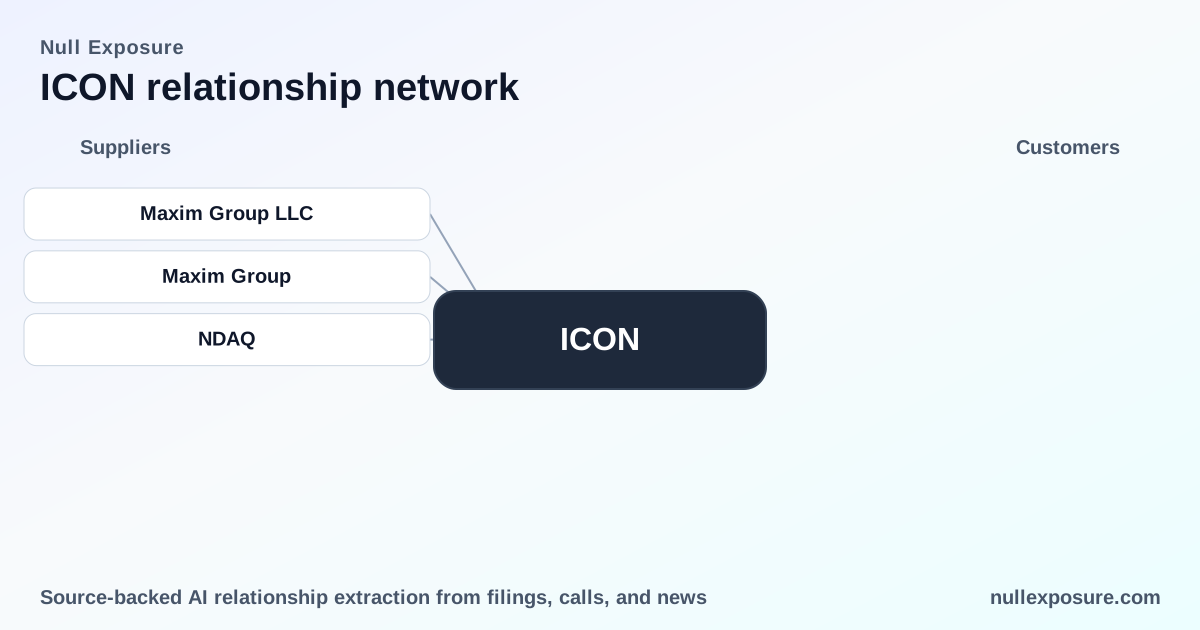
ICON: How customer charters drive near-term revenue and what investors should watch
Icon Energy Corp. operates and monetizes primarily through vessel operations and time-charter agreements that generate cash through charter revenues rather than commodity exposure; the company books revenue from fixed-term, index-linked charters and reports materially positive gross profit but negative net earnings on a trailing basis. For investors, ICON’s commercial outcomes are driven by charter structure (index linkage and term length), customer concentration, and the timing of expiries in mid‑2026. Learn more about our coverage at https://nullexposure.com/.
Business model in one line
- ICON books revenue by placing vessels on time charters that are indexed to freight benchmarks; earnings volatility is driven by charter pricing, utilization and the gap between operating margins and non‑operating costs. According to ICON’s most recent company-level data through the quarter ended 2025-12-31, trailing revenues are roughly $11.26M with gross profit of $4.93M, while net profitability remains negative (EPS -19.02), indicating strong revenue generation but ongoing cost or one‑off pressures.
What the commercial disclosures show
- ICON uses index-linked time charters, a contracting posture that transfers near-term market risk to charter counterparties while locking in vessel utilization and revenue schedules.
- Revenue concentration is notable in public disclosures: only a small number of counterparties are named in the available customer commentary, which amplifies counterparty risk and renewal importance.
- Maturity and cash‑flow timing are explicit — the company’s publicly reported charters run into mid‑2026, creating finite windows for repricing and renewal that will drive 2026 cash flows.
A complete read on every disclosed customer relationship
Evergreen — index‑linked Panamax and Kamsarmax time charters through mid‑2026
ICON disclosed two index‑linked time charters with Evergreen: an Alfa Panamax contract expiring in July 2026 and a Bravo Kamsarmax contract expiring in June 2026. These are index‑linked time charters used to lock in vessel employment and revenue while tying payment levels to freight indices. According to ICON’s commercial update published via GlobeNewswire on March 19, 2026, the company explicitly listed these two Evergreen charters as part of its commercial position for FY2026 (GlobeNewswire, Mar 19, 2026).
Operational and commercial constraints that shape predictability
- Contracting posture — index linkage: ICON favors index‑linked charters that preserve upside or downside alignment with spot market movements while providing a base of contracted revenue. This reduces absolute exposure to daily spot swings but introduces index volatility into contract cash flows.
- Concentration: The current public disclosures list very few named counterparties, creating concentration risk where a small set of charterers materially affects topline stability and renewal bargaining power.
- Criticality: Time charters are core to ICON’s revenue model; they are critical assets that determine utilization and cash conversion. The company’s operating margin is positive on a trailing basis (Operating Margin TTM 3.06%), showing core operations generate operating profit before non‑operating items suppress net income.
- Maturity and repricing windows: With the disclosed charters terminating in June–July 2026, near‑term renewal outcomes will materially affect 2026 and 2027 revenue visibility. Those expiries represent discrete opportunities to capture stronger freight markets or, conversely, to face weaker rates.
Why these signals matter to investors and operators
- Earnings sensitivity: Given positive gross profit but negative EPS, ICON’s earnings are sensitive to non‑operating items, finance costs, or episodic charges; charter pricing and utilization are the lever that can restore net profitability.
- Counterparty negotiation leverage: The small number of disclosed counterparties concentrates negotiation power. If charterers are large, long‑term counterparties, ICON can achieve stable utilization; if counterparties exert pressure at renewal, spot exposure and idle time will increase volatility.
- Liquidity and market timing: The mid‑2026 expiries create a finite timeline for management to secure renewals or re‑deploy assets, so investors should focus on renewal announcements, rate levels achieved on replacement charters, and any changes in charter mix (fixed vs. index‑linked).
Practical checks investors should run now
- Track renewal notices and replacement charter rates around the June–July 2026 window to measure realized pricing versus current reported index levels.
- Monitor counterparty disclosures and any expansion of the customer list to assess concentration risk reduction.
- Watch quarterly cash flow statements for the trajectory from positive operating cash to net profit, given the current negative EPS contrasted with operating profit.
What this means for valuation and positioning
- Valuation upside is tied to charter repricing and operating leverage. With Price/Book at roughly 0.167 and EV/EBITDA near 11.18, the market is pricing in recovery scenarios but also treating current earnings as constrained. Realizing stronger charter rates or longer fixed‑rate contracts would materially improve free cash flow and narrow the gap between operating and net profitability.
- Event risk is concentrated on mid‑2026 expiries. Positive renewals or longer‑term fixes will be value accretive; negative outcomes will depress utilization and extend the path to profitability.
Actionable intelligence and next steps
- For investment teams: prioritize tracking announced renewals and published charter rate levels; those two data points will drive near‑term revisions to revenue forecasts.
- For operators and partners: engage on contract structure — offering longer fixed deals or hybrid index floors can reduce ICON’s revenue volatility and improve lender confidence.
Bottom line ICON is a charter‑driven operator where index‑linked time charters set the rhythm of revenue and the June–July 2026 expiries are the immediate inflection point for investors. The company produces positive gross profits and operating income but has net losses to resolve; meaningful upside depends on successful renewals or improved charter economics. For continued monitoring and deeper context on counterparties and commercial disclosures, visit https://nullexposure.com/.
Sources: ICON commercial update (GlobeNewswire, March 19, 2026); company financials through the quarter ended 2025-12-31 (public company reporting).