ICR-P-A: Customer Relationships and Investment Implications
ICR-P-A is a specialty communications and advisory provider that monetizes through retained advisory fees, transaction-based mandates, and project work that increases client visibility in capital markets and corporate communications. The firm’s revenue model is driven by repeatable client engagements around investor relations, M&A communications, and strategic positioning—areas where reputation and industry networks convert directly into billable mandates and recurring retainer income. For active investors and operators, the core question is how concentrated and durable those client ties are, and whether client wins or losses can meaningfully move financial outcomes. For more on ICR-P-A and its service positioning visit https://nullexposure.com/.
Why customer maps matter for a communications shop
Communications firms operate differently from product businesses: contracts are relationship-led, human-capital-intensive, and timing-sensitive. That means small lists of high-value clients can create outsized revenue swings, while broad rosters of smaller retainer clients deliver steadier topline. For ICR-P-A, the balance between transaction-driven surges (IPO, M&A cycles) and steady retainer work determines predictability. Investor returns hinge on client concentration, the firm’s ability to cross-sell services, and the stickiness of retainers after leadership or strategy changes.
Visit https://nullexposure.com/ for deeper relationship intelligence and comparative industry context.
What the customer map reveals — single relationship coverage
The dataset provided a single customer relationship to review. Below is a plain-English take on that connection and its implications.
DRA Advisors — a brief, material client mention
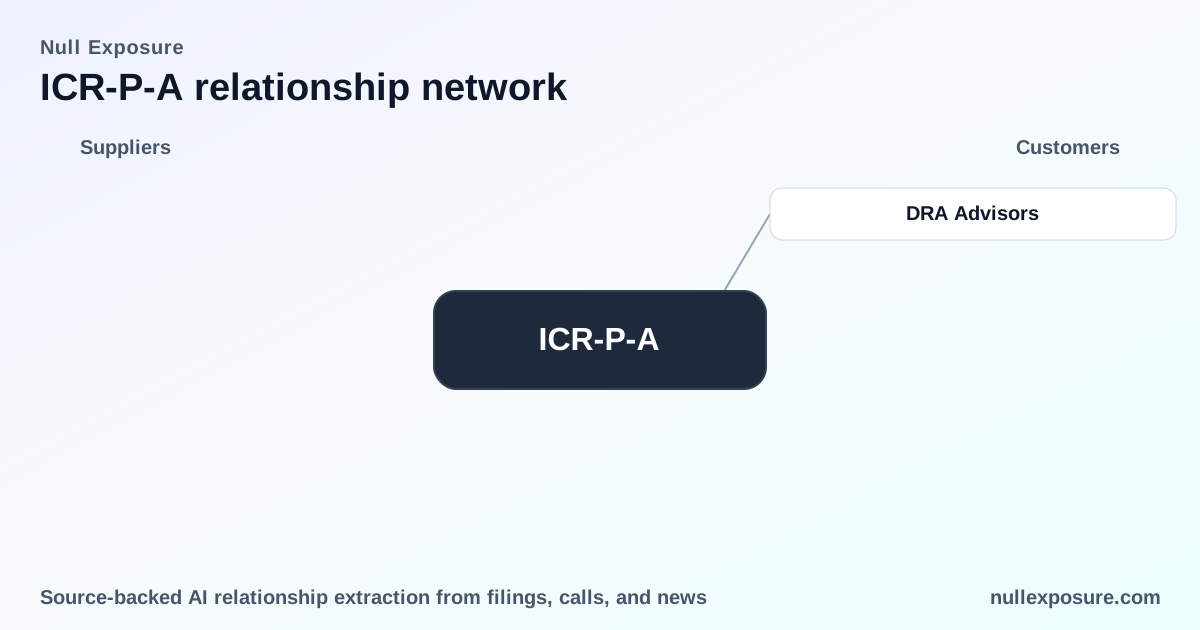
DRA Advisors is referenced in connection with a historic asset acquisition from Inland’s retail portfolio, indicating DRA’s role as an institutional acquirer in the real estate space; this connection is cited by The Real Deal (Jan 16, 2024). The mention identifies DRA as an active client universe participant for services in sectors where ICR-P-A positions itself—real estate and capital markets communications—suggesting ICR-P-A’s client base includes institutional acquirers and asset managers. Source: The Real Deal (Chicago), article on Inland and DRA Advisors (Jan 16, 2024) — https://therealdeal.com/chicago/2024/01/16/inland-names-keith-lampi-president-and-ceo/.
(Note: the dataset returned only this one relationship entry; no other named customers were present.)
Operating model and business-model characteristics investors should factor
With limited relationship disclosures, interpretive signals at the company level are the primary inputs. These are not relationship-level claims but company-level operational characteristics derived from ICR-P-A’s service description and the customer mapping approach.
- Contracting posture: ICR-P-A operates on a mix of retainers and mandate-based contracts; retainers provide stability while transaction mandates create episodic revenue spikes during deal cycles.
- Concentration risk: The firm’s focus on capital markets and corporate communications implies potential client concentration among mid-to-large corporates and asset managers, making revenue outcomes sensitive to a handful of major clients and cyclical deal flow.
- Criticality: Communications services are critically important around transactions and market events, giving the firm leverage during deals but reducing pricing power in churn periods for routine IR work.
- Maturity and scalability: The business is mature in model but limited in scale by partner capacity and senior-person dependency; growth depends on repurposing senior expertise into standardized products or expanding junior teams without diluting client service.
Key takeaway: Investors should treat ICR-P-A as a relationship-driven services business where governance of client portfolios and partner retention are the primary operational levers for stability and growth.
Risk factors and opportunity vectors
Several risk and reward themes flow from the operating model:
- Revenue volatility — Transaction-driven mandates create positive but lumpy revenue; downside risk increases if deal flow slows or a major client departs.
- Human-capital concentration — Senior bankers and communications leads are the product; losing a partner can cost both client relationships and future mandates.
- Cross-selling upside — Effective cross-sale from investor relations into crisis communications or M&A advisories represents a high-margin growth lever.
- Sector exposure — Heavy exposure to cyclical sectors (real estate, tech IPOs) amplifies both upside in active cycles and downside in market slowdowns.
How to monitor and act as an investor or operator
For portfolio managers and corporate operators evaluating ICR-P-A relationships, prioritize the following:
- Track client concentration metrics and largest-client revenue share where available; ask management for retainer vs. mandate revenue splits.
- Monitor partner turnover and publicized client wins/losses to assess near-term revenue momentum.
- Evaluate contract structure: multi-year retainers signal predictability, while single-event mandates signal volatility.
- Assess industry exposure by reviewing disclosed client sectors; firms concentrated in cyclical sectors need higher reserves for downturns.
Relationship-by-relationship summary (complete coverage)
- DRA Advisors — The Real Deal reported that DRA Advisors acquired Inland’s 132-property retail portfolio in 2016, establishing DRA as a significant institutional acquirer in the Midwest retail space; this positions DRA within ICR-P-A’s client target set for capital markets and real estate communications work. Source: The Real Deal (Chicago), Jan 16, 2024 — https://therealdeal.com/chicago/2024/01/16/inland-names-keith-lampi-president-and-ceo/.
Bottom line and next steps
ICR-P-A is a service-centric communications firm whose investment profile is dictated by client concentration, partner stability, and the mix between retainers and deal-driven mandates. The single customer mention in the available sample—DRA Advisors—suggests ICR-P-A engages with institutional acquirers active in real estate and capital markets, reinforcing its focus verticals.
For active due diligence, demand granular client-level revenue breakdowns and turnover history to convert qualitative relationship maps into investable signals. For additional comparative intelligence and deeper relationship analytics, see https://nullexposure.com/.
Bold claims above reflect the company’s stated positioning and the customer signal set available; pursue direct disclosures for precise financial modeling.