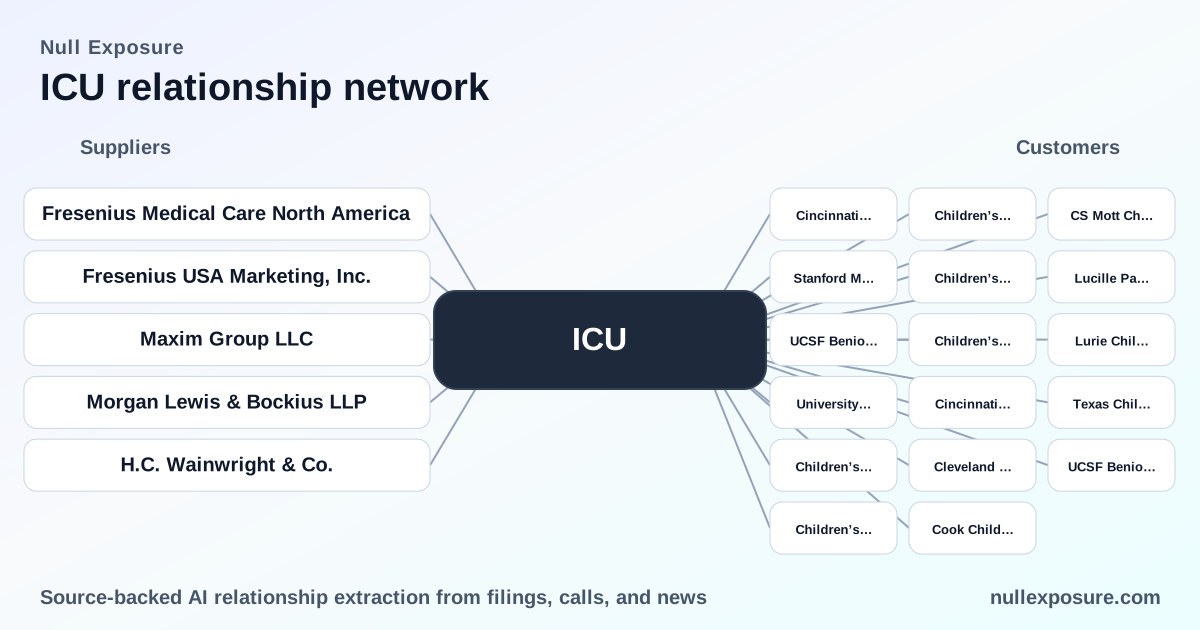
SeaStar Medical (ICU): Customer Relationships and Commercial Trajectory
Thesis: SeaStar Medical commercializes a proprietary extracorporeal membrane therapy (QUELIMMUNE/Selectively Cytopheretic Device, SCD) sold to pediatric and research hospitals under an FDA Humanitarian Device Exemption and, increasingly, through direct sales and limited distributor arrangements; monetization is product sales of SCD units, training/services to implant and monitor the therapy, and potential future reimbursement or licensing revenue as the adult program scales. For a quick route to more relationship intelligence visit Null Exposure.
What SeaStar sells and how the economics work
SeaStar’s commercial engine is simple and concentrated: a hardware-driven, hospital‑direct sale of the SCD cartridge (QUELIMMUNE) integrated into existing continuous renal replacement therapy (CRRT) circuits, plus clinical training and registry participation to drive adoption. Revenue to date is immaterial—SeaStar reported roughly $0.1–0.2 million in initial product sales following FDA HDE approval and a July 2024 first‑shipment—but the product is eligible to be sold for profit under HDE rules and the company is actively transitioning from distributor arrangements to internal commercial operations. Regulatory and reimbursement engagement with CMS and private payors is central to unlocking scalable margins; until then, sales are low-volume, high-clinical‑value, and dependent on hospital purchasing cycles.
Customer roll‑call: who is using QUELIMMUNE and what that implies
The following institutions were cited in SeaStar’s public releases and news coverage as adopters, registry participants, or commercial sites. Each entry is summarized in plain English with the source noted.
Cincinnati Children’s Hospital
Cincinnati Children’s Hospital is named by SeaStar’s CEO as a major pediatric adopter reporting clinical findings with the SCD during SeaStar’s first commercial year. According to a GlobeNewswire milestone release cited by The Manila Times (Jan 2026), Cincinnati Children’s is an early institutional customer.
Stanford Medical Center
Stanford Medical Center is listed among major pediatric centers that have adopted the SCD and reported outcomes during the company’s first year of commercialization. This is cited in SeaStar’s GlobeNewswire announcement reported in The Manila Times (Jan 2026).
UCSF Benioff Children’s Hospitals
UCSF Benioff Children’s Hospitals are identified by SeaStar as adopters and reporters of clinical experience with the SCD during the company’s initial commercial period. Source: GlobeNewswire via The Manila Times (Jan 2026).
University of Michigan
University of Michigan is included in SeaStar’s list of major pediatric medical institutions adopting and reporting on SCD therapy in the company’s FY2026 milestones. Source: GlobeNewswire via The Manila Times (Jan 2026).
Children’s Hospital of Atlanta – Arthur M. Blank
Children’s Hospital of Atlanta – Arthur M. Blank appears on SeaStar’s SAVE Registry participant list and is an institutional participant in pediatric SCD clinical/registry activity. Source: QuiverQuant news release listing ClinicalTrials.gov SAVE Registry participants (Mar 2026).
Children’s Hospital of Atlanta – Scottish Rite
Children’s Hospital of Atlanta – Scottish Rite is listed among SAVE Registry sites participating in pediatric SCD evaluations. Source: QuiverQuant news release (Mar 2026).
Children’s Hospital of Philadelphia
Children’s Hospital of Philadelphia is named as a SAVE Registry participant and therefore an institutional site using or evaluating SeaStar’s therapy in pediatric AKI contexts. Source: QuiverQuant news release (Mar 2026).
Children’s Medical Center Dallas
Children’s Medical Center Dallas is included on SeaStar’s registry list of participating pediatric centers evaluating QUELIMMUNE. Source: QuiverQuant news release (Mar 2026).
Children’s of Alabama
Children’s of Alabama is listed as a SAVE Registry participant and represents regional pediatric adoption in the Southeast. Source: QuiverQuant news release (Mar 2026).
Cincinnati Children’s Medical Center
Cincinnati Children’s Medical Center is separately listed in registry materials as a participating site, reflecting SeaStar’s multiple touchpoints within large pediatric systems. Source: QuiverQuant news release (Mar 2026).
Cleveland Clinic Children’s Hospital
Cleveland Clinic Children’s Hospital is cited as a SAVE Registry participant, signaling engagement from nationally ranked pediatric centers. Source: QuiverQuant news release (Mar 2026).
Cook Children’s Hospital
Cook Children’s Hospital is named in SeaStar’s registry participant list and represents regional adoption in the Texas market. Source: QuiverQuant news release (Mar 2026).
CS Mott Children’s Hospital
CS Mott Children’s Hospital (University of Michigan’s pediatric facility) appears as a registry participant, reinforcing the University of Michigan group’s involvement. Source: QuiverQuant news release (Mar 2026).
Lucile Packard Children’s Hospital Stanford
Lucile Packard Children’s Hospital Stanford is listed among SAVE Registry sites and underscores Stanford’s system-level participation. Source: QuiverQuant news release (Mar 2026).
Lurie Children’s Hospital of Chicago
Lurie Children’s Hospital of Chicago is on the SAVE Registry participant list and signals Midwest institutional adoption and evaluation. Source: QuiverQuant news release (Mar 2026).
Texas Children’s Hospital
Texas Children’s Hospital is included as a SAVE Registry participant and is one of the largest pediatric centers nationally, representing meaningful market validation. Source: QuiverQuant news release (Mar 2026).
UCSF Benioff Children’s
UCSF Benioff Children’s is listed again as a registry participant in separate reporting, reinforcing multi-source confirmation of clinical adoption. Source: QuiverQuant news release (Mar 2026).
What the relationship signals say about SeaStar’s operating model
- Contracting posture: SeaStar historically used exclusive licensing/distribution (Distribution Agreement with Nuwellis in Dec 2022) but terminated that distributor relationship in 2024 and is building internal commercial capability; public filings document license and distribution activity and a settlement/termination process. This indicates a shift from outsourced distribution to direct sales and controlled commercialization.
- Concentration and maturity: Revenue is concentrated and early-stage—commercial sales began in July 2024 and aggregated sales through year‑end were immaterial (sub‑$0.1M to $0.2M). The company is in a ramping phase with five active commercial sites reported and broader registry participation.
- Criticality: The SCD integrates into CRRT systems used in ICUs and is clinically critical when deployed; clinical endorsements from top pediatric centers give the product high perceived clinical value despite constrained unit volumes under HDE limitations.
- Contract tenor and spend: Contracts historically included licensing and multi‑year provisions; evidence shows long‑term terms and right‑of‑first‑refusal language with certain partners, while current spend signals from settlements and contract liabilities place typical counterparty spend in the $100k–$1M band for distributor settlements and initial commercialization activity.
- Geographic focus: Commercial activity is currently U.S.-centric (all sales located in the United States), with a strategic imperative to secure CMS and payer reimbursement before material international expansion.
Investment implications and risk profile
- Upside: Early adoption by elite pediatric centers and participation in a multi‑site SAVE Registry create a credible path to clinical evidence, publications, and hospital peer‑to‑peer adoption—key drivers for reimbursement and scale. If SeaStar secures Medicare/Medicaid coverage and private payer reimbursement for adult indications, revenue scalability accelerates materially.
- Downside: Revenue today is immaterial and concentrated; reimbursement dependency, HDE unit limits, product liability exposure, and the need to scale a direct hospital sales force are the principal near-term execution risks. Termination of previous distributor arrangements generated non‑recurring settlement cash outflows in the ~$900k band and highlights distribution execution risk.
- Operational focus: Execution priorities are hospital penetration, registry outcomes publication, CMS engagement, and controlled manufacturing scale-up to avoid recall or supply constraints.
Bottom line: commercial proof but early economics
SeaStar demonstrates early clinical adoption and institutional validation across a high-quality group of pediatric centers, but its financial profile remains nascent: low current revenue, concentrated customer base, and dependency on reimbursement policy for revenue scaling. Investors should treat SeaStar as a clinical‑evidence dependent commercial story where regulatory and payer engagements will determine when adoption converts into material top-line growth. For structured relationship intelligence and periodic updates on SeaStar’s customer footprint visit Null Exposure.