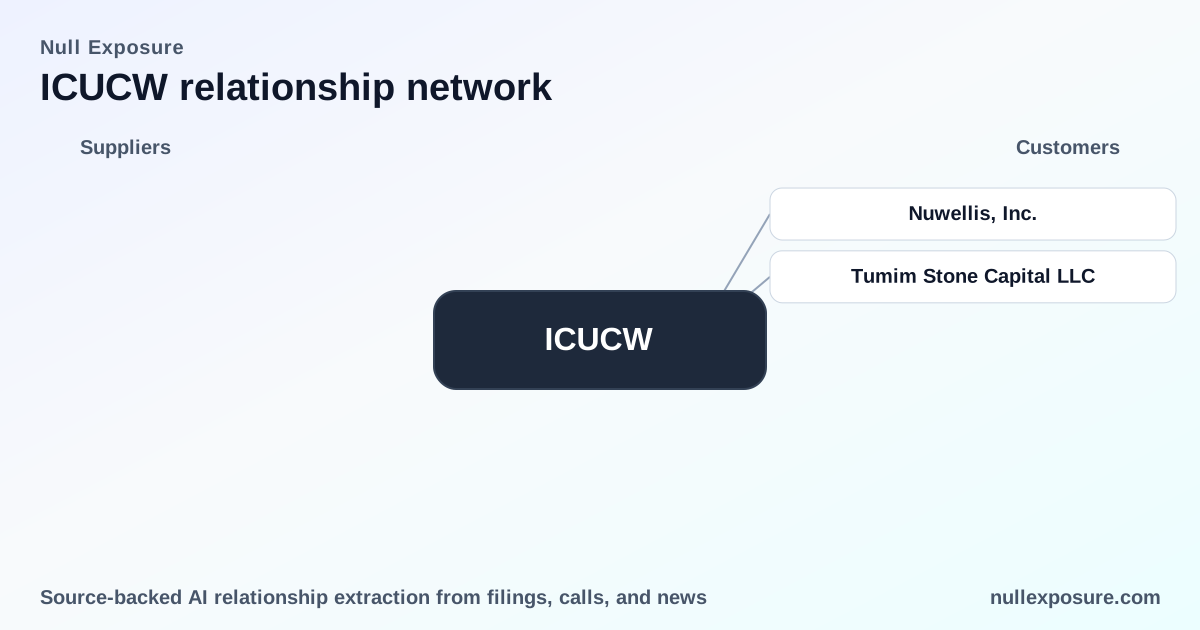
SeaStar Medical (ICUCW) — customer relationships, contracts and the commercial runway
SeaStar Medical commercializes a proprietary membrane therapy, the Selective Cytopheretic Device (SCD), monetizing through product sales of QUELIMMUNE (pediatric SCD), potential licensing or collaboration payments, government grants, and capital markets financings. The company has transitioned from distributor-led go‑to‑market arrangements toward a direct, hospital-focused sales model while running a pivotal adult trial — a hybrid approach that drives near-term revenue recognition from pediatric sales and longer-term upside from an adult approval and wider adoption. For a consolidated view of relationship intelligence and filings, visit https://nullexposure.com/.
Quick commercial snapshot investors need to front-load
SeaStar’s revenue engine today is narrow and clinical-stage plus early-commercial. The company has begun recognizing modest pediatric SCD sales after an FDA HDE in February 2024 and shipped the first commercial units in July 2024, but total recognized revenue through FY2024 is approximately $0.1 million. Operationally, SeaStar uses a mix of contractual structures: licensing/distribution, long-term supply provisions with manufacturing partners, and an emerging direct-sales model to hospitals. Geographically, sales and regulatory focus are concentrated in the United States, with international expansion explicitly deprioritized for now.
Key operating characteristics as signaled in filings:
- Contracting posture: historical reliance on distribution and license agreements supplemented by supply agreements with multi-year terms; recent shift to in‑house commercial capabilities.
- Concentration: revenue is concentrated in a single core product (the SCD), which makes commercial outcomes binary for near-term valuation.
- Criticality: relationships with payors and hospitals are critical — CMS and private reimbursement decisions materially affect adoption and pricing.
- Maturity: commercial-stage for pediatrics (limited revenue, active customers) and clinical-stage for adults (pivotal NEUTRALIZE‑AKI trial underway).
- Scale today: spend/receipts tied to the product are in the low six-figure band (~$100k recognized revenue in FY2024), while financing activity has provided mid‑double‑digit millions to the balance sheet.
How the customer contract mix looks in practice
SeaStar’s commercial footprint is shaped by a combination of distributor agreements (previously), training and service obligations, and direct institutional sales. Filings show performance obligations tied to training, discounted material rights for distributors, and recognition rules consistent with ASC 606 — each SCD sale is treated as an independent transaction with fixed transaction prices. The company also flags reimbursement and payor dependency as a core commercial risk.
Relationship-level facts drawn from the FY2024 filing
Below are the two counterparties disclosed in SeaStar’s FY2024 Form 10‑K and the plain-English takeaways investors need.
Nuwellis, Inc.
SeaStar entered a License and Distribution Agreement on December 27, 2022, appointing Nuwellis as exclusive U.S. distributor for the pediatric SCD and assigning distribution, marketing, training and certain purchase options to Nuwellis; that distribution relationship was later terminated and resolved through a confidential settlement (Company and Nuwellis entered into the Settlement Agreement on October 20, 2024), with refunds and charges recorded in FY2024. According to SeaStar’s FY2024 Form 10‑K, the Distribution Agreement created specific performance obligations (training, discounted purchase options) and the settlement resulted in a combined refund and expense of approximately $900,000. (Source: SeaStar Medical FY2024 Form 10‑K, notes regarding Distribution Agreement and Settlement Agreement, filings for the year ended December 31, 2024.)
Tumim Stone Capital LLC
Tumim Stone Capital entered into a Common Stock Purchase Agreement that gave it the right to purchase up to $100 million of SeaStar common stock; SeaStar sold 260,000 shares to Tumim for approximately $4.7 million during the period, and the parties agreed to terminate the Purchase Agreement in February 2024. The company discloses both the equity line economics and the subsequent termination in its FY2024 10‑K. (Source: SeaStar Medical FY2024 Form 10‑K, notes describing the Tumim Purchase Agreement and termination, year ended December 31, 2024.)
For deeper coverage of filings and counterparty disclosures, see https://nullexposure.com/.
What those two relationships imply for investors
- The Nuwellis distribution agreement demonstrates early-stage outsourcing of go‑to‑market functions, including training and exclusive distribution rights for a period, but the later termination shows SeaStar’s decision to bring commercialization in‑house — a strategic shift that increases operating leverage to direct sales but raises short-term execution risk as the company builds a hospital-facing infrastructure. The settlement and refund are visible as FY2024 adjustments to revenue and G&A.
- The Tumim equity line underscores SeaStar’s reliance on capital markets to fund operations; the termination of that financing vehicle reduces a predefined liquidity runway but also removes conditional dilution tied to the facility.
Investment implications and risk map
- Revenue proof point is limited but real: shipments began in July 2024 and five commercial sites completed registry and purchased product; however, sales to date are immaterial in dollar terms.
- Reimbursement is the gating item for scale: SeaStar’s growth is contingent on CMS and private payor coding, coverage and payment decisions; the company emphasizes direct engagement with CMS as a strategic priority.
- High product concentration equals binary outcomes: QUELIMMUNE is the revenue driver now; failure to gain hospital traction or adverse regulatory/reimbursement outcomes would materially impair growth. Product liability, recalls, and manufacturing capacity are notable downside risks.
- Contract mix gives optionality but increases execution work: licensing and distribution rights provide low-friction market entry, while direct sales promise higher margin capture; SeaStar has elected to pursue direct control of commercialization after terminating the Nuwellis agreement.
- Liquidity is actively managed via equity offerings: recent registered and at‑the‑market offerings increased capital, but the company continues to require additional funding to advance adult trials and scale commercialization.
Bottom line for allocators
SeaStar is a small, commercial‑stage med‑tech story with a single, regulation-dependent product and very limited revenue to date. The company has demonstrated the ability to convert regulatory approval into shipments, but investors should value SeaStar for optionality around adult pivotal data, reimbursement outcomes, and successful hospital penetration rather than current revenue run‑rate. Key catalysts over the next 12–24 months include NEUTRALIZE‑AKI trial progress, CMS coverage activity, and demonstrated inpatient adoption at scale.
If you want ongoing, relationship-level monitoring and filing-level signal extraction for SeaStar and similar small commercial med‑techs, review our intelligence offering at https://nullexposure.com/.