ID: Customer Map and Implications for Investors
L-1 Identity Solutions (ticker: ID) builds and sells identity-enrollment and issuance equipment, authentication services, and associated solutions primarily to government agencies and large institutions. The company monetizes through hardware and software sales, long-term service contracts with public-sector identity programs, and transactional contracts tied to credential issuance, creating a revenue base concentrated in high-friction procurement channels and recurring maintenance/service lines. For investors evaluating ID’s customer relationships, the key questions are contract concentration, the criticality of issued credentials to customer operations, and how prior divestitures have reshaped the company’s focus.
For a closer look at the customer footprint and strategic implications, visit the company hub: https://nullexposure.com/
How the customer relationships paint the firm’s commercial profile
Below I list each relationship present in the assembled results and explain what it implies for ID’s operating model and investment case. Each entry is a concise, plain-English takeaway followed by the source reference.
BAE Systems, Inc. — sale of L‑1 intelligence services (FY2011)
L-1 sold its intelligence services businesses to BAE Systems in a strategic divestiture that narrowed L-1’s portfolio toward identity issuance and authentication technology rather than intelligence services. According to RTTNews coverage of the FY2011 transaction, L‑1 announced the sale of its intelligence-services operations to BAE Systems, Inc. (https://www.rttnews.com/amp/1553479/l-1-identity-closes-sale-of-intelligence-services-businesses-to-bae-systems.aspx).
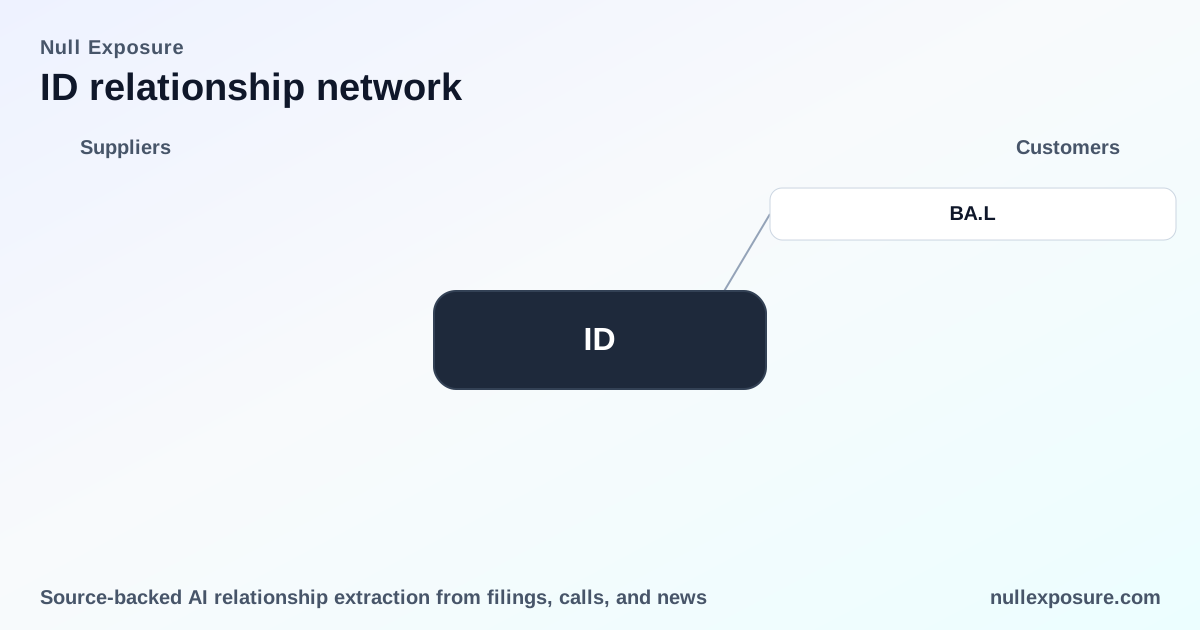
BA.L — duplicate record of the same FY2011 transaction
The same FY2011 divestiture is also recorded under the shorthand BA.L, reaffirming the transfer of intelligence assets out of L‑1 and into a large defense contractor. RTTNews reported on the sale in FY2011, documenting the transfer to BAE Systems (https://www.rttnews.com/amp/1553479/l-1-identity-closes-sale-of-intelligence-services-businesses-to-bae-systems.aspx).
Connecticut Department of Motor Vehicles — equipment for driver’s licenses and passports (FY2010)
L‑1 supplied equipment that helps produce U.S. passports and the vast majority of U.S. driver’s licenses, including systems used by the Connecticut DMV—an indicator of the company’s role as a supplier to state-level issuance programs. The Stamford Advocate noted L‑1’s equipment role in FY2010, citing production coverage of passports and roughly 85% of U.S. driver’s licenses (https://www.stamfordadvocate.com/business/article/terrorist-attacks-spawn-idea-for-l-1-identity-404505.php).
UIDAI / “ID Solutions” — listed as a contractor on Aadhaar (FY2015)
An Indian press listing from FY2015 includes “ID Solutions” among contractors awarded work by UIDAI, India’s national identity authority, signaling involvement in large-scale biometric or identity program work in India. The New Indian Express reported the inclusion on a contractor list for UIDAI in FY2015 (https://www.newindianexpress.com/thesundaystandard/2015/Sep/27/company-on-aadhaar-list-of-18-contractors-was-prosecuted-821090.html).
What these customer relationships collectively reveal
- Government and public-sector dependency: The relationships with state DMVs, national identity programs (UIDAI), and prior transactions involving defense contractors indicate that ID’s commercial footprint is anchored in public-sector identity issuance and related services. That creates predictable procurement cycles but also exposes the company to political and budgetary risk.
- Criticality of delivered capabilities: Supplying passport and driver’s-license production equipment means ID’s products are mission-critical for customer operations; replacement cycles are lengthy and switching costs high, supporting service and maintenance revenue.
- Concentration and exposure: The dataset highlights a small number of large, strategic customers and programs — a sign of concentration risk balanced by high contract value and stickiness.
- Strategic refocus through divestiture: The FY2011 sale of intelligence services to BAE Systems signals a deliberate narrowing of the business toward core identity issuance technologies and away from intelligence services, which has implications for margins and client mix.
Operational characteristics investors should weight
- Contracting posture: ID operates in a procurement-driven environment—sales cadence follows public tenders and multiyear contracts, not transactional retail cycles. That shapes liquidity and revenue visibility by front-loading sales cycles into long negotiation windows and back-loading revenue into installation and servicing.
- Customer concentration and retention dynamics: Large institutional customers dominate revenues, creating high retention potential but also single-customer risk if a major award is lost. The presence in national programs (e.g., UIDAI participation) signals ability to compete at scale in complex procurements.
- Criticality and switching costs: The company’s products are integrated into national credential issuance workflows, producing high switching costs and providing a durable moat for maintenance and upgrade streams after initial deployment.
- Maturity and product lifecycle: Evidence of legacy supply to U.S. passport and DMV programs and the FY2011 divestiture suggests a company with mature hardware and institutional relationships, where growth depends on service expansion, software monetization, and program renewals.
Investment implications and risk profile
- Positive structural tailwinds: Public-sector identity programs and passport/driver’s license issuance have high renewal and maintenance needs, supporting recurring revenue. If ID preserves contract wins, it secures multi-year revenue streams with embedded service margins.
- Key risks: Procurement dependence means revenue volatility around contract awards, and the company’s footprint in large sovereign projects exposes it to geopolitical and policy shifts—particularly relevant for work in markets like India. The FY2011 divestiture lowered diversification into intelligence services, increasing reliance on identity issuance markets.
- Due diligence checklist for investors: Validate current contract backlog and renewal timelines; confirm geographic and customer diversification beyond the relationships listed here; assess product roadmap for shifting revenue to higher-margin software and services.
For direct access to a centralized view of these relationships and to monitor updates, visit the company hub: https://nullexposure.com/
Bottom line
ID’s customer map is a classic public-sector supplier profile: high-criticality, high-switching-cost contracts with concentrated, procurement-driven customers. That structure creates predictable, service-rich revenue but requires close attention to contract pipelines and geopolitical exposure. Investors should treat ID as a company where contract wins—or losses—drive valuation swings more than consumer demand trends.